Showing posts with label crime. Show all posts

Tuesday, October 11, 2022

Social media ad-based education on fake profiles soliciting funds

Our two special needs children are chronologically fully adult now. The challenges they face are increasingly complex but their capabilities have likewise grown.

As in the past their challenges are not unique to adults with a life history of cognitive and/our neurological disorders and diversities. They are, however, more vulnerable than most adults to social media predators who focus on loneliness and relationship frustration. I have a thought on what to do about that, but first I need to provide some context for people who don't live in this world.

In the past I had more control over our children's online actives. That is no longer true, most of what they do online is their own affair.  That's partly because managing online activities at any age is very difficult; parents and guardians fight against vast economic forces with little support from Apple or Google. Mostly though it's because they want and deserve the right to make choices, including bad choices.

The bad choices including falling victim to loneliness exploits. Being alone socially and sexually is one of the biggest hardships of adults with cognitive disorders. This is an intractable problem. Cognitively disabled males outnumber females by a large margin (the curse of the stunted Y chromosome) and social interactions including friendships and sexual relationships are almost always cognitively matched. Additionally friendship creation and maintenance requires significant social and cognitive skills.

Loneliness exploits are diverse and can shade into a straightforward business transaction. Is Patreon money solicited for custom art or storytelling an exploit or a commercial transaction or a bit of both? Is the "friendship" of the Patreon relationship different from my favorite writers responding to my tweets? How does this compare to "only friends" or phone sex or sex work?

Fake social media accounts are a step beyond the murky world of Patreon friends. All men receive Facebook and Instagram messages that feature images of beautiful women with large to absurdly large breasts. Most of us understand these are not entirely sincere, but this can be difficult to explain to a lonely adult with a significant congenital or acquired cognitive disability. They want to believe, they forget explanations, and for some the line between imagination, memory, and reality is fluid.

If the authors of these fake profiles were satisfied with small monthly stipends they could be considered just another step beyond Patreon purchases or "only friends" memberships. Sadly, the authors of these fake profiles are looking for large amounts of money. The problem needs our attention.

It's a hard problem to approach directly. "I was looking at the notifications on your lock screen and this beautiful woman is actually a desperate 43 yo man in a Sri Lankan sweatshop" doesn't go over well. Instead I'm going to try responding to the next large breasted invitation I receive and then use the thread to do "hey, look what I got, do you think this is real?" indirect education.

Which leads me to the idea that prompted this post. The best way to educate vulnerable adults about this problem would be a targeted Facebook and Instagram advertising program. These would be paid ads to vulnerable users to remind them that beautiful young women do not do not send flirtatious messages to strangers. 

It would be tricky to get these ads onto social media accounts; they aren't the kind of ad that attracts Instagram users. Government support could help, but the cognitively disabled community is too small and invisible to get political support. However the demential (acquire disability) community is large, growing, and politically important. So there might be a way to benefit the congenitally cognitively disabled community by targeting the acquired disability (dementia) community. I need to play with that idea a bit. 

It would be interesting to try running a small local campaign that targeted my son. If I do that I'll update this post.

Monday, December 14, 2015

Autism and the police: St Paul Police Department Western District leads

Most of the autism meetings I attend have a largely white audience. Tonight’s ‘CARE Project Meeting’, hosted by the St Paul Police Department with help from the Autism Society of Minnesota, was different …

AUSM - Autism Society of Minnesota - CARE Project Meeting

Officer Robert Zink and the St. Paul Police Department will host an open meeting about its CARE Project (Cop Autism Response Education). Officer Zink and the department invite the community and other precincts to participate, learn more, and offer suggestions on the CARE Program.

Dec. 14, 2015 from 6:30-8 p.m.

St. Paul Police Department
389 Hamline Ave. N.
St. Paul, MN 55104

It was an impressive presentation to a diverse audience, including several who’ve had unhappy and sometimes well publicized problems with local police (transit police came up a few times). Despite that history the audience was supportive, seeking more action sooner rather than something different.

Officer Zink has two children on the autism spectrum, with the help of supportive Chief he’s been leading a police-community initiative to improve the police encounters with teens and adults on the spectrum. He’s been at this in for a few years, but now he’s morphed into a 1-man community service organization with a taser on the side. Obviously one man can’t do this alone; the SPPD is scrambling to scale up. That’s why they marketed this particular meeting..

It’s early days. They don’t yet have an informational handout to share with our local health systems. There’s a unofficial Facebook Page, otherwise communication is small scale - except for a recent newspaper article. They’re working to train local officers to manage escalations, understand meltdowns, and, in one case, manage large scary angry men with M&Ms (Officer Zink has an amusing story of running into a Walgreens, jumping to the front of a long line, and running off to a squad car with the candies. That was probably not a happy queue.)

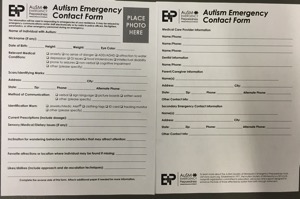
There’s an optional registration program so, in theory, police called to a household because of a crisis, such as assault of a sibling or parent or self-harm, will know how to respond. Our family will be completing the contact form:

CARE contact form

The SPPD western division is setting up protocols for contact before 911 calls, including home call introductions. Less predictably, they’re setting up post-911 follow-up visits as well.

Bottom line: One of the most encouraging autism community developments in several years.

Sunday, July 05, 2015

Special needs: so now have to worry about ISIS recruiters?

The New York Times did a good job describing ISIS (ISIL, Daeshite) recruitment of a cognitively limited 23yo woman. She’s not explicitly described as adult special needs, but she has a fatal alcohol syndrome diagnosis and limited employment options. She’s not that different from the kids and adults we care for.

Unsurprisingly her ISIL recruiter is not terribly high functioning himself.

It reminds me of the relatively harmless cults of the 1970s, but in those cults there wasn’t a lot of upside to special needs recruitment The cults wanted fundraisers; a certain amount of psychological disability was a feature, but special needs was too much. ISIL may have more use for people with cognitive disabilities.

It’s not at the top of the worry list, but if you care for a special needs teen or adult with a net connection (smartphone, etc) you can probably add ISIL to the long list of predators of vulnerable adults. Not the top of the list, but something to watch for.

Yay connectivity.

PS. I’ve long wondered what Richard (“shoe bomber”) Reid’s IQ is, and whether he’d fall in the sub 70 range of diminished responsibility.

Friday, December 27, 2013

Calibrating consequences: managing the iTunes purchases

I should have been more suspicious of the iTunes statements. There seemed to be a lot of them.

Eventually I connected with my spouse, and we realized #1 was exploiting an iOS 7 iPhone configuration error. When he inherited my 4S the iTunes account was configured for delayed authentication (the default [1]). Every time we bought a song or video, he added on a few more. Last year's Stanley Cup series was the giveaway.

When I collared him he pretended not to understand that his purchases cost us money. I respect that. If you have a cognitive disability, you might as well use it to wiggle out of problems. It didn't work though, he knew I knew that he knew how the charges worked. He quickly gave up that alibi.

So we needed consequences. What formula would be most educational, without inducing full rebellion or breakdown? How could we use this to advance his financial skills - and maybe even get some money back?

I needed a balanced formula -- something that had a built-in reward paired with a consequence extending over time. It had to be understandable to him, ideally something visual. After a bit of thought I came up with a formula that worked very well - not least because relatives gave #1 generous iTunes/Amazon gift credits this year.

I created two iTunes Playlists for him - one with the music he'd acquired honestly, the other with his criminal gains. [2] Each time he wanted a new tune, he had to pay twice. Once for the new tune, and once for an old one. I then "moved" the "stolen" tunes from the Unpaid to Paid list, in addition to putting the new purchase on his phone. We did the same thing for the videos.

After the first few purchases he caught on to how the system worked. He was clearly satisfied -- he likes justice fairly applied. Even, or especially, when it's applied to him. We went through about 1/3 of the backlog with his allowance and snow shoveling money, then a deluge of iTunes/Amazon gifts took out the rest. In an impressive gesture he cleared out the last 15 in one direct purchase.

Effective consequences require creativity; this one worked. I'll look for other opportunities to apply this kind of balanced approach. I know they'll come along.

[1] For us this was an annoyance, but in some cases the family financial impact could be serious. I wonder if Apple ever reverses charges on appeal... It would be "nice" if Siri could execute "configure this phone for a child".

[2] I intended to only sync the first to his iPhone, but with iOS 7 there's no way to prevent someone from using WiFi to put purchases music/video onto a phone. I turned the Cloud setting off, but he just turned it back on again. He's learned a lot from his iPhone.

Thursday, April 08, 2010

Persuasion, adolescence, and the joys of prison life

Low IQ special needs adolescence does not come as a "thief in the night". It comes as a ton of bricks.

Behavioral management, which was never terribly effective, has become even less effective. We may still have a "paradoxical permission" effect, whereby when we give permission for an annoying behavior it becomes less attractive. I'm not sure we have even that however.

Medications are still available, but of course side-effects may be less tolerated.

Which is why I'm turning, with a measure of desperation, to my favorite sales book: Three Steps to Yes: The Gentle Art of Getting Your Way by Gene Bidell. I hope I can use some of Bidell's techniques to change my son's choices.

Bidell emphasizes understanding your Prospect's recognized and unrecognized needs and aversions, then figuring ways to meet them to get the sale. The Prospect "needs to win", for example, so find a way they can win and you can lose -- while still getting the Sale.

Understanding my son's world is a real challenge. He combines the limited knowledge of an early teen with a limited capability to understand and assimilate new knowledge.

I think, for example, that I erred by describing prison as the outcome of particularly poor choices. In my son's mind, I now realize, prison means no school, association with the police and K9 dogs he loves, comforting concrete instead of disturbing nature, agreeable routines, few challenges, plain meals, lots of television, regular exercise, no frightening choices, no concerns about employment, and congenial like minded peers.

In his mind, prison is not a bad thing, it's a bit heavenly. The worst bit is that in some ways he's quite right. He might actually find a well run low security prison more congenial than the alternatives.

So I need to persuade him that there are better options than prison (even if I'm not entirely sure there are - but that's a different story). Juvenile detention, for example, does include math class. It doesn't provide much police contact, and there are no K9 dogs. Most of all, there are no girls and his companions may not be very friendly.

At the same time I need to come up with a better future alternative for him to work towards - and I need to come up with it very quickly.

Any ideas?

Update: In our community the local police are happy to enter a special needs person into their database with a special "tag" including disability and contact information.

Monday, April 05, 2010

A prosthetic conscience for special needs persons

Some special needs teens and adults may wish to do well, but have a great deal of difficulty modeling the impact of their actions. Impulse disorders, limited abilities to abstract, and autism-associated disabilities may all make a prosthetic conscience useful ...
Gordon's Notes: A conscience for robots - and for humans too
... Some humans too would benefit from a prosthetic conscience. It might allow persons with disorders of conscience to function more effectively in the modern world. Our prisons are full of low IQ individuals with a limited capacity to model the impacts of their actions on other persons. A prosthetic conscience might allow them to avoid prison, or to have great success after prison life...

Wednesday, October 07, 2009

Special needs criminals

The average IQ of an inmate is about 87. Since 75 is usually considered mental retardation, there are a lot mentally retarded persons in prisons. Even the average prisoner is borderline retarded.


Prisoners are a special needs population.

Hold that thought. Now, readers with children on the "explosive" spectrum, raise your hand if you have not contemplated your future adult child behind bars. Ahh, as I expected. No hands are raised.

We know some of our children don't respond normally to near term consequences - much less long term consequences. They pretty much only respond to immediate consequences and rewards. The future, for them, is a foreign land.

People studying prisoners, have come to similar conclusions from a different direction ...
Economic View - A Smarter (and Cost-Efficient) Way to Fight Crime - NYTimes.com

LAW enforcement policy in the United States rests implicitly on the “rational actor” model of traditional economics, which holds that people take only those actions whose benefits exceed their costs.

This model says that crime will be deterred if the expected punishment is strong enough — a prediction that has not been borne out in practice...

Mark Kleiman, a professor of public policy at the University of California, Los Angeles, says there is a better way. In a new book, “When Brute Force Fails,” he argues that instead of making punishments more severe, the authorities should increase the odds that lawbreakers will be apprehended and punished quickly.

... most criminals are not the dispassionate rational actors who populate standard economic models. They are more like impulsive children, blinded by the temptation of immediate reward and largely untroubled by the possibility of delayed or uncertain punishment.

The evidence suggests that when hardened criminals are reasonably sure that they will be caught and punished swiftly, even mild sanctions deter them. But not even the prospect of severe punishment is effective if offenders think they can get away with their crimes...

... Experimenters have found, for example, that even long-term alcoholics become much less likely to drink when they are required to receive a mild electric shock before drinking. Many of these same people were not deterred by their drinking’s devastating, but delayed, consequences for their careers and marriages...
Mr. Kleinman advocates a particular policing strategy that is effectively designed for a special needs population. The idea is to concentrate resources to increase the probability of capture for a targeted subgroup. The theory is this group will respond to the probability of capture -- perhaps even if the actual punishments are less severe (hence less costly). They will then change their behavior, which frees up resources to target the next sub-group (dynamic policing).

Reducing criminal behaviors is one outcome that police, wardens and parents can all agree on.

In the meantime, and in the hope of avoiding outsourcing grown child housing and care responsibilities to the penitentiary, it's useful to think about that punishment/probability of detection equation when trying to change the behavior of special needs children.

It's not the intensity or duration of the consequences that we should be thinking about, it's ensuring a high probability that any misdemeanors will be rapidly detected. The focus is on vigilance ...

Friday, March 13, 2009

Cognitive disability and false confession to crimes

Adults and children with cognitive disorders are vulnerable in many obvious ways, but also in some less obvious ways.

All memories are highly suggestible, but persons with cognitive disorders are particularly prone to memory distortion. They may feel innocent when they are guilty, but, perhaps more significantly, feel guilty when they are innocent ...
When an Innocent Confesses to a Crime: Scientific American Podcast

Confession of a crime is considered highly persuasive in court. It seems inherently honest. Why would an innocent confess guilt? It appears counterintuitive to basic human self-interest.

And yet, innocents do confess, and studies have shown that they are highly persuasive, even when jurors know they were coerced. According to the Innocence Project, false confessions contributed to 25% of wrongful convictions in the U.S. in 2008.

I'm stretching a bit here, the research doesn't say that low IQ and special needs children and adults are particularly vulnerable to false confession. But do you doubt it?