Showing posts with label cognitive impairment. Show all posts

Monday, January 29, 2024

AI Guardian - a summary post

This post will be updated for a week or two. It's to track those interested in the AI Guardian concept; this and similar posts have the tag "AIGuardian"

Saturday, November 11, 2023

AI and special needs adults: The AI Guardian is in sight

Over the past decade I've written on social media about the concept of an AI Guardian, but I realize I've never put it into a blog post [4]. With the release of the LLM AIs [1] including ChatGP4, ChatGPT plugins,  and recently GPT Agents (GPTs) the AI Guardian is much closer than I'd expected. So it's time to write something.

First, of course, I decided to ask ChatGPT. I've never seen the concept of an AI Guardian online, but evidently I've been looking in the wrong places. As of its April 2023 incarnation ChatGPT4 has quite a bit to say:

You: What do you know about the concept of an "AI Guardian" for special needs adults?

ChatGPT

The concept of an "AI Guardian" for special needs adults, particularly those with low IQ or autism, revolves around using artificial intelligence to provide support and assistance in various aspects of daily life. This concept is still emerging, but it has several potential applications: 

Safety Monitoring: AI can be used to monitor the individual’s environment for safety hazards or emergencies, alerting caregivers or authorities when necessary.

Routine and Schedule Management: AI systems can help in managing daily routines, providing reminders for medication, appointments, and other important activities.

Behavioral Analysis and Support: For individuals with autism, AI can analyze behavior patterns to predict and mitigate potential stressors or overstimulation.

Communication Aids: AI-driven tools can assist in communication, especially for non-verbal individuals or those with speech difficulties, by interpreting signs, gestures, or other forms of non-verbal communication.

Learning and Skill Development: AI can offer personalized learning experiences and skill development activities, tailored to the individual’s needs and learning pace.

Social Interaction Facilitation: AI can help in guiding and facilitating social interactions, which can be challenging for some individuals with special needs.

Health and Wellness Monitoring: Continuous monitoring of physical health, including vital signs, sleep patterns, and physical activity, ensuring prompt response to health issues.

This concept is still in its nascent stages and raises important considerations regarding privacy, ethical use, and the need for human oversight. It's crucial to balance the benefits of AI assistance with the dignity and autonomy of the individuals being assisted. As a physician with experience in health informatics [2], you'd appreciate that while AI can provide valuable tools, it cannot fully replace the nuanced understanding and empathy provided by human caregivers.

Well, that covered the bases. I would love to know what ChatGPT4 has been reading on this topic.

In our family iPhones and narrow focus AIs like Google Maps have been both an essential tool for independence and a screen addiction curse [3]. The ability to locate our children was key to them learning to navigate by bike and bus. Mapping tools compensated for very limited navigation ability. Calendaring helped with anxiety and organization. Notes and Reminders helped with memory and recall limitations. Beyond the obvious advantages of messaging we discovered both our children were better able to process text messages than verbal communication -- especially for difficult topics.

Now there is the near term prospect of far more support going forward. Monitoring email, messaging and apps for the scams and frauds that live on the cognitively disadvantaged. Monitoring financial transactions for worrisome trends and events. Monitoring home environments for worsening or dangerous conditions. Encouraging better diet and activity.  Acting as a job coach. Appropriately paced and reinforced lifelong learning. Guiding our children through the vast complexity of medical care. Even providing a form a companionship in time or facilitating finding company in the physical world. Doing, in other words, what Emily and I do after we are incapacitated or (inevitably) dead.

In the absence of personal immortality for Emily and I the AI Guardian is the best hope for our children's longterm health and happiness. Even as I have profound concerns about the disruption that comes with the rise of the modern AI I also have hope for a better options for the cognitively disadvantaged.

- fn -

[1] Some dislike applying the term "AI" to Large Language Models because they don't appear to be conscious or sentient.  Much of my professional career was loosely related to precursors of modern AI and there is absolutely no doubt that in 1995 we'd have called ChatGPT a bloody scary AI. The goalposts are mobile. LLMs are AIs by any reasonable definition. Insofar as we understand human cognition we do much of the same things that LLMs do.

[2] This "as a physician" bit startled me until I remembered that I'd given ChatGPT4 that information as a persistent context for our sessions.

[3] I tried writing a book on how best to balance these harms but I gave up when I finally accepted that there was absolutely no interest in such a book from the community I was writing for.

[4] A 2015 post on Google Inbox was the closest I could find on the topic of AI assistance. I tagged that nsAI for non-sentient AI.


Sunday, February 05, 2023

Explosions and anxiety: Adult special needs life is a tough haul

My 26yo son, "#1", is pretty solidly in the 3-4th (bottom) percentile of cognitive abilities. It's a cognitive continuum of course; what's true of the 3rd percentile can also be true of the 10th or the 20th -- especially when lack of sleep or alcohol is involved. So this isn't just about special needs adults. It's something useful to understand for tens of millions of Americans.

The other day he exploded. No harm came of it, except to him. It's a behavior we've known from childhood though it's only with time we came to understand how closely tied it is to his anxiety.

It happened during an ice hockey game. We play together at local pickup games. He's a good mid-level adult hockey player, a step above me and our usual pickup skaters, but he's not a fitness guy. He gets tired towards the end of a game and, unlike a neurotypical player, he doesn't push himself. He just takes it easy. (This logical but socially wrong behavior isn't unique to #1.) This can irritate teammates who expect him to perform well.

In this case a teammate made a mildly inappropriate (for this kind of hockey) criticism of #1s lackadaisical play. Once upon a time I'd have made a similar comment, but I've learned it doesn't work. What works is to praise the things he does well. (This simple principle took me forever to learn and apply.)

I get those kinds of comments myself from better players sometime -- but I enjoy them.  It means I can guilt my critic into being a reluctant game-long coach. (Sadly this only works once, they don't really want to coach.) Or, if it's late in the game, I'll laugh and say "yeah, I suck". 

That's advanced stuff. In this case #1 was tired. He exploded with a red faced rant and various scary seeming threats. I was nearby though, so I sat between him and his critic and explained to the poor guy that my son was a special needs adult and that I'd sort things out. #1 hates to hear himself described that way (you would too) but the moment passed for everyone but my son. For him these things endure.

I've learned not to criticize these behaviors -- for him it's all about extinction-reinforcement. I was able to walk him through how I'd have handled the comment. It wasn't over though. He's been kind of wreck since. He's complaining of a variety of physical symptoms consistent with somatization (or some horrible disease that we'll feel very bad about -- my wife and I are both physicians). It's hard to understand his internal reasoning but his behavior is consistent with shame, guilt, and a deep fear of exploding again. His usual response to an episode like this is to replay it for years and avoid the setting. I don't know if he'll continue to do the pickup hockey. For now we're managing what we think is somatization (and not, say, some post-COVID neuropathy or lymphoma [1] or whatever) and working on resetting him.

Not a good day, but also not avoidable. But it could have gone much worse. It does go much worse. A lot of men with limited cognitive or emotional control can melt down like this. If police are involved and aren't at the top of their game it can escalate very badly. Even if police aren't involved it can turn into a physical fight with all of the problems that come from that. Most special needs adults, and most men, don't have a 60+ neurotypical father to sit between them and the guy they are excessively angry with.

It's a hard world out there. If you're one of the lucky guys with good emotional control and understanding it might help to know how this goes. If you're a cop -- I hope you're getting the autism/special needs training now being introduced into high performing police forces.

- fn -

[1] That's physician humor. Any symptom can always be early lymphoma.

See also:

Tuesday, October 11, 2022

Social media ad-based education on fake profiles soliciting funds

Our two special needs children are chronologically fully adult now. The challenges they face are increasingly complex but their capabilities have likewise grown.

As in the past their challenges are not unique to adults with a life history of cognitive and/our neurological disorders and diversities. They are, however, more vulnerable than most adults to social media predators who focus on loneliness and relationship frustration. I have a thought on what to do about that, but first I need to provide some context for people who don't live in this world.

In the past I had more control over our children's online actives. That is no longer true, most of what they do online is their own affair.  That's partly because managing online activities at any age is very difficult; parents and guardians fight against vast economic forces with little support from Apple or Google. Mostly though it's because they want and deserve the right to make choices, including bad choices.

The bad choices including falling victim to loneliness exploits. Being alone socially and sexually is one of the biggest hardships of adults with cognitive disorders. This is an intractable problem. Cognitively disabled males outnumber females by a large margin (the curse of the stunted Y chromosome) and social interactions including friendships and sexual relationships are almost always cognitively matched. Additionally friendship creation and maintenance requires significant social and cognitive skills.

Loneliness exploits are diverse and can shade into a straightforward business transaction. Is Patreon money solicited for custom art or storytelling an exploit or a commercial transaction or a bit of both? Is the "friendship" of the Patreon relationship different from my favorite writers responding to my tweets? How does this compare to "only friends" or phone sex or sex work?

Fake social media accounts are a step beyond the murky world of Patreon friends. All men receive Facebook and Instagram messages that feature images of beautiful women with large to absurdly large breasts. Most of us understand these are not entirely sincere, but this can be difficult to explain to a lonely adult with a significant congenital or acquired cognitive disability. They want to believe, they forget explanations, and for some the line between imagination, memory, and reality is fluid.

If the authors of these fake profiles were satisfied with small monthly stipends they could be considered just another step beyond Patreon purchases or "only friends" memberships. Sadly, the authors of these fake profiles are looking for large amounts of money. The problem needs our attention.

It's a hard problem to approach directly. "I was looking at the notifications on your lock screen and this beautiful woman is actually a desperate 43 yo man in a Sri Lankan sweatshop" doesn't go over well. Instead I'm going to try responding to the next large breasted invitation I receive and then use the thread to do "hey, look what I got, do you think this is real?" indirect education.

Which leads me to the idea that prompted this post. The best way to educate vulnerable adults about this problem would be a targeted Facebook and Instagram advertising program. These would be paid ads to vulnerable users to remind them that beautiful young women do not do not send flirtatious messages to strangers. 

It would be tricky to get these ads onto social media accounts; they aren't the kind of ad that attracts Instagram users. Government support could help, but the cognitively disabled community is too small and invisible to get political support. However the demential (acquire disability) community is large, growing, and politically important. So there might be a way to benefit the congenitally cognitively disabled community by targeting the acquired disability (dementia) community. I need to play with that idea a bit. 

It would be interesting to try running a small local campaign that targeted my son. If I do that I'll update this post.

Saturday, February 12, 2022

Progress in adulting

 Progress in adulting

  1. When asked to do something he doesn't want to do #1 rants for shorter and shorter periods of time and often then just does it. (Assuming he sees the point of it.) Or he comes up with a reasonable compromise.
  2. #2 has a line on a reasonable government job that he can do well and that is well suited to him. (Government jobs have lots of accommodations and support for neuroatypical.)
  3. #1 hasn't gotten a handle on his diet (he's classic 'metabolic syndrome') but he understands the need and sometimes he tries. He cheerfully does his 300 calorie a day bike trainer routine. Every day.
  4. #1 has done a good job as a volunteer/aide for special hockey. (He can't really play because his shot is far too hard for our goalies and he never figured out how to shoot any other way.)
  5. #1 has managed, so far, to avoid conflict with an adult coworker who bullies and torments him.
  6. #2 has passed his community college courses so far and may be willing to do more technical coursework (that's likely to be a good fit for the gov job).
  7. #2 has been doing a solid CrossFit derivative workout once weekly. He's willing to exercise 3 times a week and his strength and endurance are consistently improving.

Saturday, August 07, 2021

Metabolic syndrome and cognitive disability - 300 calories a day with Zwift and a Schwinn IC-4

Short version

A cognitively limited adult with early metabolic syndrome (hyperlipidemia, elevated glucose, elevated blood pressure, obesity) has halted weight gain over 9 months with a 300 calorie a day exercise program and some compliance with dietary guidelines.

Ingredients

  • Schwinn IC-4 trainer ($900 to $1000 depending on demand and supply chain). This is one of the few quality cycle trainers on the market that doesn't require a subscription. (Review)
  • Zwift exercise service on iPad ($15/month - we could put this on his ABLE account but I hate his ABLE account)
  • Zwift Companion on iPhone to monitor activity (free)
  • iMessage to send screenshot of activity and praise (free)
  • The ability to disable WiFi service to a specific iPad (free with most routers)
How it works

To receive free afternoon WiFi service to his iPad #1 must do one of:

  • Complete 300 calories on the IC-4 trainers as measured by Zwift (bluetooth connection to the IC-4). This takes him about an hour at a fairly easy pace.
  • Go for a bike ride -- his usual ride is about 10 miles and takes about an hour but sometimes he goes longer
  • Go for a CrossFit workout. He does this infrequently now -- that's a challenging social environment. He'll go most often if the son of a close friend of our family is there. (He's pretty strong by the way!)
  • Participate in a family exercise outing -- typically bicycling or Nordic skiing
There are no days off -- it's 300 calories daily.

I check his workouts after 5pm using the Zwift Companion app on my iPhone. I take a screenshot and send him (and my wife) an iMessage praising his work. The iMessage is very important; if I forget he's likely to stop doing the workout.

Background - including health challenges of adults with cognitive disabilities

Obesity varies by education -- which is also a proxy for cognitive ability:

Adults who didn't finish high school had the highest level of obesity at 35.5 percent, followed by high school graduates (32.3 percent), those who attended college (31 percent) and college graduates (22.2 percent).

Adults with cognitive disabilities have the greatest risk of all. When #1 was younger he was pretty active -- participating in many sports from wrestling to inline skating to bicycling to hockey to mountain biking and more. As an adult in a socially challenging world his activities are much more limited.

His diet hasn't helped. It was never healthy, but with income from his two part-time jobs it's gone from bad to worse (switching from Coke to Coke Zero helped). His BMI steadily increased over the past two years to 30, at the low end of obesity. That's bad by itself, but his obesity is abdominal. The worst kind. 

Emily and I arm twisted him into a basic evaluation and he's classic metabolic syndrome. Everything is at the high end of normal or worse: BMI, blood pressure, glucose (HgbA1c), and LDL. He had "diabetes in 5 years with MI at 45" all over him. [1]

So we decided to exercise the "guardian of a dependent adult" role and came up with a 300 calorie a day goal and the Zwift/IC-4 scheme. Given his diet and screen habits that's not enough to lose weight but we hoped it would hold him for a while.

The incentive was WiFi restriction of his iPad. I framed as "earning" the WiFi. If he didn't do the cals, he didn't earn afternoon WiFi for his iPad (I can disable that from my wifi router).

It's #1's nature to 'just say no'. He says 'no' to most everything, then often 'yes' after he's given it some time. In this case his objections were, by his standards, pro forma. He didn't get upset when he lost WiFi for a day and then he just started doing the cals. He likes the Zwift app and rides with this videos, podcasts, and music. He takes his time -- anywhere from 50 to 70 minutes for about 10-11 miles and 300 calories.

Every day I check Zwift Companion on my iPhone, screenshot his work for the day, and iMessage it with a comment. That's important. If I forget he stops riding.

He's done it daily for 9 months, 3 seasons and a pandemic. It's a routine, and he's good at routine. He gets bored with it, but then he can do road biking or hockey or CrossFit or something else. So I'd call it successful.

PS. More posts on exercise in special needs children and adults. Incidentally, #2 is classic autism spectrum and very different from #1. He's "overweight" but not remarkably and, with fewer complaints over time, routinely does 3 exercise outings a week -- mountain biking/inline skating, home CrossFit with Emily and me, and a family bike ride or equivalent.

- fn -

[1] Or, if he was willing, he'd be on metformin, a glutide, and atorvastatin. I'm a convert to the Church of Lipitor. That sh*t is amazing.

Update 10/26/20221
I wrote their were "no days off" but he insisted he did an adequate amount of exercise running food at the local NHL arena and shouldn't have to do the trainer those days. I didn't believe it, but he wore his Apple Watch and showed me an estimate of 600-800 calories per shift (over many flights of stairs). So he won that one.

Sunday, August 02, 2020

Special Needs CrossFit

It's been two years since #1 started working with a personal trainer I knew from her CrossFit coaching, maybe one year since he started going to my regular CrossFit classes.

#1 is 23 now. He can read at about a third grade level, most of his writing is text messaging to Emily or I. He's impulsive, but has generally done well with listening to coaches and workplace supervisors. Putting it all together I thought CrossFit was a bridge too far. Trying it was his idea, not mine.

I was wrong about that. He can now do up to 2/3 of a workout with some minor guidance. Sometimes he does less, but over time he's getting better. His belly grew during the lockdown, it's been shrinking since our gyms reopened. His mood is substantially better. He rarely pushes the limits of his strength, but when he does he's clearly stronger than his 61yo Dad (he is built like a bull - his "max effort" is my routine effort).

If he persists then sometime in the next 3-4 years he will be doing the men's "Rx" workouts. I can rarely do those.

The box has been supportive but they really haven't done much for him beyond any other member. They know his name, tolerate his eccentricities, and pretty much let him do his own thing. Coaches don't push him and that's the right choice.

Anything could happen tomorrow. He has often given up on things he's good at, often for no reason he can express or we can imagine. Sometimes he goes back to them, sometimes he doesn't.

Still, it has been done. He's not the first special needs adult to do CrossFit it a regular group class, but around here he's been a pioneer. Again.

Friday, November 22, 2019

Thanksgiving 2019 - update

Continuing in the vein of "how does the story end" (Jan 2019) #1 and #2 continue to mature and achieve. It would have been a great comfort 17 years ago to see #1 vault the 36" box jump at our family CrossFit Box. I didn't think he could jump that high. Wrong.

I guess I gave away the story there. After about a year of working with a personal trainer who is also a CrossFit coach #1 joined my box. He has done better than my fondest hope. Not least because coaches have hit just the right tone ... friendly, supportive, but also treating him much like every other adult. Same for our athletes. The power of expectations is hard to overstate.

And ... special hockey volunteer, plays adult rec hockey with me, works with and rides horses, special  olympics snowboarding, power lifting, golf, summer bicycling, works two part-time jobs ...

#2 had his best grade ever on a college exam. His studying is better. Started working in a minimum wage job filling popcorn bags but tells me he doesn't mind the boring work, likes using his hands, likes the money. Managed a challenging problem while working with a supportive teacher that would have melted him a year ago. Taken on a mentoring and support role with his special hockey colleagues. Continues his Tae Kwon Do training.

Both gentlemen are a pleasure to be with.

Twin Cities facility for special needs strength and fitness training

(I copied this over from my shares feed as it fits better here).

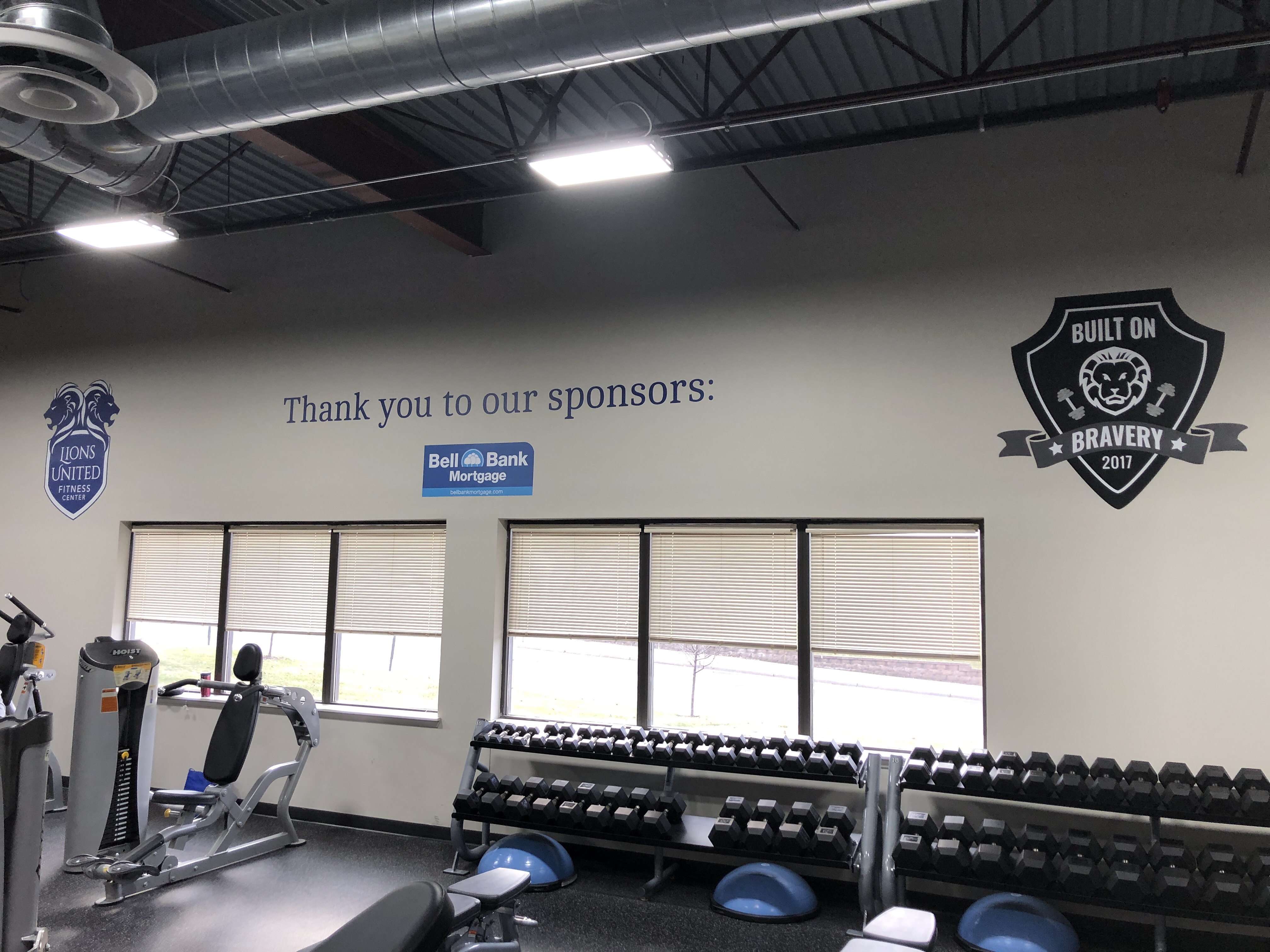
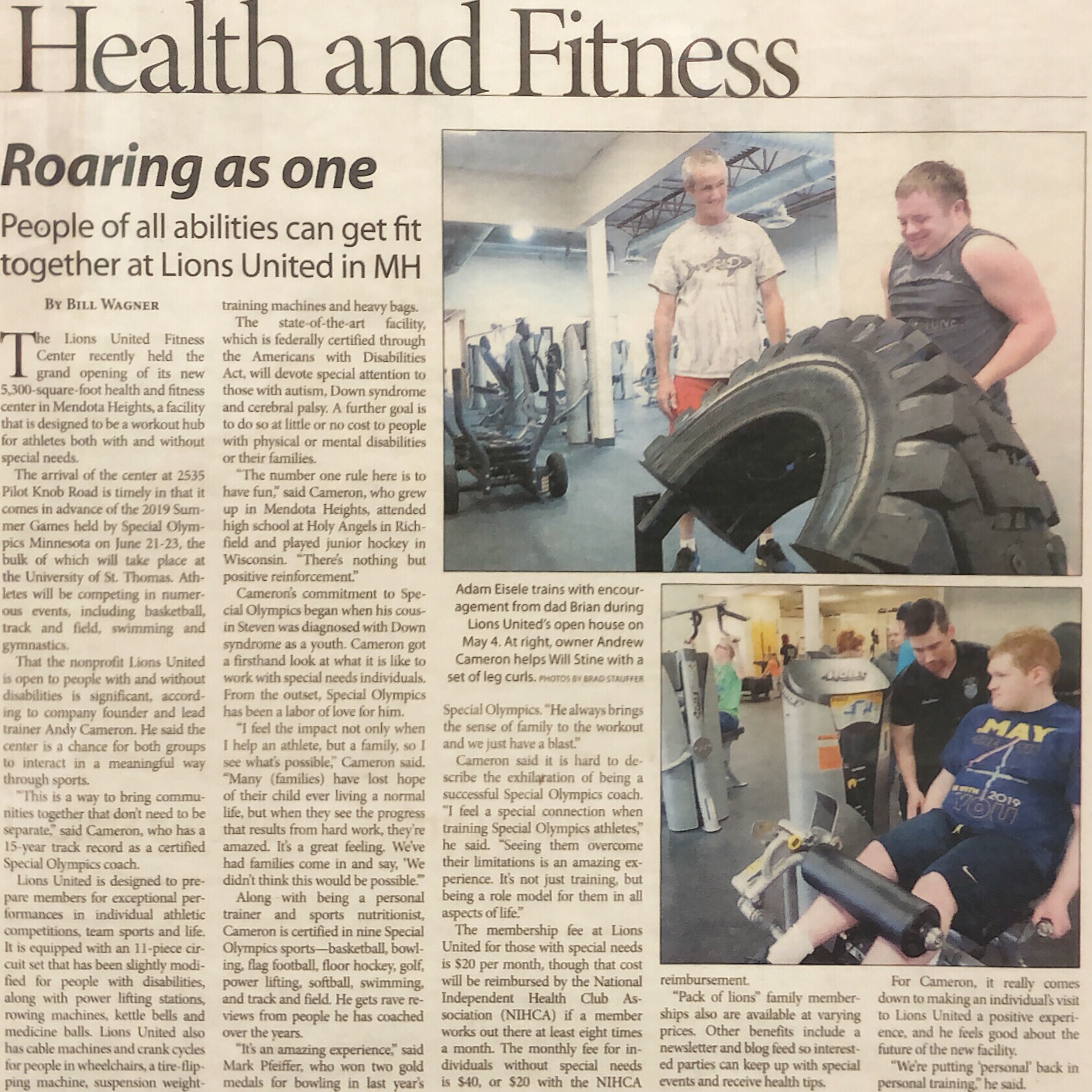
My #1 is doing their special Olympics strength training at Built on Bravery, located at the Mendota Height MN Lions United Fitness Center (map):
... Lions United is a new kind of training center, designed specifically to prepare people with disabilities for exceptional performance in individual competitions, team sports and life, especially people with autism, down syndrome and cerebral palsy. We’re dedicated to Special Olympics’ Project UNIFY and Unified Sports®, which means we bring people of all abilities together to strengthen individuals, relationships and communities....
This new facility is first in Minnesota to focus on persons with cognitive disabilities.
The Star Tribune did an interview with the founder:
Q: Membership fees and hours?
A: Twenty dollars a month for people with special needs; $40 a month for others. We’ll also have an incentive program where any member can receive up to $20 a month through their insurance. Staffed hours are Monday-Thursday, 3:30 p.m. to 10 p.m.; Friday 8 a.m. to 10 p.m.; Saturday and Sunday 8 a.m. to 6 p.m. But members will have 24-hour access.
I think there may also be family memberships.

There is a big unmet need for health and fitness support of special needs teens and adults. Diets are often worse than average and there are few welcoming places to go. (Several CrossFit gyms are welcoming, but that's a big climb. This facility has grant support.)

We need more like this!

Sunday, January 27, 2019

How did the story end?

I started writing this particular blog in September of 2004. At that time Explorer #1 was 7 and #2 was 5. They are adults now.

The early years before this blog are a blur now. I think by the time I started writing we had developed a reasonably effective approach and seen some progress. The years between 2000 and 2004 were harder.

We aged a lot in those years.

Now this blog is infrequently updated. That’s partly because of my related book project, partly because adult Explorer challenges are personal, and partly because the complex educational and financial (SSD, etc) challenges we deal with now are managed by my wife — and she doesn’t blog. We’re specialized that way.

So the story continues, but the blogging is less frequent. For the few that have followed this blog I feel like I should provide a summary of sorts. For those who are starting on a similar journey it might help to know one ending, then maybe go back through past posts and pick out things of value.

In general our Explorers have done well. They are both adults, for now both have guardianship status. We have, to date, for the moment, avoided the catastrophes parents of special needs children justly fear.

#1 has cognitive disabilities. Once he was an “explosive child”. Now he reads and even writes a bit, albeit largely on his phone. He has two part time jobs (no benefits) and he has longterm disability status and thus some potential security after our deaths. He’s been a reliable employee. His self-regulation and planning ability continue to improve. He loves his family. His diet could be better; it’s a typical non-college US diet (i.e. terrible). He needs more exercise. He remains a pretty good athlete for someone who rarely practices. 

#2 is on the classic autism “spectrum". He is in a post-secondary transition program and is a B/C student at our local community college (he’s fine with a C). Sadly he has shown zero interest in learning coding —  the one path I think could lead to his financial independence. He is usually delightful but struggles with novelty, travel, and changes in routine. He has screen time issues but works them. His self-regulation continues to improve. His work capacity is limited, but growing. His diet and exercise are better than the US average. He is kind, sweet, compassionate, and a typical middle sibling peacemaker. His great strength is persistence. He has a bad day, but the next day he tries again.

Were I to have read this in 2002 I think I’d have felt relief. The story doesn’t end until the narrator dies; it could all change at any time. But for now, well enough.

Saturday, March 10, 2018

When imagination becomes memory

I think this is terribly important, but I’ve never seen it described. So, in a few minutes, I’ll share what I think.

Almost animals have memory, save perhaps the simplest single celled organisms. We think plants have a form of memory as well. There’s nothing uniquely human about memory.

Imagination is less common. It’s not uniquely human either; crows, wolves, cephalopods, cetaceans, primates — they all have some form of something that looks like imagination. We think humans have much more of it though. We can create memories of things that have not happened or did not happen. Imagination is a form of ‘false memory’ that we know to be false.

Except … when we don’t know it to be false. And there lies a problem — but I’ll come back to that.

When did humans develop the ability to create false memories and know them to be false? We think it is older than what we call “human” now — we think our fellow modern hominids, Neandertal, Denisovan and more had well developed imaginations. We suspect we have more of this talent though, and that we might have picked up additional abilities as recently as 50,000 to 75,000 years ago.

That’s very recent evolution, so it’s not surprising that, like strength and height, imagination might vary among people. It might vary in the ability to create “false” memories, and, perhaps independently, in the ability to know them to be false.

The latter variation is key. We know from research over the past forty years that it is relatively easy to create false memories in many people, but we also know that some study subjects, typically healthy university students, are more resistant to false memories than others. If we consider imagination as the generation of false memories that we know to be false, then similarly some people will be better at retaining the knowledge of what happened versus what they imagine happened.

So we know this ability to divide imagination from memory varies. It is plausible, and it fits my own experience, that people with “connectopathies” and other cognitive disabilities may have not only more limited imaginations, but also more difficulty separating the memory of what is imagined from all other memory.

I have seen this in someone close to me. When he was a child I would be upset that he was not telling me the truth, but over time I have come to believe that for him memory and imagination are inextricably blurred. What he imagines, what he wishes to be or have been, is poorly separated from what has been. There is just enough separation, I think, to create anxiety or agitation around the recall of false memory, but not enough to tell what is true memory and what is imagination.

I don’t think this problem is unique to persons with an IQ below the 5th percentile. I suspect it’s true for very many people, and it may explain why so many today are susceptible to novel kinds of media manipulation.

It’s a problem we need to research and understand both for persons with cognitive disabilities and for our society.

Sunday, September 10, 2017

Down syndrome traits -- many also true of non-Down low IQ adult

Recently I had the privilege of taking about smartphone support for special needs adults for the Down Syndrome Association of Minnesota. As a speaker I could attend the conference for free, including a talk by a psychologist, Dennis McGuire.

I don’t have a child with Down Syndrome (John Langdon Down’s syndrome has become Down Syndrome) but #1’s IQ is in the typical Down Syndrome range. So I was curious how much of Dr McGuire’s talk applied to my son. I decided about 80% or so — even though #1’s temperament is very different from the Down Syndrome athletes I know from Special Olympics and Minnesota Special Hockey. I suspect that overlap is primarily a result of cognitive disability rather than something unique to Down Syndrome (Trisomy 21). (By way of reference #2 is classic autism spectrum disorder but has a normal college range IQ. This list would not apply to him.)

For the parent of a child with a cognitive disability this is valuable stuff. I thought nobody studied these behaviors — but it turns out they are studied in Down Syndrome. We’ve figured most of it out by now, but it would have been good to have had this list 8 years ago.

From my notes …

  1. Often do better with written word than spoken word, even if reading level grade 2.* This includes texting.
  2. A minor misfortune that a neurotypical might quickly forget may produce a strong aversion or phobia. These can be lasting and may be very hard or impossible to verbalize. Re-exposure to the context or even attempts to describe it may reproduce the emotional response (PTSD-like)*. They may result in quitting a job that had been going well or dropping a favorite activity. These can sometimes be addressed over a period of a year or so — if the root cause can be determined.
  3. It is common to make poor word or phrase choices — perhaps for lack of a range of phrases. “Kill that SOB” for “I’m really made at him”. Some will response to a (written) list of alternative and more acceptable phrasings.
  4. “Self-talk”, monologues with gestures and dialog, are common ways to process events. They may include imaginary friends. They may be mistaken for psychotic delusions. Person with Down syndrome often need training to understand self-talk should be done in a private space.
  5. When doing “self-talk” may act out roles — consistent with a fondness for theater.
  6. “Stuck groove” - McGuire's name for repetitive behaviors with a compulsive aspect. Topics and phrases that must be repeated many times with minor variations. Arranging a desk to be “just so”.
  7. A preference for ordered environments and routines. “Stubborn” is the “S word" in the Down Syndrome community.
  8. A resistance to being hurried or made to move quickly — “slow” and “slower”. (FWIW #1 does not do this, but my #2 (autism) does. I’ve seen this a bit in special hockey, but I’ve also seen Down skaters race for the puck.
  9. Anger as a common response to not understanding, feeling pushed.
  10. Reactive “No” when asked if want to do something long desired.
  11. Strong orientation to place — often very good sense of direction.
  12. Love of food and food places.
  13. Strong visual memory but poor at time sequencing. May speak of things in present tense that occurred years ago. May have difficulty with timing of routines — not able to manage “15 minute” guide for shower.

I’ll ask my Down parents whether they think this list will be helpful in coaching our Down skaters. I know it would be helpful for managing my #1.

* Dr McGuire ascribed the asterisk items to a strong visual memory, even “photographic” at times. That seems plausible, but I don’t know if there are MRI studies to go with it.

Wednesday, June 28, 2017

Minnesota adoption assistance and disability support

We have been told, and I think this is true, that if a Minnesota child with a cognitive disability receives state adoption assistance, which includes medicaid coverage it’s not possible to get disability support until the adoption assistance ends at age 21. 

It appears to be an unwritten rule. I wonder if in some cases it would be better, with a special needs adoption, to forego the adoption assistance and take the disability path instead. I’m sure this exclusion is an unintended consequence.

The transition from medicaid coverage under adoption assistance to medicaid coverage under the disability program is not instantaneous. There will be a gap. Moving from childhood disability to adult disability is not fun.

Thursday, August 25, 2016

Employment - not.

 
Two days ago, returning from a 1 week family holiday, he quit. Without notice.
 
He gave us no real warning, and, not atypically, disregarded our strenuous advice. In follow-up we hear he was doing the job well enough, his supervisor was surprised he quit. And annoyed he quit without notice.
 
#1 has had various explanations for why he left. I doubt he knows. The one he currently favors is that the work wasn’t interesting enough — he was doing grounds maintenance and he wanted to work with machinery.
 
In our own post-mortem we came up with 10 factors: 
  1. Social isolation, there was really nobody there he would be comfortable with, no other cognitively limited adults.
  2. There was no coaching, no support, no communication channels. It was an unsupported job.
  3. He had no concept of “giving notice”, wasn’t aware that was something one did.
  4. A special needs friend he admires spoke fondly of his (much less appealing, more difficult) job in food services at a sports center and advised #1 to apply.
  5. He was unhappy at not getting “time off for state fair”
  6. He was bored, the job wasn’t exciting any more, wanted to do more interesting things
  7. The holiday took him away from his routine. His memory is odd; after 3 days things seem less familiar. We needed to drive by his work on our return and anticipate reentry problems.
  8. The commute was hard and the novelty of going by bus had worn off.
  9. He has unrealistic work expectations (dream meme scam)
  10. He has a history of quitting sports teams after about 2-3 months, this fits a trend.

I think it all adds up to he got the job prematurely; he’s not ready for unsupervised and unsupported work. Maybe in 4-5 years he could do this work reliably and appreciate it, but he’s not there yet.

Now we have to twist his arm to get him back to his transition program (two years left). He now has no screen time at all before 5pm, so life at home is reading, bicycling, sleeping, and chores. That should make his screen heavy transition program time more appealing.

Thursday, July 14, 2016

Special needs urban bicycling - what streets are safe?

A few weeks ago I wrote about trying residential-urban (Saint Paul, MN) bicycle commute with #2. I realized he wasn’t ready, so we’re focusing on his mountain biking. He rides with a team I manage. It’s hard work for him, but he keeps persisting. I now do a scaled practice with him — about 50-70% of our novice rider practice routine. I got the scaling idea from my own CrossFit hobby — where I’m about 50% of the male athlete standard.

At that time I wrote that #1 was doing relatively well with his bike commuting. He has quite different cognitive traits; the two boys have complementary strengths. 

Then, on a family outing, #1 took off on a 4 lane (2 each way) 50mph+ roadway. I’m pretty sure he knew I would not approve, but he wasn’t just yanking my chain. He was also showing off how fast he is, specifically much faster than his father. (I already knew that!). I didn’t say anything at the time, but his bike was grounded when we got home.

It took a while to figure out a good approach to letting him ride streets again. I started out investigating local traffic skills classes; I thought I’d adopt that curriculum for him, maybe do a hands-on course together. I decided it was the wrong fit though. Many of the skills he already did well, some of the curriculum wasn’t relevant to real world commuting, and many of the topics were too abstract.

I realized we had two issues that were relatively unique to #1. One is long term hard. He has had words with people in bicycle trails/paths [1] and, as is typical when he experiences conflict, he now avoids all bicycle paths.[2]

The other is a simpler problem. He can’t easily classify roads into relatively safe vs. relatively dangerous. This isn’t obvious — try making up the rules! It took me a while to come up with a set of ‘safe riding places’. The current list with some familiar examples is:

It has a bike lane - like Fairview or Summit
It has a bike path - but you have to use the path (Shepherd bike path)
It is a "bike avenue" with bike pictures - like Jefferson
Speed limit is 35mph or less (NOT 45, 50, 55) AND has one lane (on each side if two way)

We’ve been over the list several times; he sometimes forgets the magic speed limit. It has helped to go over how few people survive being hit at 40mph (basically nobody, not that 35mph is so great). I put these rules, together with a checklist of essential ride items [3], into a note on his iPhone (using a browser interface to his iCloud account, as described in my Smartphones for All book).

Being as he is, it doesn’t work to get a simple agreement on these things. I keep his road bike locked, before I unlock it, he has to show he’s carrying the necessary gear, then he has to review the safe ride place rules (using is iPhone if needed). Only then do I unlock and wish him well.

He’s starting to transition to a routine. That’s a good sign; once he has a routine it tends to stick. 

Wish us luck.

- fn -

[1] I suspect this is mostly his fault, but addressing that is part of a long hard slog
[2] It is annoying to have pedestrians in the dedicated bike trails instead of the neighboring walking trail, but well tempered adults know to live and let live. #1 perseverates about these conflicts, I think they replay visually like a tape loop he can’t purge.
[3] He has quirks about carrying things. Nothing can be attached to his bike. He can’t explain why he dislikes taking his ID card or something with my number on it. His iPhone has his medical info, emergency contact and the like. I’m going to get that information written on back of his “must-carry” State ID. His iPhone shares his location using Apple Find Friends so we can track his long rides.
[4] As a teen and even as an middle-aged adult I’ve ridden more dangerous roads than the one he got grounded for. One of the unfair features of a monitored special needs adult is that you don’t get to do the stupid things your father did.

Sunday, May 22, 2016

Universal data access for all Americans - what would it look like?

The NYT has another “digital divide” article, this time using Detroit. I think they might be doing a series on this topic.

The problem of net access isn’t unique to Detroit, it applies to every low income American, which includes pretty much every special needs adult. A smartphone (net phone?) isn’t an option, it’s a necessity for modern life [1]. That’s one the reasons I’m writing my book on smartphones for special needs teens and adults.

It’s not hard to give everyone a smartphone. We’ll be drowning in cheap Android devices soon. The problem is data access. Home WiFi, which is notoriously unreliable and complex, costs at least $35/month in most markets. Home WiFi is too complex for most people to maintain anyway. Cellular data costs about the same per month, but it’s tricky to meter and it’s per-person, not per-family. For a family of five we’re looking at $175 a month — too much for a low income family.

So we need some universal mobile data access that everyone gets. Something around 1GB a month. That’s enough to support essential interactions, but not enough for streaming video. 

I’m thinking we’ll either end up with something that’s funded by advertising (Facebook, Google) [2] or a public mandate. It might be a good idea to do both. Either way it will need to incorporate some kind of intelligent data use and filtering.

Whatever happens supporters of special needs adults should be engaged.

[1] Many government programs still have ancient web sites that don’t work well on a smartphone browser. The good news is that hackers are tearing those web sites apart, so they’ll need to be upgraded. In time we may need to bring ADA suits against government web sites that are not smartphone accessible.

[2] Low income advertising, best seen on daytime TV, is often predatory. That is, it’s advertising for services and products that are largely harmful scams. That will be a problem.

Wednesday, January 20, 2016

Smartphone for all: the Guide is impersonating the Explorer. There's a problem there...

It’s only in writing or teaching something that we come to understand it. I’ve been guiding my two special needs Explorer’s using their iPhones for at least five years, but I only today realizes why the Guide role works — and why it might get harder.

I’ve put the key concepts into a book chapter (Smartphones for all) about Guide tools:

A Guide could implement many of the recommendations of this book by working on an Explorer’s smartphone every evening. You could take it in your hand and review emails, enter Calendar items, update Contacts, review Facebook Group membership and so on.

You could do that, but it wouldn’t be practical even if your Explorer lived with you. If your Explorer is an adult with their own residence it’s even less practical.

The Guide’s role is possible because of two features of today’s digital world. One is that information on a smartphone is commonly synchronized (actively duplicated) with a secure online store. The other is that it’s possible for a Guide to assume an Explorer’s identity if they know the Explorer’s digital credentials, typically their “user name” and password. These two features weren’t designed to make the Guide role possible; nobody at Google or Apple has been thinking about Guides and Explorers.

It’s easiest to understand this using an example like a Calendar. A capitol-C Calendar is how this book identifies a calendar viewed and managed by an application like the iPhone’s Calendar app (Calendar.app). A Explorer views today’s Events (appointments, scheduled things they need to do) on their iPhone, but the same Events are stored online. A Guide, using the Explorer’s credentials, can manage the Explorer’s Calendar Events using a web browser. Whatever changes the Guide makes will, typically within a few minutes, appear on the Explorer’s iPhone.

The ability to assume an Explorer’s identity is a tricky issue. Many children use their elderly parent’s credentials to their online banking, and bank staff know this very well, but it’s also explicitly forbidden. Google and Apple usually know a smartphone’s location and more or less know where a computer is located — having the same digital person in two places will trigger email warnings. For at least the next few years this will be manageable, but we Guides need to all encourage Apple and Google to support proxy users, either by better  ways to share things like Contacts and Calendars, or by formally supporting someone like a Guide. The good news is that aging parents are going to drive changes that will also support younger Explorers.

I’m pretty sure neither Google nor Apple have thought much about the needs of a special needs smartphone user, though Apple in particular has done quite a bit of work to support persons with motor, visual and auditory disabilities (“accessibility”). So they probably haven’t considered why hacking into someone’s email might be a feature, not a bug. I expect it will get harder for one “person” to be in two places at the same time; we might in time see more than warning emails.

There are several reasons for optimism though. When we leave our computer at home logged into our online accounts, and work with the same data on our smartphones, our digital self is in two places at once. A second reason is that the education market has similar needs for a supervising person to work with a student’s account data.

Most importantly however my generation are going to create large numbers of customers who are being supported by their children.

Current trends are encouraging. Banks are adding authorized surrogates and Google and Apple will likely do the same. Google already has the concept of an “Inactive Account Manager” to provide authorized access to a second user in the event of death, disability or disappearance. Apple has the concept of the iCloud “Family” for sharing media and locations. Both Apple and Google support some sharing of things like Calendars.

We have multiple market needs and the outlines of several solutions. So I think the ethical impersonation that allows me to be a Guide is going to go legit. Maybe this blog post will help a bit, and I’ll try to get something like this into a bigger forum. I’m hoping the book will help a bit too. Know anybody at Apple or Google who wants a copy?

Friday, December 11, 2015

Special needs smartphone: draft sample sub-chapter on Google Nest Cam use

Early version …

….Some people with cognitive disabilities may be prone to impulsive anger, and may need monitoring when home with siblings but no parents. A teen with ADHD and autism may alleviate boredom by pestering a sibling. Head injury related to seizure activity could lead to extended unconsciousness. Kitchen hygiene neglect may be causing roommate or landlord problems.

These are all familiar problems for supporters of special needs teens and adults. In each case we’d like to be able to peek around the corner, even while we’re at work or simply away from home. We can do just that with a smartphone and some gear, we can even make warnings and ultimatums come out of thin air.

The gear is something like Google’s “Nest Cam”, formerly known as the DropCam. The Nest Cam is marketed as a home security device for $200 plus a $100/year fee for access of up to 10 days of stored video. At the moment it requires a WiFi network; Nest doesn’t sell a mobile cellular version.

For the situations mosts of us are dealing with we don’t need the stored video, we just need to be able to launch the Nest Cam app on our iPhone or Android and see what the camera shows. The Nest Cam has a speaker; the app lets us “speak” from the camera and see and hear responses. It’s not suited to conversation, but it works well for “Stop That!”. The smartphone software can be be used with multiple Nest Cams.

There are less expensive competitors, but the Nest Cam comes with excellent Android and iOS smartphone software and lifetime access to secure, reliable, on-demand streaming video backed by Google’s infrastructure. For our particular needs it’s the only solution worth looking at.

The Nest Cam has a single power USB power cord. It can be mounted on a wall, but most users will place it on a convenient shelf. It’s relatively easy to connect it to an encrypted home WiFi network. When you connect to a Nest Cam from a smartphone it begins streaming video to a secure Google server and from there to your phone. At that point you can see, and more importantly hear, what’s happening at the camera locale. Depending on what you’re seeing you may sign off, phone, or use the built-in speakers to deliver a suggestion.

The standard Nest Cam configuration turns a red light on when in use, but the light can be disabled. If the video-active light is disabled there’s no way to know if the video is streaming or not.

On demand notification-free monitoring has an ominous flavor. In practice, of course, it depends on the context. The average teenager does not want Mom or Dad doing secret observation, but if it keeps their older brother calm and well behaved around the XBOX many will welcome it. In some cases a special needs teen or adult will find the existence of the camera calming, so that in practice it is rarely used.

In other cases the camera may be masked and the video light will warn that an audio channel is opened. Then video may be enabled or not depending on the circumstances. In other circumstances video might be activated only if both text message and phone call go unanswered. There are many ways to use this technology wisely and to everyone’s mutual satisfaction….

Tuesday, November 03, 2015

Cognitive disability and AI assistance with Google Inbox.app. Suddenly, a new world.

Google announced nsAI (non-sentient artificial intelligence) assisted email today, it will debut in the Android and iOS Inbox.app.

My first thought was that this will be kind of annoying. A few minutes later I was thinking about AI-responses generating AI-responses and the various spam implications. I decided this would be interesting, exciting, maybe a bit scary. There will certainly be unexpected consequences.

Then I remembered how much iOS word and phrase completion has helped #1 son with texting and email. I remembered that I’ve been watching for more nsAI assistance to support both of my sons. 

That’s when I realized how big this announcement really is.

I’ve reinstalled Inbox.app on my iPhone and Ill be planning how to transition both of my sons to the new platform and how to introduce the concepts of nsAI assistance to our local educational system.

This is how the future comes crashing in.

Wednesday, September 23, 2015

Special needs - death by car and what we can do about it

The Centers for Disease Control’s pedestrian injury page tells us that in 2012, "4,743 pedestrians were killed in traffic crashes in the United States, and another 76,000 pedestrians were injured….  Pedestrians are 1.5 times more likely than passenger vehicle occupants to be killed in a car crash on each trip…"

Some groups are more at risk than others. "Pedestrians ages 65 and older accounted for 20% of all pedestrian deaths and an estimated 9% of all pedestrians injured ...more than one in every five children between the ages of 5 and 15 who were killed in traffic crashes were pedestrians."

The CDC doesn’t collect statistics on ambulatory special needs adults, but if they did I suspect this would be the highest risk population. Special needs adults don’t drive, and they have to live where services and work are available. Getting to and from work by foot means more exposure to fast moving heavy metal objects guided by imperfect humans. Cognitive disabilities often means less awareness of high risk surroundings, less understanding of human errors, and more impulsiveness.

Which is perhaps how T., beloved by family and friends and community, was killed by a car a few days ago. My wife attended his funeral today, I’m writing while away from home, caring for my father. Our #1 son and I saw him about 3 weeks ago, T. was showing my adult son his home, acting as a mentor for our son’s transition towards more or less independent living.

The CDC’s has recommendations for reducing the risk of death for people who walk, such as using reflective clothing and a “flashlight” at night. The recommendations are not harmful but, really, they won’t make much difference. It would be generous to describe them as weak and unimaginative.

So what could be done? In the long term, decades from now, humans will not drive cars or trucks on city streets. Machines will do that better than the best of today’s human drivers. That will be a boon to all people, not least those with cognitive disabilities. I hope to live long enough to see that day — I only wish it would come as quickly as some imagine. It won’t though.

There are things we can do while we wait. Streets can be made a lot safer for walkers by reducing speeds, providing accessible crosswalks, converting 4 lanes to 3 with a turning lane (“road diet”) and enforcing crosswalk laws. We can and should push legislators to make those changes; perhaps there’s an opportunity to leverage the Americans for Disabilities Act to that end. It is a shame that, for political reasons, the CDC didn’t put that on their recommendation list.

But we can do more than improve existing roads and sidewalks. We can’t build autonomous cars yet, but we do have the technology to equip new vehicles with sensors warning drivers of pedestrians and cyclists and recording and transmitting close encounters. We can and should demand legislative action to accelerate development and adoption of augmented driving systems for pedestrian and cyclist safety. We should do this in T.’s memory, and for all the persons we love with and without special needs. That’s a recommendation the CDC should make, and it’s one we can advance to our legislators.