Showing posts with label exercise. Show all posts

Sunday, February 05, 2023

Explosions and anxiety: Adult special needs life is a tough haul

My 26yo son, "#1", is pretty solidly in the 3-4th (bottom) percentile of cognitive abilities. It's a cognitive continuum of course; what's true of the 3rd percentile can also be true of the 10th or the 20th -- especially when lack of sleep or alcohol is involved. So this isn't just about special needs adults. It's something useful to understand for tens of millions of Americans.

The other day he exploded. No harm came of it, except to him. It's a behavior we've known from childhood though it's only with time we came to understand how closely tied it is to his anxiety.

It happened during an ice hockey game. We play together at local pickup games. He's a good mid-level adult hockey player, a step above me and our usual pickup skaters, but he's not a fitness guy. He gets tired towards the end of a game and, unlike a neurotypical player, he doesn't push himself. He just takes it easy. (This logical but socially wrong behavior isn't unique to #1.) This can irritate teammates who expect him to perform well.

In this case a teammate made a mildly inappropriate (for this kind of hockey) criticism of #1s lackadaisical play. Once upon a time I'd have made a similar comment, but I've learned it doesn't work. What works is to praise the things he does well. (This simple principle took me forever to learn and apply.)

I get those kinds of comments myself from better players sometime -- but I enjoy them.  It means I can guilt my critic into being a reluctant game-long coach. (Sadly this only works once, they don't really want to coach.) Or, if it's late in the game, I'll laugh and say "yeah, I suck". 

That's advanced stuff. In this case #1 was tired. He exploded with a red faced rant and various scary seeming threats. I was nearby though, so I sat between him and his critic and explained to the poor guy that my son was a special needs adult and that I'd sort things out. #1 hates to hear himself described that way (you would too) but the moment passed for everyone but my son. For him these things endure.

I've learned not to criticize these behaviors -- for him it's all about extinction-reinforcement. I was able to walk him through how I'd have handled the comment. It wasn't over though. He's been kind of wreck since. He's complaining of a variety of physical symptoms consistent with somatization (or some horrible disease that we'll feel very bad about -- my wife and I are both physicians). It's hard to understand his internal reasoning but his behavior is consistent with shame, guilt, and a deep fear of exploding again. His usual response to an episode like this is to replay it for years and avoid the setting. I don't know if he'll continue to do the pickup hockey. For now we're managing what we think is somatization (and not, say, some post-COVID neuropathy or lymphoma [1] or whatever) and working on resetting him.

Not a good day, but also not avoidable. But it could have gone much worse. It does go much worse. A lot of men with limited cognitive or emotional control can melt down like this. If police are involved and aren't at the top of their game it can escalate very badly. Even if police aren't involved it can turn into a physical fight with all of the problems that come from that. Most special needs adults, and most men, don't have a 60+ neurotypical father to sit between them and the guy they are excessively angry with.

It's a hard world out there. If you're one of the lucky guys with good emotional control and understanding it might help to know how this goes. If you're a cop -- I hope you're getting the autism/special needs training now being introduced into high performing police forces.

- fn -

[1] That's physician humor. Any symptom can always be early lymphoma.

See also:

Tuesday, October 26, 2021

Exercise for autism - the home mini-CrossFit program

A few weeks ago I posted about a mandated 300 calorie a day weight stabilization program for #1. I also mentioned there's a different program for #2. There's no mandate for his program -- it's something he and I put together. He dislikes exercise but feels it his duty to do it.

The program has 3 events each week that we do together:

- Depending on season either a 1h singletrack mountain bike ride or a 1h MN Special Hockey event.

- A few miles of walking or (depending on season) 2h family road bike ride or 1h outdoor ice skating loop*.

- Home mini-CrossFit

The home mini-CrossFit is a highly scaled version of a standard CrossFit workout -- perhaps 1/3 of the intensity and effort. We have a COVID home gym so we have a good range of options.  He does it with my wife and I; having Mom participate was key to building his confidence.

After some experimentation we've settled on a standard pattern. First the "WOD" (workout of the day) then the strength portion. The strength portion is standard power lifting, no Olympic lifts. We have a good set of dumbbells and a full rack and bar.

The WOD follows a standard pattern. It has four different movements that vary widely (movements are chose to also be a warm up for the strength portion since he won't do a separate warmup). The duration is always 16 minutes and each movement is done within 1 minute (so each of the 4 movements has 4 reps) or 2 minutes (each of 4 movements has 2 reps). Movement number is set so he has roughly equal time spent working and resting.

We've been doing this particular pattern for a few months and he's dramatically fitter and stronger. I don't think he realizes how much he's improved. Things that were hard for him a few months ago he now does while reading his phone. I have been gradually increasing the frequency and weight as he starts to finish in 15 seconds rather than 30 seconds. Sometime in the next year his bench press will pass mine.

I think most of the improvement is from the mini-CrossFit, though the singletrack ride would tire many adults and its certainly helpful. His exercise days are my rest days, but the effect is still impressive. It helps to be young.

* Years ago our entire family inline skated at the Metrodome every week or two all winter long. It was great and we'd do it again ... except that structure was torn down for an essentially useless Vikings football stadium.

Saturday, August 07, 2021

Metabolic syndrome and cognitive disability - 300 calories a day with Zwift and a Schwinn IC-4

Short version

A cognitively limited adult with early metabolic syndrome (hyperlipidemia, elevated glucose, elevated blood pressure, obesity) has halted weight gain over 9 months with a 300 calorie a day exercise program and some compliance with dietary guidelines.

Ingredients

  • Schwinn IC-4 trainer ($900 to $1000 depending on demand and supply chain). This is one of the few quality cycle trainers on the market that doesn't require a subscription. (Review)
  • Zwift exercise service on iPad ($15/month - we could put this on his ABLE account but I hate his ABLE account)
  • Zwift Companion on iPhone to monitor activity (free)
  • iMessage to send screenshot of activity and praise (free)
  • The ability to disable WiFi service to a specific iPad (free with most routers)
How it works

To receive free afternoon WiFi service to his iPad #1 must do one of:

  • Complete 300 calories on the IC-4 trainers as measured by Zwift (bluetooth connection to the IC-4). This takes him about an hour at a fairly easy pace.
  • Go for a bike ride -- his usual ride is about 10 miles and takes about an hour but sometimes he goes longer
  • Go for a CrossFit workout. He does this infrequently now -- that's a challenging social environment. He'll go most often if the son of a close friend of our family is there. (He's pretty strong by the way!)
  • Participate in a family exercise outing -- typically bicycling or Nordic skiing
There are no days off -- it's 300 calories daily.

I check his workouts after 5pm using the Zwift Companion app on my iPhone. I take a screenshot and send him (and my wife) an iMessage praising his work. The iMessage is very important; if I forget he's likely to stop doing the workout.

Background - including health challenges of adults with cognitive disabilities

Obesity varies by education -- which is also a proxy for cognitive ability:

Adults who didn't finish high school had the highest level of obesity at 35.5 percent, followed by high school graduates (32.3 percent), those who attended college (31 percent) and college graduates (22.2 percent).

Adults with cognitive disabilities have the greatest risk of all. When #1 was younger he was pretty active -- participating in many sports from wrestling to inline skating to bicycling to hockey to mountain biking and more. As an adult in a socially challenging world his activities are much more limited.

His diet hasn't helped. It was never healthy, but with income from his two part-time jobs it's gone from bad to worse (switching from Coke to Coke Zero helped). His BMI steadily increased over the past two years to 30, at the low end of obesity. That's bad by itself, but his obesity is abdominal. The worst kind. 

Emily and I arm twisted him into a basic evaluation and he's classic metabolic syndrome. Everything is at the high end of normal or worse: BMI, blood pressure, glucose (HgbA1c), and LDL. He had "diabetes in 5 years with MI at 45" all over him. [1]

So we decided to exercise the "guardian of a dependent adult" role and came up with a 300 calorie a day goal and the Zwift/IC-4 scheme. Given his diet and screen habits that's not enough to lose weight but we hoped it would hold him for a while.

The incentive was WiFi restriction of his iPad. I framed as "earning" the WiFi. If he didn't do the cals, he didn't earn afternoon WiFi for his iPad (I can disable that from my wifi router).

It's #1's nature to 'just say no'. He says 'no' to most everything, then often 'yes' after he's given it some time. In this case his objections were, by his standards, pro forma. He didn't get upset when he lost WiFi for a day and then he just started doing the cals. He likes the Zwift app and rides with this videos, podcasts, and music. He takes his time -- anywhere from 50 to 70 minutes for about 10-11 miles and 300 calories.

Every day I check Zwift Companion on my iPhone, screenshot his work for the day, and iMessage it with a comment. That's important. If I forget he stops riding.

He's done it daily for 9 months, 3 seasons and a pandemic. It's a routine, and he's good at routine. He gets bored with it, but then he can do road biking or hockey or CrossFit or something else. So I'd call it successful.

PS. More posts on exercise in special needs children and adults. Incidentally, #2 is classic autism spectrum and very different from #1. He's "overweight" but not remarkably and, with fewer complaints over time, routinely does 3 exercise outings a week -- mountain biking/inline skating, home CrossFit with Emily and me, and a family bike ride or equivalent.

- fn -

[1] Or, if he was willing, he'd be on metformin, a glutide, and atorvastatin. I'm a convert to the Church of Lipitor. That sh*t is amazing.

Update 10/26/20221
I wrote their were "no days off" but he insisted he did an adequate amount of exercise running food at the local NHL arena and shouldn't have to do the trainer those days. I didn't believe it, but he wore his Apple Watch and showed me an estimate of 600-800 calories per shift (over many flights of stairs). So he won that one.

Sunday, August 02, 2020

Special Needs CrossFit

It's been two years since #1 started working with a personal trainer I knew from her CrossFit coaching, maybe one year since he started going to my regular CrossFit classes.

#1 is 23 now. He can read at about a third grade level, most of his writing is text messaging to Emily or I. He's impulsive, but has generally done well with listening to coaches and workplace supervisors. Putting it all together I thought CrossFit was a bridge too far. Trying it was his idea, not mine.

I was wrong about that. He can now do up to 2/3 of a workout with some minor guidance. Sometimes he does less, but over time he's getting better. His belly grew during the lockdown, it's been shrinking since our gyms reopened. His mood is substantially better. He rarely pushes the limits of his strength, but when he does he's clearly stronger than his 61yo Dad (he is built like a bull - his "max effort" is my routine effort).

If he persists then sometime in the next 3-4 years he will be doing the men's "Rx" workouts. I can rarely do those.

The box has been supportive but they really haven't done much for him beyond any other member. They know his name, tolerate his eccentricities, and pretty much let him do his own thing. Coaches don't push him and that's the right choice.

Anything could happen tomorrow. He has often given up on things he's good at, often for no reason he can express or we can imagine. Sometimes he goes back to them, sometimes he doesn't.

Still, it has been done. He's not the first special needs adult to do CrossFit it a regular group class, but around here he's been a pioneer. Again.

Friday, November 22, 2019

Twin Cities facility for special needs strength and fitness training

(I copied this over from my shares feed as it fits better here).

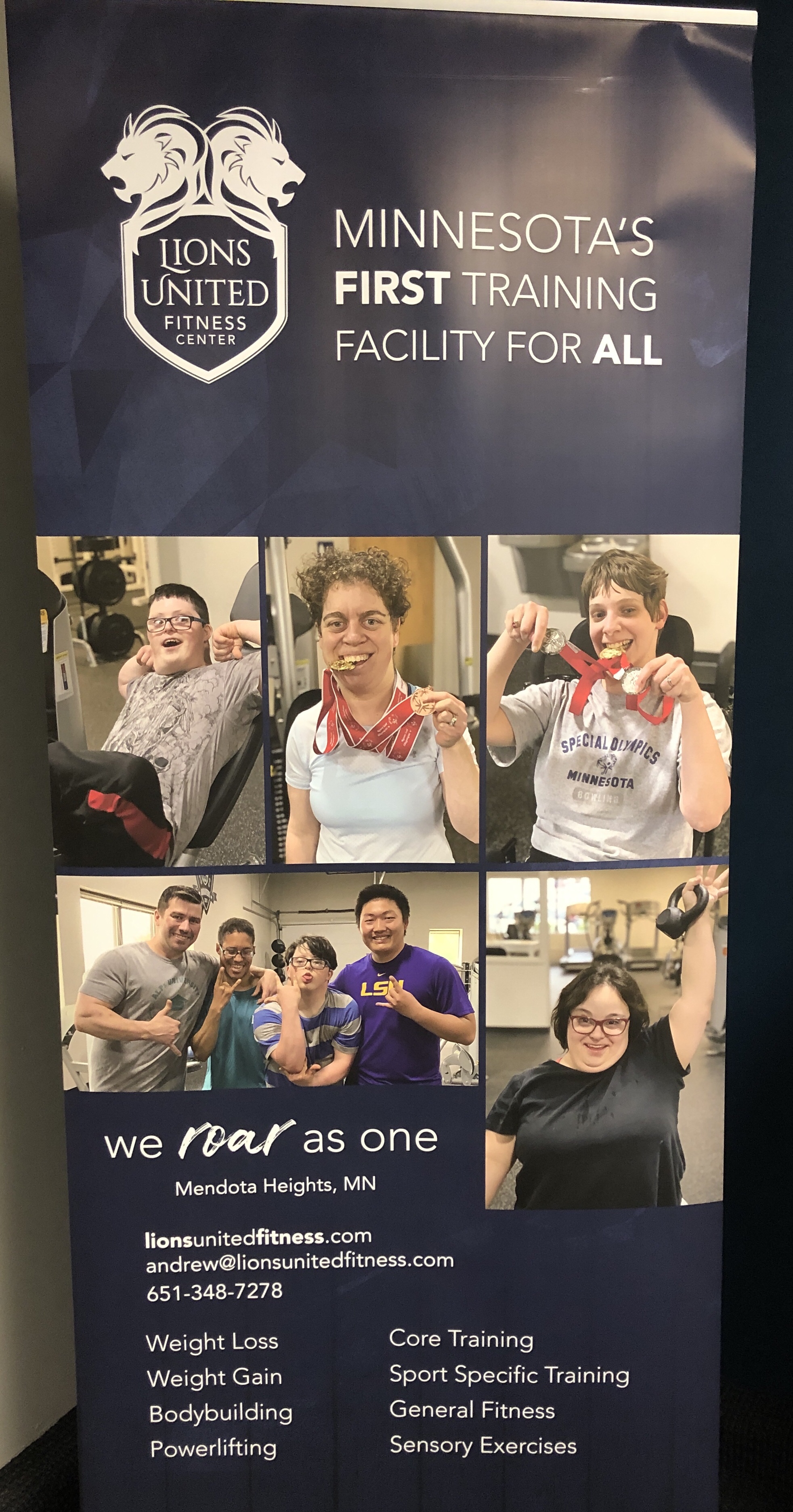
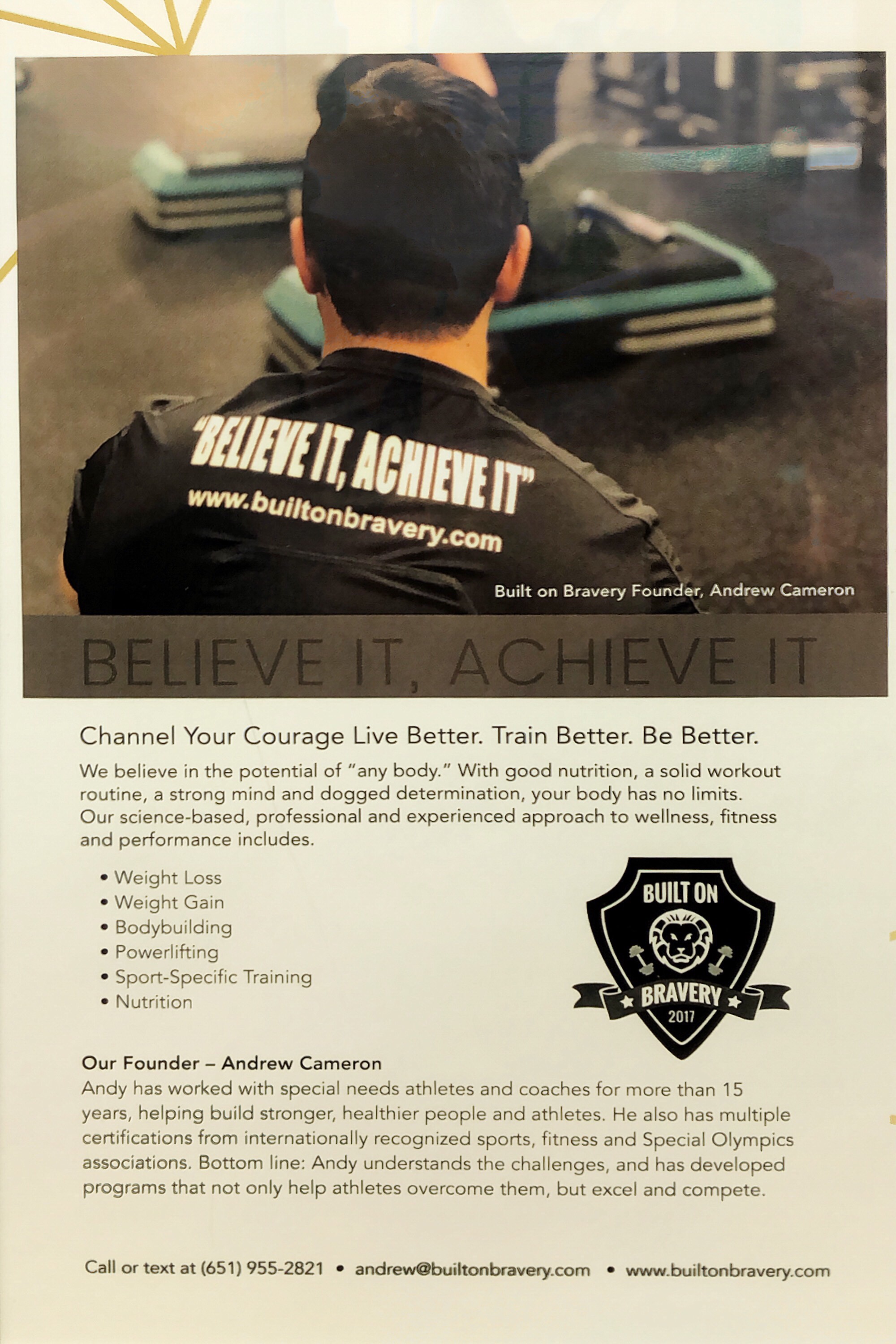
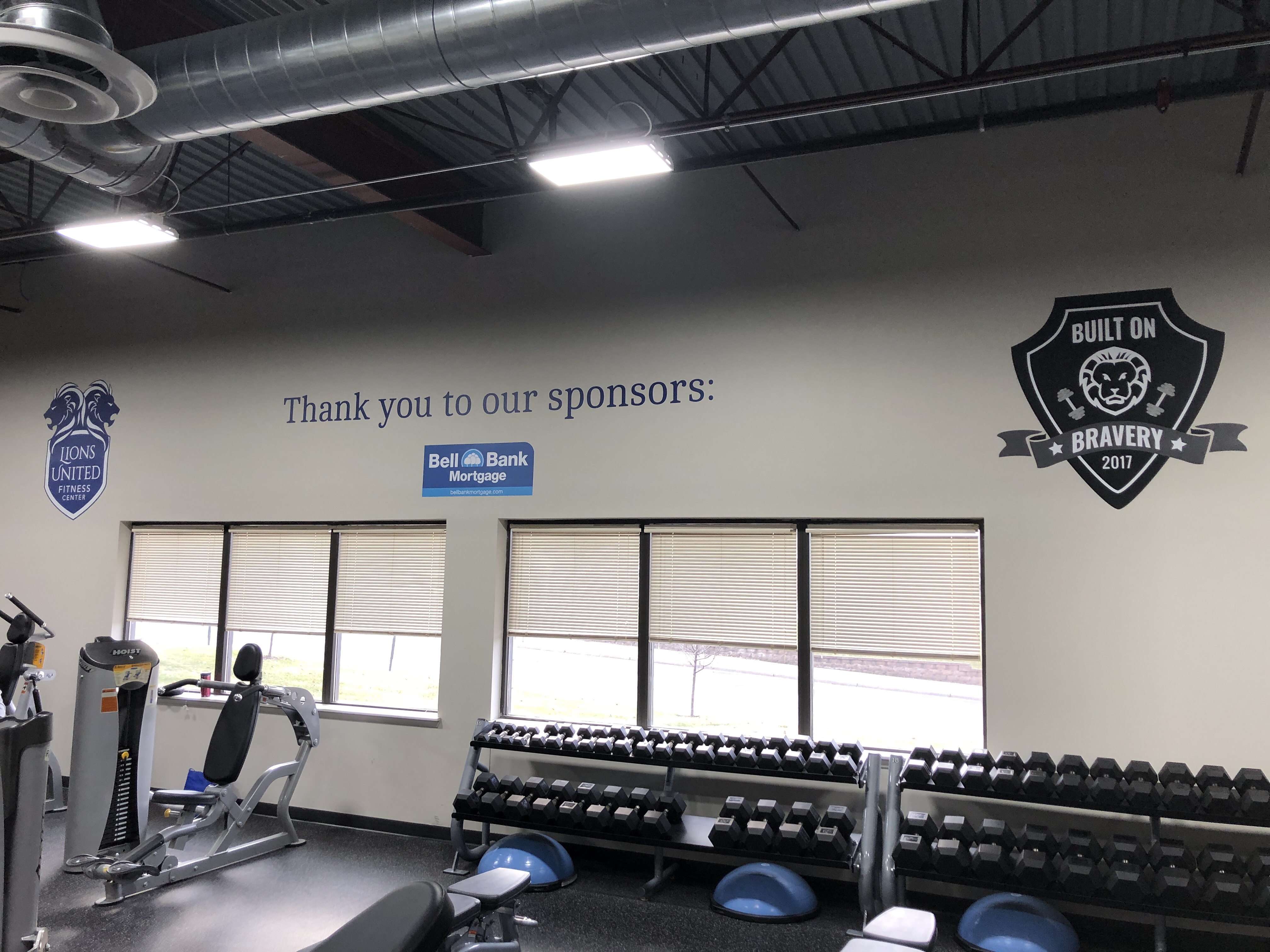
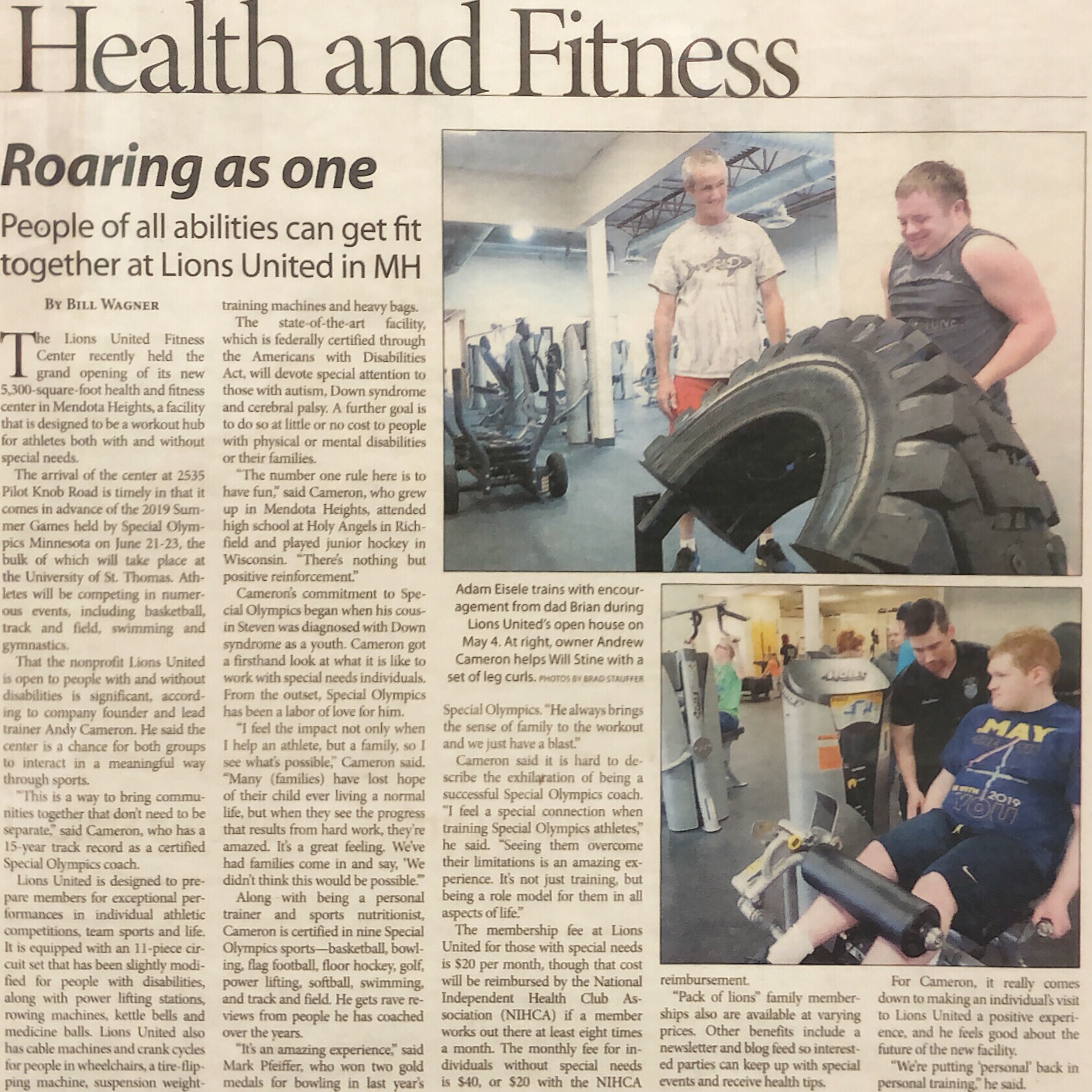
My #1 is doing their special Olympics strength training at Built on Bravery, located at the Mendota Height MN Lions United Fitness Center (map):
... Lions United is a new kind of training center, designed specifically to prepare people with disabilities for exceptional performance in individual competitions, team sports and life, especially people with autism, down syndrome and cerebral palsy. We’re dedicated to Special Olympics’ Project UNIFY and Unified Sports®, which means we bring people of all abilities together to strengthen individuals, relationships and communities....
This new facility is first in Minnesota to focus on persons with cognitive disabilities.
The Star Tribune did an interview with the founder:
Q: Membership fees and hours?
A: Twenty dollars a month for people with special needs; $40 a month for others. We’ll also have an incentive program where any member can receive up to $20 a month through their insurance. Staffed hours are Monday-Thursday, 3:30 p.m. to 10 p.m.; Friday 8 a.m. to 10 p.m.; Saturday and Sunday 8 a.m. to 6 p.m. But members will have 24-hour access.
I think there may also be family memberships.

There is a big unmet need for health and fitness support of special needs teens and adults. Diets are often worse than average and there are few welcoming places to go. (Several CrossFit gyms are welcoming, but that's a big climb. This facility has grant support.)

We need more like this!

Tuesday, March 12, 2019

A (very) inclusive CrossFit gym - in Reno Nevada

Fitness is a problem for many people, not least special needs teens and adults. Diabetes and obesity are common in our population.

Diet is a factor — it takes a lot of cognitive work to outrun the American junk food industry. The special needs population is vulnerable to deceptive advertising implying health benefits of "sports drinks".

Exercise is also a problem. Special Olympics and Special Hockey programs are low volume — typically once a week. Group classes may be intimidating or unwelcoming. Incomes are low and gyms can be costly [1]. Workout music may be intolerable. The feel and odor of sweat may be unusually bothersome. Lastly, suffering for health is a bit abstract for many with special needs.

Today I learned of an extraordinary example of doing something more ...

Upstate Nevada - CrossFit Everyday Heroes

… Upstate Nevada is the first nonprofit facility for community fitness and is motivated by the philosophy that “nobody should be denied a healthy lifestyle due to physical, cognitive or financial impairments.” ...

… The Upstate Nevada board and staff run a community first, gym second … Inclusive and adaptive programs for any type of physical or mental impairments...

… Our Everyday Heroes program offers free or reduced price memberships for the following ...

-Adults with physical or cognitive impairments and their families

-Children with physical or cognitive impairments and their families

Wow. Very impressive. I’ve seen something a bit like this at CrossFit Icehouse in Fargo ND, but Upstate Nevada is at another level. I hope they share their learnings with the broader health and special needs community. 

- fn -

[1] OTOH, adults on disability support often have to spend down to avoid asset caps — exercise classes and personal trainers can be a healthy option.

Wednesday, October 05, 2016

Autism - updating my thinking

This blog is about two very different people with atypical minds connected by family. One is now an adult, the other is almost there. I call them #1 and #2.

#1 wants to be independent. He does less with me now, and more on his own. That’s a sad thing for me, but I’m hardly the first father to miss time with an adult son. #2, at the moment, wants Dad time even as he takes on new things that test his limits. Things like joining a neurotypical high school mountain biking team [1].

Seeing him in that setting I have more insight into how his world looks. When he’s stressed I see him move into a mode where the world fades away to only two people — #2 and Dad.

It’s a kind of extreme focus, a tunnel vision. Even the environment fades away. In cold rain, on a muddy dirt road, surrounded by a team I’m responsible for, I need to stop and give him full attention for an extended discussion of my inadequacies. I see him enter ‘full aspie’ mode, then respond to a threat of decreased screen time by resuming motion, followed by the  beginning of a stereotypical dialog. The dialog begins with me accepting responsibility for my faults, then I provide a structured apology, then he performs an analysis of what went wrong, followed shortly by an often perceptive self-analysis, then a return to the world.

Over time the cycle seems to go more quickly. The progress is encouraging, even though the journey is longer than he yet realizes.

#1 carries the autism label. He meets criteria and it helps with services. Autistic is not a great description of him though. He’s more complex. Greene’s “Explosive child”, (see my 2007 reading list) might have the best description of #1.

For #2 autism is a helpful label, and books on “autism” feel relevant. Including one I first read in 2013; and recently reread (emphases mine) …

Autism, Inside and Out - Download The Universe (review and exposition by Steve Silberman of the NeuroTribes blog)

… Harmon … published “Autistic and Seeking a Place in an Adult World," an account of the search for employment by a young artist named Jason Canha. While dozens of news stories a week speculate about candidate genes, environmental factors, and other possible causes for the condition, Harmon zeroed in on the practical issue that all families face when their kid “ages out” of services: How are they supposed to support themselves and learn to live independently?…

… The controversy over the term mindblindness -- and its relationship to compassion and empathy -- is one of the most yawning abysses in autism discourse, and too deep to do justice to here. Suffice it to say that Baron-Cohen made things worse by muddying the distinction between an inability to parse social cues in real time — which seems to be the cognitive issue unifying all points on the spectrum — and empathy, which is more like a capacity to care about how another person is feeling...

… Anyone who has spent time with autistic people can tell you that they're intensely concerned with how other people are feeling, to the point of being overwhelmed. But they often can't piece those feelings together from the usual clues of facial expression, tone of voice, and body language. At the same time, however, autistics are often adept at reading each other’s emotional states from signs that would be opaque to their typical peers…

The thing missing from this short essay, a thing I see in #2, is how dynamic his autism state is. At peak performance he has low-normal perception of his surroundings including some social cues, under stress that falls away. There’s great variability. The essay does capture #2’s empathy and compassion for other people.

- fn -

[1] The mountain biking community has quite a few people on the spectrum. In retrospect that makes sense. There’s a rhythmic swing/bouncing motion to trail riding, especially on flow trails. There’s a social aspect of doing things together, but mostly one is riding the bike and managing the terrain. Conversation is limited and one can always talk about the bike. For #2 most exercise is excruciatingly boring, but mountain biking demands focus and attention. It’s a good spectrum sport.

Wednesday, August 10, 2016

Exercising with autism: working within the energy budget

A post about energy levels and autism activity reminded me how #2 has managed his mountain biking team participation.

He is one of the more consistent attendees of practices, but he doesn’t do a full practice. He started out doing about half a practice. Over time that’s edged up to perhaps 2/3 of a practice. He goes at a pace that feels very slow to a near 60yo father/coach — but he goes.

His consistency is remarkable. It’s the same with inline skating. He shows up. He goes at his own pace. He does it.

He is almost always limited by his “emotional energy”, not his lungs and muscles. He loves to talk to me while he does things; if we talk on a topic he’s excited about he doesn’t get tired. If the activity is not exciting, or the conversation or audio isn’t engaging, he tires quickly. I think he does better with inline skating and mountain biking because they if one doesn’t focus they can be painful. During our winter walks he listens to the podcasts he loves, then talks about them with me.

It turns out that one can improve fitness even if one’s heart rate doesn’t peak and sweat is minimal. He is going further and faster, though never with great effort.

I’m impressed.

Monday, July 18, 2016

Tips for managing one Asperger's athlete

Both #1 and #2 are physically active. This is very much by design and lifelong persistence. #1 often enjoys team sports and personal bicycling, but these activities are also agitating, disturbing, and anxiety provoking. He’s very sensitive to criticism, very insensitive to advice and feedback, and by nature macho and blunt. That is a hard combination, but #2 is harder.  I think #2 may be more typical of the active Asperger’s athlete.

#2 does not like exercise. He does it because it helps him psychologically as well as physically and because he wants to please me. I encourage it because it’s critical to his mental health. He is poorly connected to body signals — so I have to remind him to drink water, to eat, and adjust clothing to temperature. He dislikes this advice and when he’s stressed he reacts badly — but he is learning to use “I don’t want water” as a signal that he’s moving into a difficult mood zone. He does best on a full stomach in cool or cold weather and poorly in hot conditions.

#2 dislikes some activities less than others. Special hockey works for historical reasons and because his brother does it. It helps that the ice is cool. Currently he least dislikes mountain biking, cross country skiing and inline skating. He has liked climbing in the past but climbing gyms are a poor location for a meltdown (which still happen). He does all these things at what I consider a novice pace; far slower than he could manage if a bear were after him. Only hockey triggers bursts of impressive speed. His pacing doesn’t change even when he becomes skillful; he handles inline skating terrain with aplomb, but always slowly.

Unsurprisingly I’m almost always his one-on-one coach. There can be other coaches around though; such as on the High School Mountain Biking team he rides with. I sometimes think about what tips I might give those that are interested in helping people on the spectrum. In order of decreasing confidence I came up with…

  1. Ask parents/guardians what works and what to avoid.
  2. He won’t remember your name or that of any other riders. He won’t recognize your or anyone else if you see him on the street. He won’t remember you without cues. If you see him in a social setting say “Hi, I’m X. I am one of your coaches. It is good to see you. See you at practice. ” That’s about right.
  3. His limits are psychic, not physical. He very rarely approaches any kind of physical limit, long before that he feels emotionally exhausted. At the very best he can do about half of what a novice can do.
  4. He thinks social interaction and manners are a very good thing. He also finds them exhausting. This frustrates him as he wishes he could do them. He likes a short greeting, but dislikes any questions. He is temperamentally unable to engage in typical social conversation; for him insincerity is a crime. (He’s very sympathetic to people in distress if he recognizes the distress. He loves counseling people by letting them vent.)
  5. Give intermittent low key positive feedback. Understated, brief, positive. “Nice climb ___” is good. Minimize enthusiasm.
  6. Avoid any criticism of the form “you’re doing x, you should do y”. He has a wildly exaggerated response to well intended criticism; he plunges into despair.
  7. Give feedback in the form of “It’s ___ I’m going to ___”. For example: “It’s hot - I’m taking off my jacket.”, “I’m thirsty, I’m going to drink water.”, “I’m going to go fast down this bit so I can quickly climb the other side."
  8. He can be unexpectedly talkative. Polite responses are good. You don’t need to contribute much, just occasional topic related verbal prompts.

Thursday, July 14, 2016

Special needs urban bicycling - what streets are safe?

A few weeks ago I wrote about trying residential-urban (Saint Paul, MN) bicycle commute with #2. I realized he wasn’t ready, so we’re focusing on his mountain biking. He rides with a team I manage. It’s hard work for him, but he keeps persisting. I now do a scaled practice with him — about 50-70% of our novice rider practice routine. I got the scaling idea from my own CrossFit hobby — where I’m about 50% of the male athlete standard.

At that time I wrote that #1 was doing relatively well with his bike commuting. He has quite different cognitive traits; the two boys have complementary strengths. 

Then, on a family outing, #1 took off on a 4 lane (2 each way) 50mph+ roadway. I’m pretty sure he knew I would not approve, but he wasn’t just yanking my chain. He was also showing off how fast he is, specifically much faster than his father. (I already knew that!). I didn’t say anything at the time, but his bike was grounded when we got home.

It took a while to figure out a good approach to letting him ride streets again. I started out investigating local traffic skills classes; I thought I’d adopt that curriculum for him, maybe do a hands-on course together. I decided it was the wrong fit though. Many of the skills he already did well, some of the curriculum wasn’t relevant to real world commuting, and many of the topics were too abstract.

I realized we had two issues that were relatively unique to #1. One is long term hard. He has had words with people in bicycle trails/paths [1] and, as is typical when he experiences conflict, he now avoids all bicycle paths.[2]

The other is a simpler problem. He can’t easily classify roads into relatively safe vs. relatively dangerous. This isn’t obvious — try making up the rules! It took me a while to come up with a set of ‘safe riding places’. The current list with some familiar examples is:

It has a bike lane - like Fairview or Summit
It has a bike path - but you have to use the path (Shepherd bike path)
It is a "bike avenue" with bike pictures - like Jefferson
Speed limit is 35mph or less (NOT 45, 50, 55) AND has one lane (on each side if two way)

We’ve been over the list several times; he sometimes forgets the magic speed limit. It has helped to go over how few people survive being hit at 40mph (basically nobody, not that 35mph is so great). I put these rules, together with a checklist of essential ride items [3], into a note on his iPhone (using a browser interface to his iCloud account, as described in my Smartphones for All book).

Being as he is, it doesn’t work to get a simple agreement on these things. I keep his road bike locked, before I unlock it, he has to show he’s carrying the necessary gear, then he has to review the safe ride place rules (using is iPhone if needed). Only then do I unlock and wish him well.

He’s starting to transition to a routine. That’s a good sign; once he has a routine it tends to stick. 

Wish us luck.

- fn -

[1] I suspect this is mostly his fault, but addressing that is part of a long hard slog
[2] It is annoying to have pedestrians in the dedicated bike trails instead of the neighboring walking trail, but well tempered adults know to live and let live. #1 perseverates about these conflicts, I think they replay visually like a tape loop he can’t purge.
[3] He has quirks about carrying things. Nothing can be attached to his bike. He can’t explain why he dislikes taking his ID card or something with my number on it. His iPhone has his medical info, emergency contact and the like. I’m going to get that information written on back of his “must-carry” State ID. His iPhone shares his location using Apple Find Friends so we can track his long rides.
[4] As a teen and even as an middle-aged adult I’ve ridden more dangerous roads than the one he got grounded for. One of the unfair features of a monitored special needs adult is that you don’t get to do the stupid things your father did.

Saturday, June 18, 2016

Hubris

“Pride goeth before the fall” doesn’t mean first you lose your pride then you fail.

It means “the famine goeth before the plague” or “the herald goeth before the king”. Get cocky, hit the wall. The sin of Hubris.

Did that one this weekend. Asked too much of my guys. 

It could have been worse. Ended up being a lot of driving for me and a lot of stress and yelling for #1, but there was nobody around but his brother. I could have handled my own frustration better, but I think we all survived with minimal scars. The car didn’t crash. Nobody rode their bike over a cliff.

The morning after I did my retrospective. What was I thinking?! I should have done the math. On an event that combined a new setting and not one but two novel and high stress activities all of which were weather dependent… what were the odds it would work out? Maybe 1/5.

That’s hubris. We’d had a string of successful adventures and I got cocky.

I should have had more contingency plans and I should have had at most one novel and stressful challenge to meet.

I get to try again this weekend …

Tuesday, June 07, 2016

Special needs bike commuting -- it's cognitively demanding

This is probably more obvious to most people than it was to me. My judgment is distorted by a lifetime of urban bicycling.

It was very difficult to teach #1 and #2 to ride a bicycle (it would be easier today - we know more). Almost as hard as teaching them to swim. They did well in the end though. #1 competed in high school mountain biking and I think he is a relatively safe urban cyclist. His impulsivity and rigidity are balanced by native caution and seemingly strong visual processing. 

#2 has a substantially higher IQ than #1, but he’s a weaker bicyclist. We did a trial bike ride to school today; he did well with guidance but he was exhausted. I think the relatively simple ride was cognitively draining. #2 is closer to the classic Asperger’s pattern — persistent attention to the external world is very difficult. He may never be able to bicycle commute safely, though he does well mountain biking (and inline skating - remarkable balance there).

In retrospect I’m not sure urban bicycle commuting is cognitively less demanding than urban driving. There’s more time to plan actions, but there’s a lot more judgment involved. By comparison car driving is more rule-bound.

Special needs mountain/gravel biking, or bicycling on separated trails, works for #2. Bicycling on city streets - not so much.

Sunday, October 26, 2014

Special needs interscholastic mountain bike racing

NICA, the National Interscholastic Cycling Association, has been expanding into Minnesota. This year #1’s high school participated in the mountain biking program, and he joined the team. He started riding with them this past summer.

Special needs and mountain biking are not an obvious combination, but despite his autism-spectrum cognitive disability #1 has been a pretty good recreational athlete. He’s played mainstream rec baseball, hockey, and soccer, learned swimming (mean butterfly), XC skiing, snowboarding, skateboarding, road biking [1] and more. High school wrestling didn’t go too well, but I thought that one was seriously crazy.

So mountain biking wasn’t out of the question. He joined the team, did well on practices when I was able to join as a ride leader, and … 

… he completed two NICA mountain bike races - riding challenging courses for about 2 hours. He’s done some impressive things in his almost 18 years, but this was the toughest challenge he’s taken on.

It wasn’t easy for me either. Over the past two years, perhaps as #1 becomes more aware of the gulf between him and his neurotypical peers, he’s tended to make a good start on his sports teams but then get discouraged and anxious — and finally drop out [2]. This hits me on a tender spot - I’m not good with quitting. It doesn’t help that he usually wants me to be an active parent — so when I follow him out the door I leave his team short a parent volunteer.

I had to struggle to remember lessons from a year ago, but I was also inspired by a May 2014 NYT article on interventions that help low confidence college students…

Who Gets to Graduate? - NYTimes.com

Select the students who are least likely to do well, but in all your communications with them, convey the idea that you have selected them for this special program not because you fear they will fail, but because you are confident they can succeed…

…  The negative thoughts took different forms in each individual, of course, but they mostly gathered around two ideas. One set of thoughts was about belonging. Students in transition often experienced profound doubts about whether they really belonged — or could ever belong — in their new institution. The other was connected to ability. Many students believed in what Carol Dweck had named an entity theory of intelligence — that intelligence was a fixed quality that was impossible to improve through practice or study. And so when they experienced cues that might suggest that they weren’t smart or academically able — a bad grade on a test, for instance — they would often interpret those as a sign that they could never succeed. Doubts about belonging and doubts about ability often fed on each other, and together they created a sense of helplessness. That helplessness dissuaded students from taking any steps to change things. Why study if I can’t get smarter? Why go out and meet new friends if no one will want to talk to me anyway? Before long, the nagging doubts became self-fulfilling prophecies….

… Every college freshman — rich or poor, white or minority, first-generation or legacy — experiences academic setbacks and awkward moments when they feel they don’t belong. But white students and wealthy students and students with college-graduate parents tend not to take those moments too seriously or too personally. Sure, they still feel bad when they fail a test or get in a fight with a roommate or are turned down for a date. But in general, they don’t interpret those setbacks as a sign that they don’t belong in college or that they’re not going to succeed there…

It is only students facing the particular fears and anxieties and experiences of exclusion that come with being a minority — whether by race or by class — who are susceptible to this problem. Those students often misinterpret temporary setbacks as a permanent indication that they can’t succeed or don’t belong [3]

#1 isn’t going to college, but I think there’s a broad lesson hear for special needs students as well.

So, my part in this project was to keep it positive. I’d grind my teeth when he skipped practice, but I’d grind quietly. I backed off, didn’t get wound up [4], stayed positive. This only worked because his coaches were pretty laid back — something that may be more common in mountain bikers than baseball coaches. I kept the bribery to small things offered when he was obviously looking for something to boost his confidence.

It worked. We could play it again and it might work better or it might not work at all. We were right on the edge. 

Knowing he can do this though — that’s a confidence booster that was worth the wear and tear on the both of us.

- fn -

[1] The road biking has become his first self-discovered anxiety/stress control behavior. He does 10-15 miles a day, tracked using Find Friends.app

[2] My interpretation. It’s very hard to to judge his emotional states, I’m not sure they map onto common models.

[3] Not directly related to this post, but I grew up poor and ended up, by chance, at Caltech. I definitely felt like a fraud, I think I only succeeded because I had no other choice.

[4] Much. Except when the low end bike he started with reached end of life. I bought a decent race-quality (entry level) mountain bike, at which point he stopped mountain biking altogether. That cost me some enamel; I think he found it hard to make the transition to a new bike. Change.

See also

Friday, August 15, 2014

You never know ...

One of our family's big achievements in our early years with special needs and autism was teaching both boys, #2 with classic autism (now "Aspergers") and #1 with more complex disabilities, to swim.

This took years of persistence and patience, fueled by Emily's hatred of preventable drowning. Try and fail. Try and fail. Pool one and two. Teacher five and six. Again and again. Money spent and lost - more than many could afford. Private and group. Family practice.

After years of this they could swim enough. After that it was improvement. #1, if he were motivated, could be competitive in butterfly -- a stroke I can't do. (I'm a strong swimmer.)

#2 just passed his "pre-lifeguard" course.

You never know.