Showing posts with label Explosive Child. Show all posts

Sunday, February 05, 2023

Explosions and anxiety: Adult special needs life is a tough haul

My 26yo son, "#1", is pretty solidly in the 3-4th (bottom) percentile of cognitive abilities. It's a cognitive continuum of course; what's true of the 3rd percentile can also be true of the 10th or the 20th -- especially when lack of sleep or alcohol is involved. So this isn't just about special needs adults. It's something useful to understand for tens of millions of Americans.

The other day he exploded. No harm came of it, except to him. It's a behavior we've known from childhood though it's only with time we came to understand how closely tied it is to his anxiety.

It happened during an ice hockey game. We play together at local pickup games. He's a good mid-level adult hockey player, a step above me and our usual pickup skaters, but he's not a fitness guy. He gets tired towards the end of a game and, unlike a neurotypical player, he doesn't push himself. He just takes it easy. (This logical but socially wrong behavior isn't unique to #1.) This can irritate teammates who expect him to perform well.

In this case a teammate made a mildly inappropriate (for this kind of hockey) criticism of #1s lackadaisical play. Once upon a time I'd have made a similar comment, but I've learned it doesn't work. What works is to praise the things he does well. (This simple principle took me forever to learn and apply.)

I get those kinds of comments myself from better players sometime -- but I enjoy them.  It means I can guilt my critic into being a reluctant game-long coach. (Sadly this only works once, they don't really want to coach.) Or, if it's late in the game, I'll laugh and say "yeah, I suck". 

That's advanced stuff. In this case #1 was tired. He exploded with a red faced rant and various scary seeming threats. I was nearby though, so I sat between him and his critic and explained to the poor guy that my son was a special needs adult and that I'd sort things out. #1 hates to hear himself described that way (you would too) but the moment passed for everyone but my son. For him these things endure.

I've learned not to criticize these behaviors -- for him it's all about extinction-reinforcement. I was able to walk him through how I'd have handled the comment. It wasn't over though. He's been kind of wreck since. He's complaining of a variety of physical symptoms consistent with somatization (or some horrible disease that we'll feel very bad about -- my wife and I are both physicians). It's hard to understand his internal reasoning but his behavior is consistent with shame, guilt, and a deep fear of exploding again. His usual response to an episode like this is to replay it for years and avoid the setting. I don't know if he'll continue to do the pickup hockey. For now we're managing what we think is somatization (and not, say, some post-COVID neuropathy or lymphoma [1] or whatever) and working on resetting him.

Not a good day, but also not avoidable. But it could have gone much worse. It does go much worse. A lot of men with limited cognitive or emotional control can melt down like this. If police are involved and aren't at the top of their game it can escalate very badly. Even if police aren't involved it can turn into a physical fight with all of the problems that come from that. Most special needs adults, and most men, don't have a 60+ neurotypical father to sit between them and the guy they are excessively angry with.

It's a hard world out there. If you're one of the lucky guys with good emotional control and understanding it might help to know how this goes. If you're a cop -- I hope you're getting the autism/special needs training now being introduced into high performing police forces.

- fn -

[1] That's physician humor. Any symptom can always be early lymphoma.

See also:

Sunday, August 02, 2020

Special Needs CrossFit

It's been two years since #1 started working with a personal trainer I knew from her CrossFit coaching, maybe one year since he started going to my regular CrossFit classes.

#1 is 23 now. He can read at about a third grade level, most of his writing is text messaging to Emily or I. He's impulsive, but has generally done well with listening to coaches and workplace supervisors. Putting it all together I thought CrossFit was a bridge too far. Trying it was his idea, not mine.

I was wrong about that. He can now do up to 2/3 of a workout with some minor guidance. Sometimes he does less, but over time he's getting better. His belly grew during the lockdown, it's been shrinking since our gyms reopened. His mood is substantially better. He rarely pushes the limits of his strength, but when he does he's clearly stronger than his 61yo Dad (he is built like a bull - his "max effort" is my routine effort).

If he persists then sometime in the next 3-4 years he will be doing the men's "Rx" workouts. I can rarely do those.

The box has been supportive but they really haven't done much for him beyond any other member. They know his name, tolerate his eccentricities, and pretty much let him do his own thing. Coaches don't push him and that's the right choice.

Anything could happen tomorrow. He has often given up on things he's good at, often for no reason he can express or we can imagine. Sometimes he goes back to them, sometimes he doesn't.

Still, it has been done. He's not the first special needs adult to do CrossFit it a regular group class, but around here he's been a pioneer. Again.

Friday, November 22, 2019

Thanksgiving 2019 - update

Continuing in the vein of "how does the story end" (Jan 2019) #1 and #2 continue to mature and achieve. It would have been a great comfort 17 years ago to see #1 vault the 36" box jump at our family CrossFit Box. I didn't think he could jump that high. Wrong.

I guess I gave away the story there. After about a year of working with a personal trainer who is also a CrossFit coach #1 joined my box. He has done better than my fondest hope. Not least because coaches have hit just the right tone ... friendly, supportive, but also treating him much like every other adult. Same for our athletes. The power of expectations is hard to overstate.

And ... special hockey volunteer, plays adult rec hockey with me, works with and rides horses, special  olympics snowboarding, power lifting, golf, summer bicycling, works two part-time jobs ...

#2 had his best grade ever on a college exam. His studying is better. Started working in a minimum wage job filling popcorn bags but tells me he doesn't mind the boring work, likes using his hands, likes the money. Managed a challenging problem while working with a supportive teacher that would have melted him a year ago. Taken on a mentoring and support role with his special hockey colleagues. Continues his Tae Kwon Do training.

Both gentlemen are a pleasure to be with.

Twin Cities facility for special needs strength and fitness training

(I copied this over from my shares feed as it fits better here).

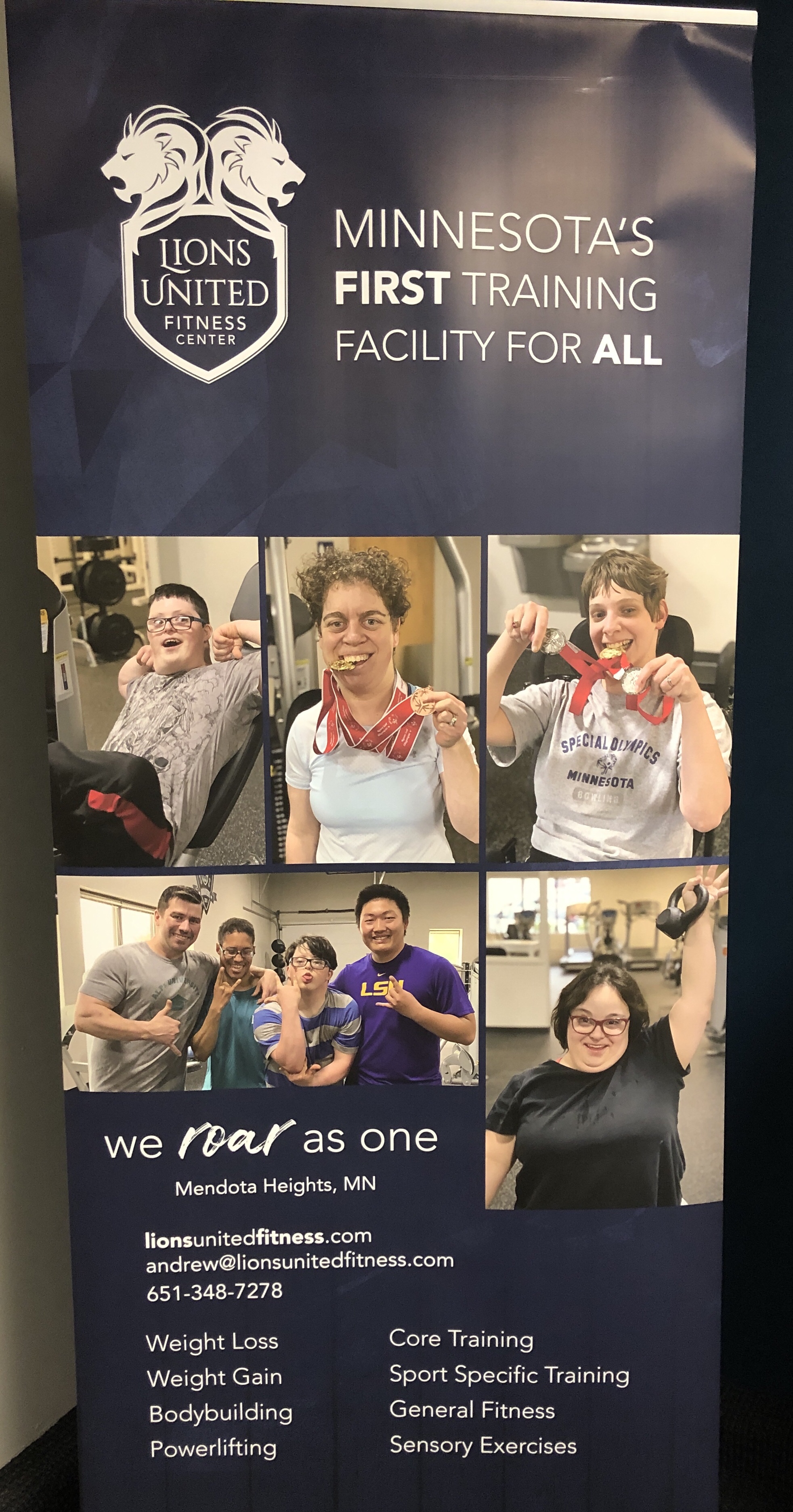
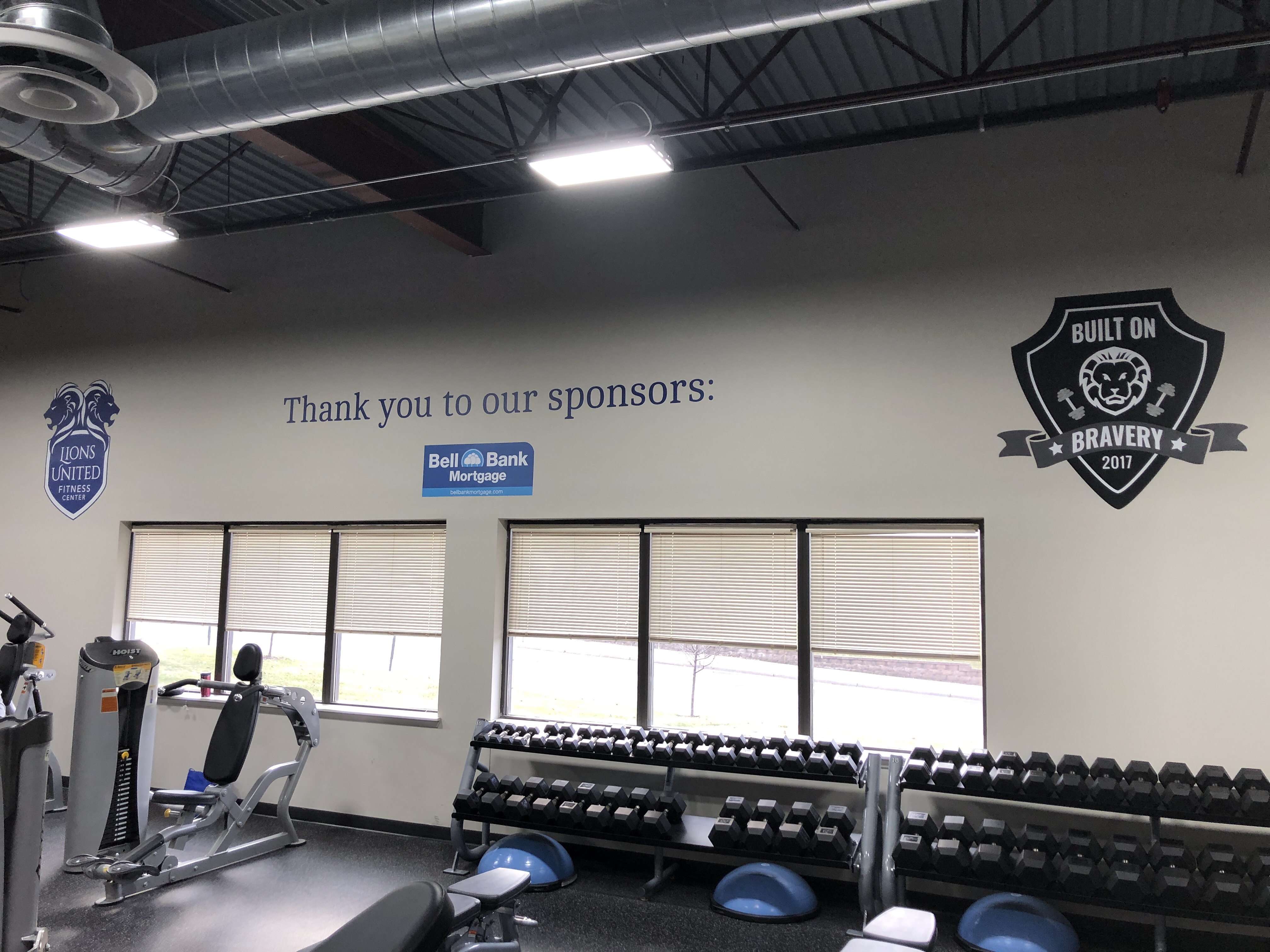
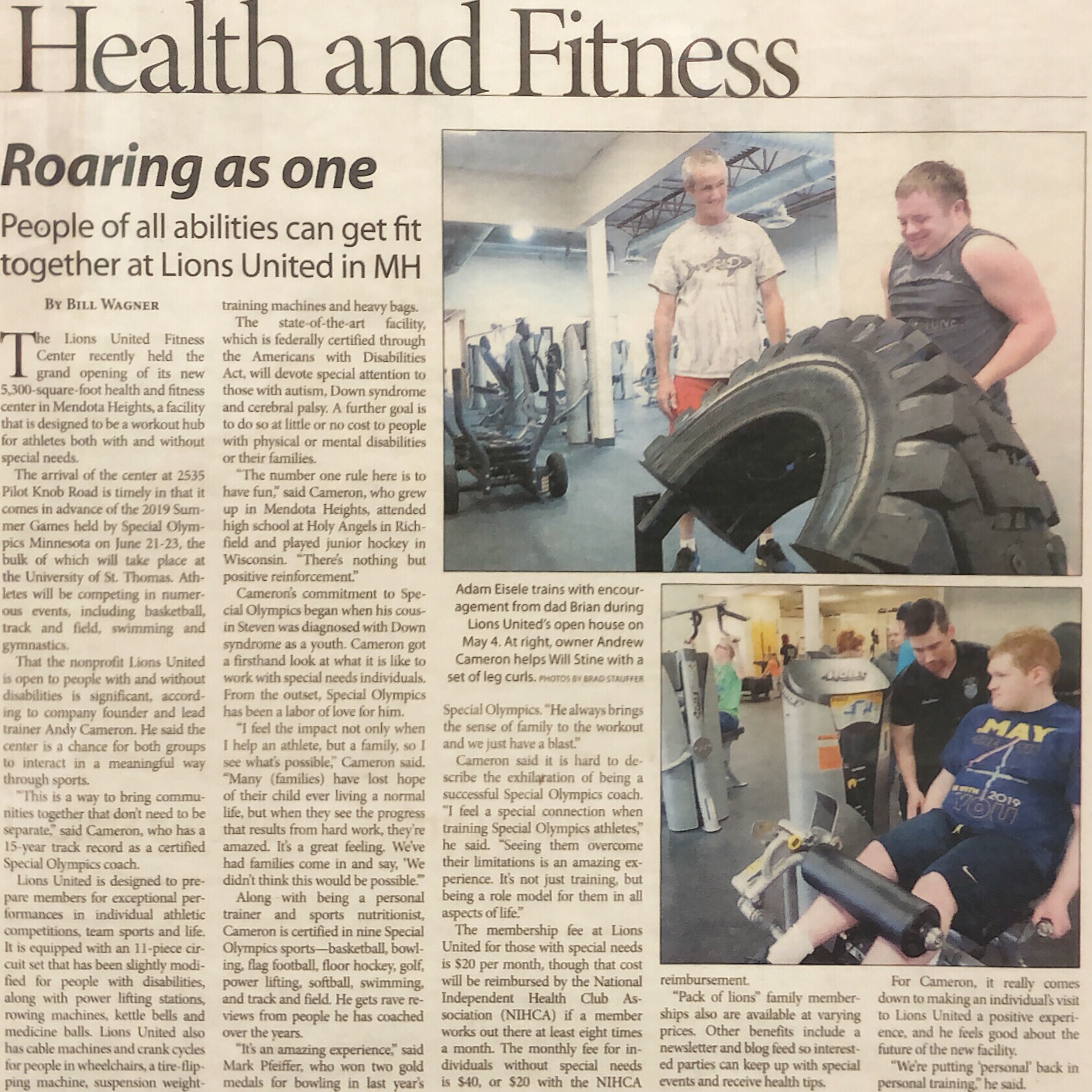
My #1 is doing their special Olympics strength training at Built on Bravery, located at the Mendota Height MN Lions United Fitness Center (map):
... Lions United is a new kind of training center, designed specifically to prepare people with disabilities for exceptional performance in individual competitions, team sports and life, especially people with autism, down syndrome and cerebral palsy. We’re dedicated to Special Olympics’ Project UNIFY and Unified Sports®, which means we bring people of all abilities together to strengthen individuals, relationships and communities....
This new facility is first in Minnesota to focus on persons with cognitive disabilities.
The Star Tribune did an interview with the founder:
Q: Membership fees and hours?
A: Twenty dollars a month for people with special needs; $40 a month for others. We’ll also have an incentive program where any member can receive up to $20 a month through their insurance. Staffed hours are Monday-Thursday, 3:30 p.m. to 10 p.m.; Friday 8 a.m. to 10 p.m.; Saturday and Sunday 8 a.m. to 6 p.m. But members will have 24-hour access.
I think there may also be family memberships.

There is a big unmet need for health and fitness support of special needs teens and adults. Diets are often worse than average and there are few welcoming places to go. (Several CrossFit gyms are welcoming, but that's a big climb. This facility has grant support.)

We need more like this!

Sunday, January 27, 2019

How did the story end?

I started writing this particular blog in September of 2004. At that time Explorer #1 was 7 and #2 was 5. They are adults now.

The early years before this blog are a blur now. I think by the time I started writing we had developed a reasonably effective approach and seen some progress. The years between 2000 and 2004 were harder.

We aged a lot in those years.

Now this blog is infrequently updated. That’s partly because of my related book project, partly because adult Explorer challenges are personal, and partly because the complex educational and financial (SSD, etc) challenges we deal with now are managed by my wife — and she doesn’t blog. We’re specialized that way.

So the story continues, but the blogging is less frequent. For the few that have followed this blog I feel like I should provide a summary of sorts. For those who are starting on a similar journey it might help to know one ending, then maybe go back through past posts and pick out things of value.

In general our Explorers have done well. They are both adults, for now both have guardianship status. We have, to date, for the moment, avoided the catastrophes parents of special needs children justly fear.

#1 has cognitive disabilities. Once he was an “explosive child”. Now he reads and even writes a bit, albeit largely on his phone. He has two part time jobs (no benefits) and he has longterm disability status and thus some potential security after our deaths. He’s been a reliable employee. His self-regulation and planning ability continue to improve. He loves his family. His diet could be better; it’s a typical non-college US diet (i.e. terrible). He needs more exercise. He remains a pretty good athlete for someone who rarely practices. 

#2 is on the classic autism “spectrum". He is in a post-secondary transition program and is a B/C student at our local community college (he’s fine with a C). Sadly he has shown zero interest in learning coding —  the one path I think could lead to his financial independence. He is usually delightful but struggles with novelty, travel, and changes in routine. He has screen time issues but works them. His self-regulation continues to improve. His work capacity is limited, but growing. His diet and exercise are better than the US average. He is kind, sweet, compassionate, and a typical middle sibling peacemaker. His great strength is persistence. He has a bad day, but the next day he tries again.

Were I to have read this in 2002 I think I’d have felt relief. The story doesn’t end until the narrator dies; it could all change at any time. But for now, well enough.

Thursday, August 25, 2016

Employment - not.

 
Two days ago, returning from a 1 week family holiday, he quit. Without notice.
 
He gave us no real warning, and, not atypically, disregarded our strenuous advice. In follow-up we hear he was doing the job well enough, his supervisor was surprised he quit. And annoyed he quit without notice.
 
#1 has had various explanations for why he left. I doubt he knows. The one he currently favors is that the work wasn’t interesting enough — he was doing grounds maintenance and he wanted to work with machinery.
 
In our own post-mortem we came up with 10 factors: 
  1. Social isolation, there was really nobody there he would be comfortable with, no other cognitively limited adults.
  2. There was no coaching, no support, no communication channels. It was an unsupported job.
  3. He had no concept of “giving notice”, wasn’t aware that was something one did.
  4. A special needs friend he admires spoke fondly of his (much less appealing, more difficult) job in food services at a sports center and advised #1 to apply.
  5. He was unhappy at not getting “time off for state fair”
  6. He was bored, the job wasn’t exciting any more, wanted to do more interesting things
  7. The holiday took him away from his routine. His memory is odd; after 3 days things seem less familiar. We needed to drive by his work on our return and anticipate reentry problems.
  8. The commute was hard and the novelty of going by bus had worn off.
  9. He has unrealistic work expectations (dream meme scam)
  10. He has a history of quitting sports teams after about 2-3 months, this fits a trend.

I think it all adds up to he got the job prematurely; he’s not ready for unsupervised and unsupported work. Maybe in 4-5 years he could do this work reliably and appreciate it, but he’s not there yet.

Now we have to twist his arm to get him back to his transition program (two years left). He now has no screen time at all before 5pm, so life at home is reading, bicycling, sleeping, and chores. That should make his screen heavy transition program time more appealing.

Monday, April 11, 2016

Hockey as a guide to behavioral interventions

#1 and I made our first trip to the yearly USA Hockey Disabled Hockey Festival, special hockey division.

Watching two of his hockey issues I realized they mapped well onto behavioral issues.

He’s a strong player, but very weak at passing. He also over-responds to aggression or even accidents, rapidly escalating. (Sometimes, to his credit, the emotional response is so strong he removes himself from play. Which isn’t a great response, but not the worst. Fortunately this is special hockey, a more forgiving place.)

I think both of these match onto more global issues.

Passing is cognitively hard and, unless one has skilled teammates, often unrewarding. Instead of scoring a goal, the puck goes to the opposing team. The only reason a strong player passes to a weaker player is because of social pressure and social rewards. Turn-taking type behavior in other words. #1 is weak at this kind of interaction; he doesn’t “feel” the social pressure.

Handling escalation is also tricky. #1’s sister can set him off with a look. (If she’s in a bad mood this works well to spread the feeling.) He is unable to respond with an equal or lesser action; in part because he mis-remembers the initial provocation. In his memory it is far bigger than it was; though in hockey the aggression is often flagrant*.

Both of these issues will factor into our summer behavioral program goals. Special hockey will give us a concrete way to manage progress. If he passes the puck, and returns an elbow with no more than an elbow, then we’ll have made real progress.

* Parenthetically, we have a bit of a referee problem in special hockey. If they come from regular hockey they overlook the routine illegal roughness that is hard for even neurotypical players to handle (fights!) and is well beyond what special hockey players can manage. Conversely, if they are used to less competitive special hockey they are unprepared to see elbows thrown and sticks slashed. It’s a hard job.

Friday, December 11, 2015

Special needs smartphone: draft sample sub-chapter on Google Nest Cam use

Early version …

….Some people with cognitive disabilities may be prone to impulsive anger, and may need monitoring when home with siblings but no parents. A teen with ADHD and autism may alleviate boredom by pestering a sibling. Head injury related to seizure activity could lead to extended unconsciousness. Kitchen hygiene neglect may be causing roommate or landlord problems.

These are all familiar problems for supporters of special needs teens and adults. In each case we’d like to be able to peek around the corner, even while we’re at work or simply away from home. We can do just that with a smartphone and some gear, we can even make warnings and ultimatums come out of thin air.

The gear is something like Google’s “Nest Cam”, formerly known as the DropCam. The Nest Cam is marketed as a home security device for $200 plus a $100/year fee for access of up to 10 days of stored video. At the moment it requires a WiFi network; Nest doesn’t sell a mobile cellular version.

For the situations mosts of us are dealing with we don’t need the stored video, we just need to be able to launch the Nest Cam app on our iPhone or Android and see what the camera shows. The Nest Cam has a speaker; the app lets us “speak” from the camera and see and hear responses. It’s not suited to conversation, but it works well for “Stop That!”. The smartphone software can be be used with multiple Nest Cams.

There are less expensive competitors, but the Nest Cam comes with excellent Android and iOS smartphone software and lifetime access to secure, reliable, on-demand streaming video backed by Google’s infrastructure. For our particular needs it’s the only solution worth looking at.

The Nest Cam has a single power USB power cord. It can be mounted on a wall, but most users will place it on a convenient shelf. It’s relatively easy to connect it to an encrypted home WiFi network. When you connect to a Nest Cam from a smartphone it begins streaming video to a secure Google server and from there to your phone. At that point you can see, and more importantly hear, what’s happening at the camera locale. Depending on what you’re seeing you may sign off, phone, or use the built-in speakers to deliver a suggestion.

The standard Nest Cam configuration turns a red light on when in use, but the light can be disabled. If the video-active light is disabled there’s no way to know if the video is streaming or not.

On demand notification-free monitoring has an ominous flavor. In practice, of course, it depends on the context. The average teenager does not want Mom or Dad doing secret observation, but if it keeps their older brother calm and well behaved around the XBOX many will welcome it. In some cases a special needs teen or adult will find the existence of the camera calming, so that in practice it is rarely used.

In other cases the camera may be masked and the video light will warn that an audio channel is opened. Then video may be enabled or not depending on the circumstances. In other circumstances video might be activated only if both text message and phone call go unanswered. There are many ways to use this technology wisely and to everyone’s mutual satisfaction….

My book to be: The special needs smartphone for independent living

I’m working on a book with a working title of Special Needs Smartphone. I don’t think that will be my final title, but it’s a good description. It’s a book I’m well placed to write; I have years of experience with two very different special needs smartphone users, I’m a geek, I’m used to writing, and I have the opportunity to do it. I’m not expecting to make money, but I do hope to make a positive difference. The book will cover both iOS and Android (that’s not easy, by the way :-).

I’m writing this book for parents and other supporters of teens and adults with a range of different minds. This includes teens and adults with IQs of 60-70 and limited reading skills, but it also includes normal IQ autism spectrum teens managing disabling preoccupations or aversions to some independent living skills. Some on the spectrum, for example, might find calendaring painful, have an aversion to lists and schedules, or be unfortunately prone to getting lost.

The goal of this work is to support independent living and mitigate harm that can come to a vulnerable population living with a tool of amazing, sometimes frightening, power and versatility.

I’m considering publishing options and a kickstarter campaign, but my default assumption is that I’ll self-publish through Amazon print-on-demand and self-fund. For the community I’m trying to reach I think a printed book is essential, eBook is secondary.

At some point in the next few weeks I’ll launch a domain and blog/tweet under my “true name” to promote the book and support readers. Until then I’ll have some posts here; I like blogging as a way to think about what I’m working on and some of these posts should be useful in themselves. You can get a feel for what’s coming by reviewing the Best You Can Be blog posts I’ve written on this topic over several years (Technology tag). One caveat — the book tone will be lighter and brighter than my usual somewhat dour style (I blame my Scots ancestry).

If you have ideas, advice, want to recommend a publisher or just want email notification of publication, please email me at jgordon@kateva.org or leave a comment below.

I’ll let you know how it goes.

Saturday, June 20, 2015

Lessons from 18 years of a "disruptive mood dysregulation disorder" child

Just back from a Mountain Bike outing with #1. We had a great time. Can’t be that that many special needs NICA mountain bike racers; it’s something he’s proud of. He’s already telling tall tales of his daring runs. Another happy memory.

It didn’t have to be happy though. I’d planned a 3 day trip — some biking, some hanging, some other stuff. Instead after biking on day one he said he wanted to go home. Of course I’d already paid for two nights of peak season lodging.

It’s not clear why he cut the trip short, but in retrospect 3 relatively unstructured days was a lot for him. To make that workable I’d have had to plan out all 3 days in detail, and get the schedule on his iPhone calendar. I think he was also missing his sibs, especially since #2 is leaving for a 1 week autism away camp. Our kids are close, glued by shared struggle.

So this was yet another test for Dad - I’d spent the money, and now he wanted to bail. Did I fight for the principal of “commitment” or fold?

I said it was a happy memory, so you can guess I folded. The money spent was a sunk cost. It didn’t matter any more.  Once I told him we’d head home his mood transformed and we had a happy dinner. The next morning he hung out while I went off on a bike adventure of my own. We had a fun drive home. Tonight he remembers the trip fondly. I passed the test.

Our drive home gave me time to reflect. #1 is 18 now, and he’s “finished” [1] High School. Overall we’re about where I’d hoped we would be with him. There’s lots to work on, but he keeps making progress. Maybe we all did something right, not least his coaches and teachers.

So what did we do right? I think I can put it into 6 short phrases, 5 of which are deliberately familiar.

  1. Choose your battles.
  2. Make happy memories.
  3. Accentuate the positive.
  4. Cut your losses.
  5. Tomorrow is another day.
  6. Quit when you’re ahead.
Yes, 5 of the 6 are clichés. I did that deliberately; I realized I could take my original language and turn it into something superficially banal. Read it and try to imagine that you’d never heard those words before.
 
Here are the same ideas in the same order, but with different language…
  1. Greenes/Explosive child: Divide behaviors into A (irreversible harm risk), B (criminal, reversible harm, C (infuriating, obnoxious). Always work on A, take B selectively, C is nice to do.
  2. Make happy memories. Memories are made of doing things. Declare victory early. Take pictures. Put ‘em on the family screens. Burn the happy memories into the kids brains. Soon they’re programmed into thinking life was all happy. They forget the rest…
  3. Kazdin and Shamu: Reward desired behavior, ignore (extinguish) unwanted.
  4. Realize when you’ve got a losing hand and fold. That’s what I did today. After a while you know when you can win and when it’s time to remember what a sunk cost is.
  5. It’s not a sprint, it’s an ultra-marathon. Don’t burn out in one battle, there will be time to engage with a winning hand.
  6. When you’re winning, declare and celebrate victory. Don’t wait to see things to the end, celebrate the moment. Do this right and you have a heck of a winning streak. In this season, we have the power to define when each game ends and a new one begins.
- fn -

[1] He’s actually in an indeterminate state, which is a weird arrangement peculiar to special needs students. He completed his adapted course work, but after the graduation ceremony he was diverted from picking up his diploma. This magically keeps him in the school system, so he’s funded for a “transition” program that’s supposed to teach “work schools”. We think of it as 3 years of somewhat useful entertainment while his frontal lobes develop. I assume this weird arrangement is a time honored manipulation of old statute language.

I may write more about High School (the sports teams were the best part) and “transition” in future. There’s a lot to say, most of it mixed.

See also

Saturday, November 22, 2014

Techniques for negotiation with people on the autism spectrum

Negotiation is a big part of parenting any child, but the toolkit varies.

We’ve used “Three Steps to Yes” (persuasion for geeks), Kazdin’s extinction/reinforcement, Greenes Explosive Child (above all) and more for working with #1. It’s made him a skilled negotiator, which isn’t a bad skill to have. For #3, so far, standard parenting tools suffice.

#2 is different — he’s classic Asperger [1]. He needs a different set of negotiating techniques — such as the set outlined in a recent NYT essay on Hostage Hoiidays. Another addition to the toolkit - I particularly liked the obviously-fake-but-genuinely-effortful apology, the focus on vocal inflection, the techniques of partitioning/minimizing and “Track II” / 3rd party interventions.

Special needs parenting is very educational.

[1] We have no useful terms for taking about these complex neurological disorders, but he resembles the original stories. Remarkably he was classically autistic as a young child, once upon a time we weren’t supposed to revise that early label. Lots of nonsense in our dying classifications…

See also

Saturday, December 21, 2013

"Explosive Child" Greenes has web site for "Disruptive Mood Dysregulation Disorder" kids and caregivers

#1 and I went snowboarding today. Which doesn't sound like much except that for him snowboarding has been more aspirational than real, and I'm a 50+ Dad.

I knew he needed me doing it with him, and what we both needed was bunny hill time. Not lessons, we did some of those years ago -- a borderline fail then. We needed sliding time in decent conditions.

Which we got. There were some anxieties of his I had to work around, some on the fly strategy invention, and of course I had to learn to snowboard (yay quick iPhone wikihow consultation) -- but we succeeded. Good runs on the greens for both of us. We stopped when he wanted to quit -- at a successful moment.

On the way home I thought of how far he's come since ages 3-7. Those were tough years, they left their marks on our faces. When I started this blog we were just emerging from the worst of it. By then we were experts in applying the lessons of Greene's "The Explosive Child", which I wrote about in 2007

It occurred to me that I ought to send Greene a thank you note. That led me to a relatively new site and organization of his, called Lives in the Balance. Nice to see the team working there. 

You can Tell Your Story | Lives in the Balance. I figured that would be one way to say thanks...

For our cognitively impaired multi-label son, ages 3 to 7 were hard. Very hard. I'm glad I don't remember them all that well; I do remember contemplating splitting the family so I could care for him away from his sibs.

We studied the Explosive Child intensively. It wasn't the only thing I studied -- operant conditioning with extinction of negative behaviors and rewards for positive behaviors was essential too.

Things started to get better around ages 7-9. We had more challenges, especially as he got older and stronger, but somehow his judgment developed just a bit ahead of his physical strength. The biting went away, the hitting went away...

He learned to read - at least to around 6th grade level. He learned many other things too -- hockey, swimming, snowboarding, biking, mountain biking, baseball, wrestling (ugh), xc skiing... Many more.

He's almost 17 now. Who knows what lies ahead. Things could go south at any time, but that's true for any of us.

He's come a long way.

The Explosive Child was the most important book we ever read ...

PS. Visiting the site I learned the "Explosive Child" has a new DSM-5 label: Disruptive Mood Dysregulation Disorder - replaces the misused 'bipolar disorder' for kids like #1. There's a comic outlining the evolution of the label, which is as good and as bad as any of 'em .... "PIA", Conduct Disorder, Oppositional Defiant Disorder, Intermittent Explosive Disorder, Pediatric Bipolar Disorder, Disruptive Mood Dysregulation Disorder.

Saturday, October 05, 2013

ADHD, CDD, and Related Conditions - what I wrote in 2002 holds up pretty well today

I started this blog in 2004, Best You Can Be, when #2 (Asperger) was 5 and #1 was 7. Since that time I've written about my thoughts on the nature of brain disorders and the limits of our medical classifications -- among other topics.

Today I rediscovered one of my last pre-blog classic personal web pages -- it was largely written in 2002 and when #2 was not-quite diagnosed and we were getting our heads around how to work with a 5 year old #1. In some ways the hardest times (to date!) were behind us -- but I'd had time to think about the nature of cognitive disorders and disability. I put some of those thoughts into a web article called ADHD, CDD, and Related Conditions.

Rereading it today it holds up pretty well -- I did a good job anticipating the next decade of evolving thinking about classifications and the nature of disability. If you're thinking of ADHD or similar disorders, it might be worth a scan even now.

Sunday, March 17, 2013

Adolescent special needs: Sometimes Judo works

#1 was on track to give up on mainstream hockey halfway through the season. I'd been using carrot and (proverbial) stick but he was dug in and sullen. It looked like he was going to lose one of his best growth and happiness sources, that he was going to drop out of hockey just as he'd dropped out of baseball last summer.

I was frustrated, but I could see I wasn't going to win. Better to lose this battle than to lose our relationship.

So when he challenged me to bribe him to finish the season I pulled a Judo move. I stepped back.

I sat down with him at a time I chose -- when he was at his best. I said that now that he was almost an adult, he really had to make his own decisions. I told him I thought he'd gain a lot from continuing and that it would make me happy, but it was his decision. There'd be no prize or reward for finishing the season -- just his usual post-hockey chips or soda. There would be no punishment for dropping out ...

Well ... I cheated a bit on the last. I didn't want him substituting iPhone-zombie-time for his hockey. So there'd be no computer/iPhone use during times he would have been at hockey. He could read or do other activities [1].

Of course, as you can guess from the post title, it worked. At first he was uncertain, but one night we walked through the season schedule. He picked one late night practice he'd skip and one he'd miss due to a High School sports conflict. (He ended up missing only one practice when I was out of town and we couldn't bring him.) After that review he was relaxed and enthusiastic.

I don't know if it was my talk that worked, or the support of his coaches who also had Special Hockey experience, or if a girl he liked said something nice about his hockey. At his age I'm only one of a lot of influences, and probably not the biggest one.

I was surprised that he did so well; I don't think this would have worked in the past. His mind is developing -- he's starting to have more of a sense of time and of future events, and he's starting to work with abstractions like "promises" and "obligations" and "duty" and "honesty". He never used to respond to 'negative' feedback [2], but now he seems to consider consequences a wee bit beyond the immediate.

I don't want to overstate the changes. A bird in the hand is still worth a thousand in the bush. There is progress though, and reason to celebrate another victory. [3].

- fn -

[1] We have very limited household television access.
[2] Hence our heavy use of positive incentives and extinction rather than the balanced approaches that work for most children. We have a neurotypical daughter, and she essentially raised herself with a minuscule parental contribution. Our #2 is at the Asperger's end of the spectrum but is super-sensitive to feedback. #1 is different. Yes, we snort milk out our noses when we read conventional parenting books. 
[3] Our philosophy is to celebrate victory often. So every time we can plausibly declare victory, we do. There should be a name for this philosophy; it results in a lifelong string of repeated victories until the game is called.

See also 

Friday, August 24, 2012

Special needs adolescence: enter the unknown country.

To us raising a healthy neurotypical child seems almost absurdly easy. Send them to school, try to avoid major injuries, apply some basic behavioral modification measures, don't do bad things, have fun. It seems more of a hobby than a job.

Except then comes adolescence. Sometimes it's fairly quiet, sometimes it's hell -- even for a neurotypical child. Parenting starts over as the human brain goes through a painful and problematic reboot. Considering what we have learned about the extent of brain remodeling during adolescence, it's astounding that the young male can function at all. It's not surprising that things can go badly.

Special needs adolescence, is, of course, even more complex. It is truly an unknown country; unexplored and unmapped. In special needs adolescence brain remodeling is running against a background of dysfunction and compensation. Even more than neurotypical adolescence, it would be surprising if it went well.

In our case #1 does not disappoint. He is complex and challenging. Our mission therefore is to get through this with an intact family, no jail time, and have him positioned to resume life.

It may be helpful (or discouraging) to share part of his story - at least in the abstract. Imagine, to begin with, a mixture of behaviors from ages 3 to 15. A taste for both stuffed animals and educational web sites (I've learned a lot.) Imagine previous disabilities, but now with new features. So anxiety and irritability ("Explosiveness") remain - but now there are features of obsessive-compulsive disorder. Compulsions and obsessions not only with airport schedules and soccer teams, but also with unearned acquisition and icons of lost childhood. Now add confusions in sexual identity. Next add a growing and well deserved fury at newly recognized limits for independent life, for education, for sexual expression and partnership. Did I mention integration of an exceptionally difficult adoption narrative?

Yes, complex and challenging. Travel, for one, is far more difficult. Just as we would want him to be more independent, he requires even more monitoring. Alas, his guile and stealth belie his measured IQ; our monitoring is not always successful.

It could be worse of course. He's not a threat to himself or others. He's not hitting or biting. He's reasonably good to his siblings and kind to animals. He can still be charming. Alas, going by past experience, things will get worse before they get better.

So, somewhat creakily, we pivot. (Our pivoting doesn't get easier as we wear out.)

Now we need to learn about behavioral management for OCD. Now we need to meet with his psychiatrist and review medications. Perhaps we will need to decrease stimulant use, and consider SSRIs (though he did poorly on them as a younger child). We may ask his therapist to consider family rather than individual therapy, especially since he now likes to engage his younger brother as an advisor and "lawyer" in matters of family discipline.

We can expect some confusion from our consultants; #1 is usually a bit out of their playbook. As always, we will have to come up with our own program, based on bits and pieces from books and experienced therapists and our own experience and judgment.

We will have to map the unknown country as we visit it.

Saturday, July 28, 2012

GPS tracking for an impulse-control teen

We'd like #1 to travel further afield on his own, but we have reason to distrust his judgment. So we'd like to be able to track him.

At one time I thought we'd be able to use a smartphone tracking device, but the same judgment issues that limit his independence mean data plans are also problematic. I don't know of any smartphone that would support gps tracking and robust data access controls.

So now we're looking into dedicated gps tracking devices. The market for these devices tends to be prisoners, demented persons, children of anxious or wealthy parents, special needs kids, dogs and high value goods. So a bit of a niche marke. The devices typically need some sort of data plan; the real costs are the data plan costs. I don't know of any devices that work with, say, Google Latitude.

I'm unimpressed with marketed items like the Amber Alert GPS Armor and the Spark nano 3.0 GPS tracker The dog GPS trackers are a little more interesting, such as:

Using "Tagg" and "Garmin" as keywords I was able to find some relatively interesting discussions (the baseline Google results were SEO-scam infested).

My overall impression was there's nothing good on the market at the moment. The Tagg device is probably the least bad.

So now I have to consider plan B again -- is there a way I can make his iPhone work ...

Update 6/2014U.S. Will Finance Devices to Track Children With Autism (1/2014). Justice department, I don’t know if this is in place federally. Since I wrote this article in 2012 Find My Phone has become much more secure, so a minimal data plan with Find My Phone would work on iPhone. 

More significantly, there’s an entire site dedicated to wandering management in autism. Look there!

Monday, September 05, 2011

Guanfacine (Tenex) and working memory

#1 takes both Ritalin and Guanfacine (Tenex and other trade names) - longterm. So I track research on both meds.

Ritalin is as well understood as any brain med. As best we can tell it's unreasonably safe and effective for ADHD, despite a trashy article in a pop science magazine.

Guanfacine, a second line med for ADHD also used (off label) for "explosive" kids, is much less studied than Ritalin. The proposed mechanisms of action are interesting, it seems to increase certain kinds of neuronal connections and to perhaps facilitate learning capabilities.

On the one hand, this is encouraging. Working memory deficits are a significant component of most developmental disorders of the brain. On the other, it's disturbing. When clinicians hear "increased cellular activity" in brains we think "cancer" and "seizure".

Fortunately, so far, there's no sign of that (though we're in early days). There is, however, continued research on Guanfacine's effect on working memory and task performance in primates. Studies have recently moved to using elderly primates, but results are mixed. As best I can tell from the abstract, this was a negative result (A typical child dose of Guanfacine would be .04 mg/kg) ...

Effects of the alpha-2 adrenoceptor agonist g... [Eur J Neurosci. 2011] - PubMed - NCBI

Alpha-2 adrenergic receptors are potential targets for ameliorating cognitive deficits associated with aging as well as certain pathologies such as attention deficit disorder, schizophrenia and Parkinson's disease. Although the alpha-2 agonist guanfacine has been reported to improve working memory in aged primates, it has been difficult to assess the extent to which these improvements may be related to drug effects on attention and/or memory processes involved in task performance. The present study investigated effects of guanfacine on specific attention and memory tasks in aged monkeys.

Four Rhesus monkeys (18-21 years old) performed a sustained attention (continuous performance) task and spatial working memory task (self-ordered spatial search) that has minimal demands on attention. Effects of a low (0.0015 mg/kg) and high (0.5 mg/kg) dose of gunafacine were examined. Low-dose guanfacine improved performance on the attention task [i.e. decreased omission errors by 50.8 ± 4.3% (P = 0.001) without an effect on commission errors] but failed to improve performance on the spatial working memory task. The high dose of guanfacine had no effects on either task. Guanfacine may have a preferential effect on some aspects of attention in normal aged monkeys and in doing so may also improve performance on other tasks, including some working memory tasks that have relatively high attention demands.

The doses are interesting here -- much lower than a human therapeutic dose and much higher. They were also looking at a one time dose effect. This reads like a mini-pub as a research team gears up for the real research. It's a modest investigation, and they basically didn't find anything. (Give the cost and ethics of primate experimentation one assumes there's much more to come.)

So the results are pretty meaningless. What's interesting is that the research is gearing up.

We should learn a lot more about the risks and benefits of Guanfacine over the next five years. For now I'm comfortable with our son's use of this medication.

Friday, May 06, 2011

Adolescent computing and OS X Parental Controls - training wheels

My 14 yo's computer skills have continued to be a real strength. Of course, being both 14 and having disabilities in executive function, he does not always use them wisely.

Years ago I hoped the iPhone and other iOS devices would provide app-restricted services while limiting web access. Sadly, I've been disappointed by Apple's deceptive iOS "parental controls" [1]. That didn't work very well. On the other hand, monitoring his computer use and punishing misuse isn't working that well either. We can't be looking over his shoulder everywhere -- such as in his school room.

So now I'm trying Plan B, an educational program of trial and reward based on techniques that have worked before.

I've set up an account on a machine using OS X Parental Controls [2]. I've whitelisted a number of sites he's interested in, including bing.com [3]. I give him 10 minutes every day to use the machine without me watching. When he's done we review his history and log files together (in Parental Control mode history files can't be wiped -- he learned that trick at school).

If he's used the computer responsibly, he gets some reward tokens. If he hasn't he doesn't get any and I make the whitelist more restrictive. Since I'm trying to extinguish the bad behavior I keep things dull.

He's keen on this, and so far he's doing well. My plan is to keep broadening the list and reducing the parental controls, rewarding self-control over time.

I'm sure it won't fully succeed, but at the very least I'm hoping he'll learn some discretion. If he can think for a second before acting, he may avoid a lot of trouble.

[1] I'm trying various channels to get Apple to improve, including contacting legislators and this email to Consumer Reports ...

I'm writing to ask you to include 'parental control' functions in yuor next evaluation of smartphones.

We've been very disappointed in the parental controls Apple provides; in some ways they're worse than nothing. It seems we can limit web access by disabling Safari, but many, many apps contain embedded browsers. Once a child has access to an embedded browser, they can usually find their way to a Google search and abundant porn.

Embedded browsers are found in encyclopedias, MLB (major league baseball), reference works, educational materials, and many others.

The fix is simple. Apple needs to provide a parental control that restricts embedded browsers. Until they do, iPhone parental controls are a deceptive fake.

If you include parental control functions in your evaluations, Apple and other vendors will pay attention.

[2] They're mediocre at best, but they're (barely) enough for this experiment. See updated documentation below.
[3] Though Bing's parental controls are even worse than Google's he's less familiar with Bing so he doesn't dodge them as readily.

Update 5/29/11: This is working better than I'd hoped. The huge advantage of Bing.com over Google.com is that Bing doesn't use https. So OS X Parental Controls show a meaningful history of sites visited. I'm going to explicitly block Google.com but permit Bing.com.

Update 6/12/11: History files cannot be wiped in the most strict form of parental controls. In the "automatic detection" mode they can be wiped. See Gordon's Tech: OS X Parental Controls Review - State of the art in OS X 10.5 and 10.6.

Monday, February 07, 2011

The expectations trap

Four months ago we learned lessons from two family bicycle outings. One was an educational failure. The follow-up was a memorable success.

No denying, I was proud of that one. I wouldn't have thought it possible just three years before. If we weren't willing to risk failure, we wouldn't established a new baseline.

That's why I was willing to try another crazy idea. This time we tried a mass nordic ski event after dark in unfamiliar territory. This went well beyond last year's Nordic ski resort.

We applied what we'd learned. We studied satellite maps of the ski route and the surrounding territory, developing and revising our primary and backup plans. We researched parking in detail. We took a car and drove the route at night -- that's how we learned event map's major parking area was now a massive hole in the ground. We adjusted our plans accordingly. I took both our special needs guys with me on the event day to collect our race bibs -- so they could see the parking and starting area in daylight.

We left early on event day, which meant we got the prime parking garage rather than our fallback option. At the event we adjusted plans; one of our guys needed to race, so we aborted a rendezvous and left ten minutes early.

It was easy. The only glitch was a bit of overheating while fussing with race bibs indoors. I expected to need more of our contingency plans. As it was, I had only to track the son who's prone to getting lost. His brother with the oddball savant visual abilities raced far ahead, and, as expected, materialized from darkness whenever we reached a stopping area.

It was easy, but maybe it was too easy. Now I need to wonder if I've fallen into an expectations trap.

The expectations trap is what happens around 9th grade in most schools. Instead of the slow, tedious, work of developing reading and other academic skills, teaching focuses on "social skills". These can be fun for all involved, but for some it's too easy. They could do better. The expectations trap is inside the comfort zone; it closes options too soon.

I think I need to move my expectations up.


Tuesday, December 28, 2010

Victory: The war against 20th century psychiatric diagnoses is all but won

I started rabble rousing about the fallacies of psychiatric classifications (diagnoses, nosologies) about eight years ago. Five years ago I went public, since that time I've labeled 29 posts as "diagnostic definition" related [1] including my most recent rant...

... We're due for another DSM edition, but I doubt that will be any better.

The good news is that in the last 8 years it's become clear to every researcher that all of the common neurospychiatric conditions, from "ADHD" to "ODD" to "Autism" to "Aspergers" to "Bipolar disorder" to "Schizophrenia" are very rough categorizations of thousands of different "phenotypes" (where a phenotype is the end-result of the interaction between genes and environment) that are themselves dynamic over the lifetime of the brain. (Even after adolescence, we see major changes in schizophrenic symptoms between 20 and 50.

Over the last 3 years we've seen that many different combinations of diverse gene variants, combinations, "malfunctions" and prenatal genetic express modification can produce superficially similar clinical presentations that we squeeze into the garbage bins of "mental retardation", schizophrenia, and "autism spectrum disorder". Most surprisingly, many brains with extraordinary genetic disorders appear normal.

This classification problem isn't simply an annoyance for researchers and industrial ontologists. It has important legal, educational, financial and, yes, clinical implications. The legal, educational and financial implications are large but outside the scope of this post. Suffice to say there is a reason that the diagnosis of "autism" has exploded while the diagnosis of "mental retardation/DCD" has shrunk (clinically speaking both diagnoses are about equally useless)...

I think I can stop now. When Scientific American starts to talk about the problems with our current classifications of mind and brain disorders the war is over (emphases mine) ...

...  In a recent article in the American Journal of Psychiatry, a Swedish team of researchers led by Paul Lichtenstein studied 7,982 twin pairs. They found a heritability of 80% for autism spectrum disorders, but also found substantial sharing of genetic risk factors among autism, attention deficit hyperactivity disorder, developmental coordination disorder, tic disorders, and learning disorders.

In another recent article in the American Journal of Psychiatry, Marina Bornovalova and her University of Minnesota colleagues studied 1,069 pairs of 11-year-old twins and their biological parents. They found that parent-child resemblance was accounted for by shared genetic risk factors: in parents, they gave rise to conduct disorder, adult antisocial behavior, alcohol dependence, and drug dependence; in the 11-year-olds these shared factors were manifest as attention deficit hyperactivity disorder, conduct disorder, and oppositional-defiant disorder. (Strikingly, attention deficit disorder co-occurs in both the autism spectrum cluster and disruptive disorder cluster.)

... , DSM disorders do not breed true. What is transmitted across generations is not discrete DSM categories but, perhaps, complex patterns of risk that may manifest as one or more DSM disorders within a related cluster. Second, instead of long-term stability, symptom patterns often change over the life course, producing not only multiple co-occurring diagnoses but also different diagnoses at different times of life.

Please read the above excerpt. I tear up looking at it.

This is progress! This is what Osler did for medicine in around 1900 when he tore down the outworn and deceptive strictures of 19th century medicine. He had to throw out the old ideas to move medicine forward. At long, long, last psychiatry, and neurology, are ready to be refactored.

The battle may rage for years, but the war is done. It's just mopping up now.

Now we can move forward.

[1] Greene's Explosive Child, by the way, led the way in 2005 by setting aside non-useful ICD-9 and DSM classifications in favor of a label that tied symptoms to effective management.