Some drugs, like acetominophen (tylenol), are considered "safe" when they are fundamentally quite toxic.
Others, like Ritalin, are properly regarded with great suspicion. How can such a powerful medication be safe for decades of use in a developing brain?
Surprisingly, the literature is reassuring. I can now add some informal updates courtesy of a family member who does NIH funded research in this domain. The research community has long expected ritalin to have some deleterious effect on neuronal proliferation, but recently concluded studies, and those still in progress, will likely show (again) surprisingly negative results. Probably Ritalin has some effect on brain development, but the effect size is small.
Hard to believe really, but it does affirm my prejudice in favor of this well aged medication. Given Ritalin's safety record, it would take a lot to make me shift to another medication of the same or similar class.
Friday, August 25, 2006


Wednesday, August 09, 2006
MN Special Hockey registration for 2006-2007 is now open!
The Minnesota Special Hockey is preparing for Season II. We're recruiting skaters, and would-be skaters, with developmental disabilities living in the Twin Cities area.
Please spread the word. The registration deadline is 10/16/06.
Please spread the word. The registration deadline is 10/16/06.
Tuesday, August 08, 2006
Ultrasound, neuronal migration, and autism
Autism is thought to be a disorder of neuronal migration with a genetic and intrauterine environmental etiology. Although it is not clear that the overall prevalence of childhood cognitive disorders has substantially increased, the diagnosis of autism is made far more frequently than in years past. This may represent a change in how we conceptualize cognitive disorders of childhood, or it may reflect a true change in disease pattern and/or frequency.
There is strong evidence for a polygenic predisposition to autism; a collection of genetic traits that favor neuronal migration disorders. The evidence is fairly strong that this is not related to mercury levels, thimerasol preservatives, or immunization practices. What else can one look for in the environment? What has changed in the past 20 years? The list is very long, which is why this study is mildly interesting (emphases and annotation mine):
When I was doing obstetrical care, I and the thoughtful colleagues I worked with shared a common suspicion of the complete safety of ultrasound. There have always been small studies in animals suggesting worrisome effects, but it was absolutely clear that for any significant concern in pregancy ultrasound was indicated. I was less convinced of the case for routine dating ultrasounds, but I also recognized that there was no way we were going to avoid those given current practice and litigation risks. I was, and am, very opposed to recreational ultrasound. I knew enough of the history of medicine to worry about "perfectly safe" interventions.
Which is all to say that I'm predisposed to find this study interesting, and I may be giving it undeserved attention. We can expect it to be well investigated.
I suspect if there is an effect in humans, it may turn out to only be true for a genetically vulnerable fetus exposed at a very critical time for unusually long ultrasounds. I would also wonder if rather than creating a new cognitive disorder it biases the nature of neuronal migration dysfunction in the direction of autism rather than some other cognitive disorder pattern.
This study should discourage recreational ultrasound use. I would also be very slighly more reluctant to use ultrasound on a mother with a strong family history of autism or with a personal history of autism.
Update 9/7/06: There's a weird sequelae to this story.
There is strong evidence for a polygenic predisposition to autism; a collection of genetic traits that favor neuronal migration disorders. The evidence is fairly strong that this is not related to mercury levels, thimerasol preservatives, or immunization practices. What else can one look for in the environment? What has changed in the past 20 years? The list is very long, which is why this study is mildly interesting (emphases and annotation mine):
Ultrasound Affects Embryonic Mouse Brain DevelopmentSo mouse exposed to proportionately very long periods of ultrasound have some changes to neuronal migration, but it's unclear if there are any behavioral effects. It would be very interesting to repeat these studies in a mouse population that's genetically predisposed to develop "murine autism".
.... The prolonged and frequent use of ultrasound on pregnant mice causes brain abnormalities in the developing mouse fetus, Yale School of Medicine researchers report August 7 in the Proceedings of the National Academy of Sciences.
'Proper migration of neurons during development is essential for normal development of the cerebral cortex and its function,' said Pasko Rakic, M.D., chair of the Department of Neurobiology and senior author of the study. 'We have observed that a small but significant number of neurons in the mouse embryonic brain do not migrate to their proper positions in the cerebral cortex following prolonged and frequent exposure to ultrasound.'
Neurons in mammals multiply early in fetal development and then migrate to their final destinations following an inside-to-outside sequence. The destination defines the neurons' connectivity and function. It has been reported earlier by others that abnormal cortical function may result when this process is grossly altered by genetic or environmental factors such as alcohol and drugs.
The study reported on August 7 is believed to be the first to look at the possible effect of ultrasound waves (USW) on neuronal migration in mice at a late stage of embryonic brain development, when the migratory pathways are the longest and may be most vulnerable. The Yale team injected more than 335 fetal mice at embryonic day 16 with special markers to track neuronal development. Exposure to USW for 30 minutes or longer [jf: adjusting for mouse lifespans and gestation, this would be hours to days in a human] caused a small but statistically significant number of neurons to remain scattered within inappropriate cortical layers and/or in the adjacent white matter.
'The magnitude of dispersion of labeled neurons was highly variable but increased with duration of exposure to ultrasound waves,' Rakic said. 'These findings suggested the desirability of further work in this area. We do not have any evidence ourselves that USW cause behavioral effects in mice or have any effect on the developing human brain.'
When I was doing obstetrical care, I and the thoughtful colleagues I worked with shared a common suspicion of the complete safety of ultrasound. There have always been small studies in animals suggesting worrisome effects, but it was absolutely clear that for any significant concern in pregancy ultrasound was indicated. I was less convinced of the case for routine dating ultrasounds, but I also recognized that there was no way we were going to avoid those given current practice and litigation risks. I was, and am, very opposed to recreational ultrasound. I knew enough of the history of medicine to worry about "perfectly safe" interventions.
Which is all to say that I'm predisposed to find this study interesting, and I may be giving it undeserved attention. We can expect it to be well investigated.
I suspect if there is an effect in humans, it may turn out to only be true for a genetically vulnerable fetus exposed at a very critical time for unusually long ultrasounds. I would also wonder if rather than creating a new cognitive disorder it biases the nature of neuronal migration dysfunction in the direction of autism rather than some other cognitive disorder pattern.
This study should discourage recreational ultrasound use. I would also be very slighly more reluctant to use ultrasound on a mother with a strong family history of autism or with a personal history of autism.
Update 9/7/06: There's a weird sequelae to this story.
Monday, July 24, 2006
Autism and compensatory reasoning by imagery
[Via FMH]
Many, but not all, of persons with the label 'autism spectrum disorder' do a great deal of visual reasoning. Temple Grandin in particular has written about her own way of problem solving. It's widely assumed that the brain is 'routing around problems' by repurposing visual subsystems to solve language and reasoning problems. The adaptive brain does some things better than conventional brains, and some things less well.
A recent neuroimaging study fills out this picture:
Many, but not all, of persons with the label 'autism spectrum disorder' do a great deal of visual reasoning. Temple Grandin in particular has written about her own way of problem solving. It's widely assumed that the brain is 'routing around problems' by repurposing visual subsystems to solve language and reasoning problems. The adaptive brain does some things better than conventional brains, and some things less well.
A recent neuroimaging study fills out this picture:
New Scientist Breaking News - How people with autism miss the big pictureI'd like some evidence based recommendations on how to teach reading to someone who problem solves with the parietal cortex ...
Brains scans of people with the condition show that they place excessive reliance on the parietal cortex, which analyses images, even when interpreting sentences free of any imagery. In other people, the image centre appears to be active only when the sentences contain imagery.
The results agree with anecdotal reports that people with autism are fixated on imagery but struggle to interpret words and language. They frequently excel at recording visual detail, but overlook the bigger picture and the context that comes with it.
Researchers led by Marcel Just of Carnegie Mellon University in Pittsburgh, Pennsylvania, scanned volunteers' brains while they were deciding if certain statements were true or false. Some of the statements relied on analysis of language alone, while others could only be understood by considering the imagery they conjured up. "The number 8, when rotated 90 degrees, looks like a pair of spectacles", for instance, needs both arithmetic interpretation and visualisation of the rotated number.
Just says that the observed over-reliance on the parietal cortex might have arisen to compensate for poor brain connections to the prefrontal cortex, which interprets language (Brain, DOI: 10.1093/brain/awll64)...
Saturday, July 22, 2006
Create a lightweight screen reader in OS X
[This is a complete rewrite of my original post, because the initial post was misguided.]
Once upon a time if you wanted a reading aide for a child with learning disabilities you could invest hundreds of dollars in complex applications that were slow, quirky, unreliable, hard to use, and difficult to integrate into real world behaviors.
Now, if you have a Mac that can run OS X 10.3 or later, you can create a de facto reading aide that's available everywhere, from your web browser to your word processor to your PDF viewer (Preview or Acrobat). It works the same way in all of these applications -- highlight the text, type a shortcut, hear the word. (Children with motor disabilities can use OS X accessibility features to help with shortcut key use.)
You say you'd never heard of this? Well, it's not advertised. Even I (geek, special needs parent, etc) hadn't put the pieces together until now -- despite having played with this once. It turns out to be easy to do if you know the path to follow.
First, you must avoid the misleading alternative paths. OS X Tiger (10.4) includes screen reader services for visually impaired persons (VoiceOver). It's not appropriate as a reading aide however, it's too complex and designed for a very different function. Alternatively the 'services' options available for modern OS X applications (Cocoa based) includes an obscure command to read highlighted text, however the user interface is extremely awkward, shortcut key assignment is buggy in 10.3, and it doesn't work in Firefox (not Cocoa), Acrobat or Microsoft Word.
What you need to do is enable text-to-speech; it's disabled by default.
 You can read the directions in the above link, or follow along here. Go to the System Preferences and look for the Speech icon (see below if this is grayed out). Click on it.
 [This is from Tiger, OS X 10.4. The layout in 10.3 is a bit different but it works just as well.]
You'll probably see the Speech Recognition tab, but click on Text to Speech. The only one you want is 'Speak selected text when the key is pressed'. You'll be asked for a shortcut key.
 I typed Option-S to get this. So far it works, though it's so simple there's a risk I might have change it.
Double key combinations are less likely to have conflicts, but they (Option-Control-S for example) are harder for some children to type. I may put a special mark on the option button as well as it's easy for the child to type Cmd-S (save menu) instead. If I change the shortcut combination I'll update this post.
Now if a child or adult is reading and finds a word he or she can't read the sequence is:
PS. You can't select this preference, it is grayed out: If the preference is not available then this user has a 'managed account' and their privileges have been restricted. Annoyingly, even 10.4 does not allow one to enter an Admin username and password and get access to the preferences. You have to logout of the user account, login as an Admin, escalate user privileges, login to the user account, make the changes, logout from the user account, switch to Admin, and restrict user privileges again. I assume 10.5 will fix this ...
Update 7/31: There's definitely a bug with this functionality. I thought it was OS X 10.3 specific, but it happens with 10.4 too. I think it happens more often with slower machines. The OS seems to "miss" the keystroke. My son has learned to hold the option key and tap the S several times until the word is spoken. After the first trial it works better. The 10.4 "voices" are better than 10.3.
Once upon a time if you wanted a reading aide for a child with learning disabilities you could invest hundreds of dollars in complex applications that were slow, quirky, unreliable, hard to use, and difficult to integrate into real world behaviors.
Now, if you have a Mac that can run OS X 10.3 or later, you can create a de facto reading aide that's available everywhere, from your web browser to your word processor to your PDF viewer (Preview or Acrobat). It works the same way in all of these applications -- highlight the text, type a shortcut, hear the word. (Children with motor disabilities can use OS X accessibility features to help with shortcut key use.)
You say you'd never heard of this? Well, it's not advertised. Even I (geek, special needs parent, etc) hadn't put the pieces together until now -- despite having played with this once. It turns out to be easy to do if you know the path to follow.
First, you must avoid the misleading alternative paths. OS X Tiger (10.4) includes screen reader services for visually impaired persons (VoiceOver). It's not appropriate as a reading aide however, it's too complex and designed for a very different function. Alternatively the 'services' options available for modern OS X applications (Cocoa based) includes an obscure command to read highlighted text, however the user interface is extremely awkward, shortcut key assignment is buggy in 10.3, and it doesn't work in Firefox (not Cocoa), Acrobat or Microsoft Word.
What you need to do is enable text-to-speech; it's disabled by default.
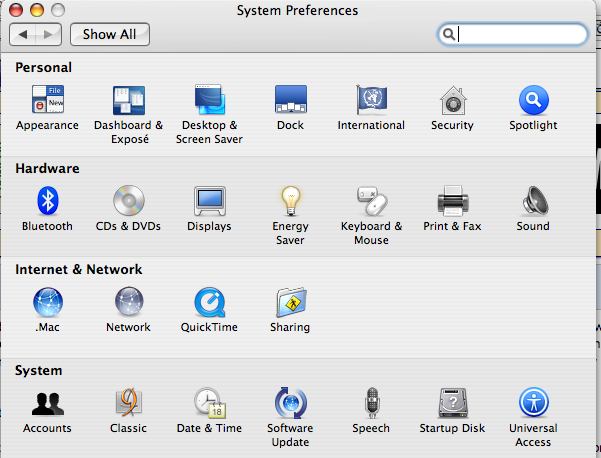 You can read the directions in the above link, or follow along here. Go to the System Preferences and look for the Speech icon (see below if this is grayed out). Click on it.
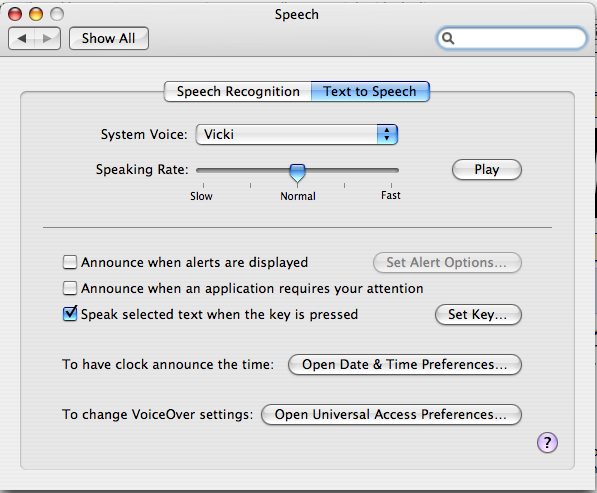 [This is from Tiger, OS X 10.4. The layout in 10.3 is a bit different but it works just as well.]
You'll probably see the Speech Recognition tab, but click on Text to Speech. The only one you want is 'Speak selected text when the key is pressed'. You'll be asked for a shortcut key.
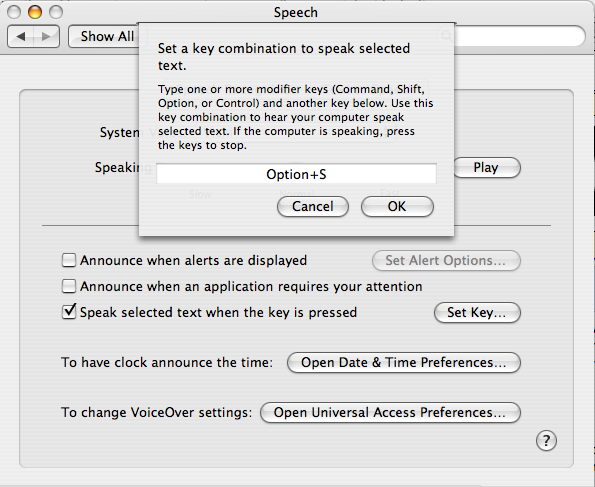 I typed Option-S to get this. So far it works, though it's so simple there's a risk I might have change it.
Double key combinations are less likely to have conflicts, but they (Option-Control-S for example) are harder for some children to type. I may put a special mark on the option button as well as it's easy for the child to type Cmd-S (save menu) instead. If I change the shortcut combination I'll update this post.
Now if a child or adult is reading and finds a word he or she can't read the sequence is:
- Click twice to select word or click and drag (if you extend the selection by triple-clicking or dragging all words selected will be read).
- Hold the option key and tap the S key. The word is read.
Update 7/31: There's definitely a bug with this functionality. I thought it was OS X 10.3 specific, but it happens with 10.4 too. I think it happens more often with slower machines. The OS seems to "miss" the keystroke. My son has learned to hold the option key and tap the S several times until the word is spoken. After the first trial it works better. The 10.4 "voices" are better than 10.3.
Reading exercises for older novice readers: ESL (English as second language)
This is yet another example of intelligence amplification by Google.
I'd been wondering where I could find readable texts for an older novice reader. My son reads at a first grade level, but his interests are age appropriate. There's not much that combines the right reading level and topic.
On a whim I typed "reading exercises" into Google. The first hits I got back were for teaching English as a second language (ESL), including this overview.
Duh. Of course, obvious in retrospect.
I'll report how well these work with the OS X word reader services and Safari.
Update: Well, the good news is I figured out how to create a lightweight OS X 10.3 reading tool by assigning a keyboard shortcut to the Safari-compatible OS X speech service. The bad news is the ESL texts I found were awful. I suspect there's much better stuff locked on Chinese web sites, but I'd need to read Chinese. I've gotten another idea though, and it might be a good one. More to say if it works ...
I'd been wondering where I could find readable texts for an older novice reader. My son reads at a first grade level, but his interests are age appropriate. There's not much that combines the right reading level and topic.
On a whim I typed "reading exercises" into Google. The first hits I got back were for teaching English as a second language (ESL), including this overview.
Duh. Of course, obvious in retrospect.
I'll report how well these work with the OS X word reader services and Safari.
Update: Well, the good news is I figured out how to create a lightweight OS X 10.3 reading tool by assigning a keyboard shortcut to the Safari-compatible OS X speech service. The bad news is the ESL texts I found were awful. I suspect there's much better stuff locked on Chinese web sites, but I'd need to read Chinese. I've gotten another idea though, and it might be a good one. More to say if it works ...
Wednesday, July 19, 2006
CHARGE: an ambitious study of autism seeking causal agents
I'm not sure what to make of this. It sounds exceedingly ambitious, but do we really have a good enough definition of the disorder to do this kind of study? Maybe they figure by the time it really gets going we'll have better genetic markers to use for inclusion criteria. It will likely be many years before the study yields results.
They definitely have enough buzzwords, I'll cross my fingers and hope they can stick with the project.
Environ Health Perspect. 2006 Jul;114(7):1119-25. The CHARGE Study: An Epidemiologic Investigation of Genetic and Environmental Factors Contributing to Autism. Hertz-Picciotto I, Croen LA, Hansen R, Jones CR, van de Water J, Pessah IN.Note that when they say "environmental" they're talking about "expression may be influenced, in some cases strongly, by the prenatal and early postnatal environmental milieu". I don't know what they mean about "early postnatal". Do they mean months or years? My guess is they're looking a the first few months of life.
.... In light of major gaps in understanding of autism, a large case-control investigation of underlying environmental and genetic causes for autism and triggers of regression has been launched. The CHARGE (Childhood Autism Risks from Genetics and Environment) study will address a wide spectrum of chemical and biologic exposures, susceptibility factors, and their interactions. Phenotypic variation among children with autism will be explored, as will similarities and differences with developmental delay. The CHARGE study infrastructure includes detailed developmental assessments, medical information, questionnaire data, and biologic specimens. The CHARGE study is linked to University of California-Davis Center for Children's Environmental Health laboratories in immunology, xenobiotic measurement, cell signaling, genomics, and proteomics....
They definitely have enough buzzwords, I'll cross my fingers and hope they can stick with the project.
Monday, July 10, 2006
Increasingly sophisticated fraud a threat to special needs adults?
Special needs adults are going to be targeted by increasingly sophisticated fraud. Our community needs to think about how to respond.
Sunday, July 09, 2006
A deluge of research on the genetics of autism
My online blog reader (bloglines) regularly checks the RSS feed I set up on PubMed to monitor autism genetics. Today I got caught up after a missing a few weeks. Lord, what a deluge. There must be forty articles, including:
- discussion of animal models for autism (how else to find out if deep brain stimulation would help?)
- Pten gene deletion in the mouse activates a pathway that produces disordered neurons and dysfunctional social relations (did you say ... animal model?)
- Yep, Pten might give us an animal model ...
- A good review (from last year?)
.... There is no single biological or clinical marker for autism, nor is it expected that a single gene is responsible for its expression; as many as 15+ genes may be involved. However, environmental influences are also important, as concordance in monozygotic twins is less than 100% and the phenotypic expression of the disorder varies widely, even within monozygotic twins. Multiple susceptibility factors are being explored using varied methodologies, including genome-wide linkage studies, and family- and case-control candidate gene association studies. This paper reviews what is currently known about the genetic and environmental risk factors, neuropathology, and psychopharmacology of autism. Discussion of genetic factors focuses on the findings from linkage and association studies, the results of which have implicated the involvement of nearly every chromosome in the human genome. However, the most consistently replicated linkage findings have been on chromosome 7q, 2q, and 15q. The positive associations from candidate gene studies are largely unreplicated, with the possible exceptions of the GABRB3 and serotonin transporter genes. No single region of the brain or pathophysiological mechanism has yet been identified as being associated with autism. Postmortem findings, animal models, and neuroimaging studies have focused on the cerebellum, frontal cortex, hippocampus, and especially the amygdala. The cerebello-thalamo-cortical circuit may also be influential in autism... - the usual mixture of articles pounding more stakes into the undead heart of the MMR/thimerasol mercury meme ...
Teaching special needs children to ride a bicycle: the bike camp
The web site for this bicycle camp is excellent:
These people use modified two wheelers that look incredibly stable -- big angular momentum in the front wheel, easy to touch down. A wonderful web site and resource.
Learn How to Ride a Bicycle at Lose The Training Wheels.orgI've had some success using more traditional approaches, but it's been touch and go. It's hard to be patient enough, and to come up with the right mix of incentives. I found one area where the combination of packed earth, grass, and slope allowed the children to steer into terrain that gradually slows the bicycle ...
One of the pieces for us this summer is a "Kids on 2 Wheels, Inc." week-long bike "camp" in River Falls, WI next week. (One and a half hours each day at the bike camp, 2 hours in the car!) We are hoping our son, Brandon, will realize a life-long dream and master riding a 2-wheel bike. I'll give you a review later this summer. There are great tips for teaching your child to ride at:
These people use modified two wheelers that look incredibly stable -- big angular momentum in the front wheel, easy to touch down. A wonderful web site and resource.
Subscribe to:
Posts (Atom)