Sharing what I have learned supporting two atypical minds from childhood to adulthood.
Tuesday, October 11, 2022
Social media ad-based education on fake profiles soliciting funds
Saturday, February 12, 2022
Progress in adulting
- When asked to do something he doesn't want to do #1 rants for shorter and shorter periods of time and often then just does it. (Assuming he sees the point of it.) Or he comes up with a reasonable compromise.
- #2 has a line on a reasonable government job that he can do well and that is well suited to him. (Government jobs have lots of accommodations and support for neuroatypical.)
- #1 hasn't gotten a handle on his diet (he's classic 'metabolic syndrome') but he understands the need and sometimes he tries. He cheerfully does his 300 calorie a day bike trainer routine. Every day.
- #1 has done a good job as a volunteer/aide for special hockey. (He can't really play because his shot is far too hard for our goalies and he never figured out how to shoot any other way.)
- #1 has managed, so far, to avoid conflict with an adult coworker who bullies and torments him.
- #2 has passed his community college courses so far and may be willing to do more technical coursework (that's likely to be a good fit for the gov job).
- #2 has been doing a solid CrossFit derivative workout once weekly. He's willing to exercise 3 times a week and his strength and endurance are consistently improving.
Tuesday, October 26, 2021
Exercise for autism - the home mini-CrossFit program
A few weeks ago I posted about a mandated 300 calorie a day weight stabilization program for #1. I also mentioned there's a different program for #2. There's no mandate for his program -- it's something he and I put together. He dislikes exercise but feels it his duty to do it.
The program has 3 events each week that we do together:
- Depending on season either a 1h singletrack mountain bike ride or a 1h MN Special Hockey event.
- A few miles of walking or (depending on season) 2h family road bike ride or 1h outdoor ice skating loop*.
- Home mini-CrossFit
The home mini-CrossFit is a highly scaled version of a standard CrossFit workout -- perhaps 1/3 of the intensity and effort. We have a COVID home gym so we have a good range of options. He does it with my wife and I; having Mom participate was key to building his confidence.
After some experimentation we've settled on a standard pattern. First the "WOD" (workout of the day) then the strength portion. The strength portion is standard power lifting, no Olympic lifts. We have a good set of dumbbells and a full rack and bar.
The WOD follows a standard pattern. It has four different movements that vary widely (movements are chose to also be a warm up for the strength portion since he won't do a separate warmup). The duration is always 16 minutes and each movement is done within 1 minute (so each of the 4 movements has 4 reps) or 2 minutes (each of 4 movements has 2 reps). Movement number is set so he has roughly equal time spent working and resting.
We've been doing this particular pattern for a few months and he's dramatically fitter and stronger. I don't think he realizes how much he's improved. Things that were hard for him a few months ago he now does while reading his phone. I have been gradually increasing the frequency and weight as he starts to finish in 15 seconds rather than 30 seconds. Sometime in the next year his bench press will pass mine.
I think most of the improvement is from the mini-CrossFit, though the singletrack ride would tire many adults and its certainly helpful. His exercise days are my rest days, but the effect is still impressive. It helps to be young.
* Years ago our entire family inline skated at the Metrodome every week or two all winter long. It was great and we'd do it again ... except that structure was torn down for an essentially useless Vikings football stadium.
Saturday, August 07, 2021
Metabolic syndrome and cognitive disability - 300 calories a day with Zwift and a Schwinn IC-4
Short version
A cognitively limited adult with early metabolic syndrome (hyperlipidemia, elevated glucose, elevated blood pressure, obesity) has halted weight gain over 9 months with a 300 calorie a day exercise program and some compliance with dietary guidelines.
Ingredients
- Schwinn IC-4 trainer ($900 to $1000 depending on demand and supply chain). This is one of the few quality cycle trainers on the market that doesn't require a subscription. (Review)
- Zwift exercise service on iPad ($15/month - we could put this on his ABLE account but I hate his ABLE account)
- Zwift Companion on iPhone to monitor activity (free)
- iMessage to send screenshot of activity and praise (free)
- The ability to disable WiFi service to a specific iPad (free with most routers)
To receive free afternoon WiFi service to his iPad #1 must do one of:
- Complete 300 calories on the IC-4 trainers as measured by Zwift (bluetooth connection to the IC-4). This takes him about an hour at a fairly easy pace.
- Go for a bike ride -- his usual ride is about 10 miles and takes about an hour but sometimes he goes longer
- Go for a CrossFit workout. He does this infrequently now -- that's a challenging social environment. He'll go most often if the son of a close friend of our family is there. (He's pretty strong by the way!)
- Participate in a family exercise outing -- typically bicycling or Nordic skiing
Adults who didn't finish high school had the highest level of obesity at 35.5 percent, followed by high school graduates (32.3 percent), those who attended college (31 percent) and college graduates (22.2 percent).
Sunday, August 02, 2020
Special Needs CrossFit
Saturday, April 11, 2020
ABLE (529A) plans -- what's a good one and who has it
ABLE programs are similar to tax-advantaged 529 plans for college savings.[8] In addition, a 529 plan can be rolled over into an ABLE account for a qualified beneficiary.An ABLE account can be opened by a disabled individual who became disabled before 26 years of age.[8] An ABLE account can receive after-tax cash contributions from any person, including its owner.[1] Contributions in a year are limited to the federal gift tax exclusion [9] for that year — $15,000 in 2018.[10] If the beneficiary works and does not contribute to a 401(a), 401(k), 403(b), or 457 plan, the beneficiary can contribute an additional amount above that limit. The additional amount is equal to the lesser of the beneficiary's annual compensation or the federal poverty level for an individual — $12,060 in 2018.
- A debit or credit card tied to the account. I want self-documenting transactions. If #1 is buying a new iPhone I want that on the transaction record.
- Low fees
- Small management fees
- A quality web site
... 529 plans, especially ABLE accounts can only be administered by a state. When does a state see money and not figure out a way to skim off the top. The dirty little secret is that a significant portion of program management fees goes to the state. For example, Maryland and Oregon take 0.30% in administrative fees themselves in their 529 ABLE plans.
The best I have seen so far is LA ABLE for Louisiana state residents only. No annual fee, no program management fee and 0.07%-0.15% for six Vanguard funds, including the four LifeStrategy Funds. There is a state alliance of GA, KY, MO, NH, OH, SC, and VT that offers funds with asset based fees of 0.31%-0.34% for those state's residents (0.57%-0.60% non-residents).
For non-residents the National ABLE Alliance of AK, CO, DC, IL, IA, IN, KS, MN, MT, NC, NV, PA and RI. Offers funds with asset based fees of 0.34%-0.38%. Their program management management fee is 32% and I'm sure the states gets a significant chunk of that. The underlying expense ratios are 0.02%-0.06% (based on fixed portfolios using Vanguard, Schwab and iShares funds/ETFs). They have a $15 ($11.25 e-delivery)/qtr account fee.
The best plan for non-residents based on cost might be Tennessee's ABLE TN, offering Vanguard and DFA funds with asset based fees mostly in the range of 0.35%-037% (Wellington at 0.35%) with no account fees. As always the devil is in the details. E.g. the plan does not offer a debit card.
Ohio
- STABLE card: loadable prepaid debit card
- Vanguard
- $42/year maintenance fee
- Has debit card
- Fidelity Attainable Savings Plan
- No annual fees
- web site information unimpressive, doesn't explain how the prepaid card works
- has annual fee, does at least describe management fees on mutual funds (most sites don't do this)
Friday, November 22, 2019
Thanksgiving 2019 - update
I guess I gave away the story there. After about a year of working with a personal trainer who is also a CrossFit coach #1 joined my box. He has done better than my fondest hope. Not least because coaches have hit just the right tone ... friendly, supportive, but also treating him much like every other adult. Same for our athletes. The power of expectations is hard to overstate.
And ... special hockey volunteer, plays adult rec hockey with me, works with and rides horses, special olympics snowboarding, power lifting, golf, summer bicycling, works two part-time jobs ...
#2 had his best grade ever on a college exam. His studying is better. Started working in a minimum wage job filling popcorn bags but tells me he doesn't mind the boring work, likes using his hands, likes the money. Managed a challenging problem while working with a supportive teacher that would have melted him a year ago. Taken on a mentoring and support role with his special hockey colleagues. Continues his Tae Kwon Do training.
Both gentlemen are a pleasure to be with.
Twin Cities facility for special needs strength and fitness training
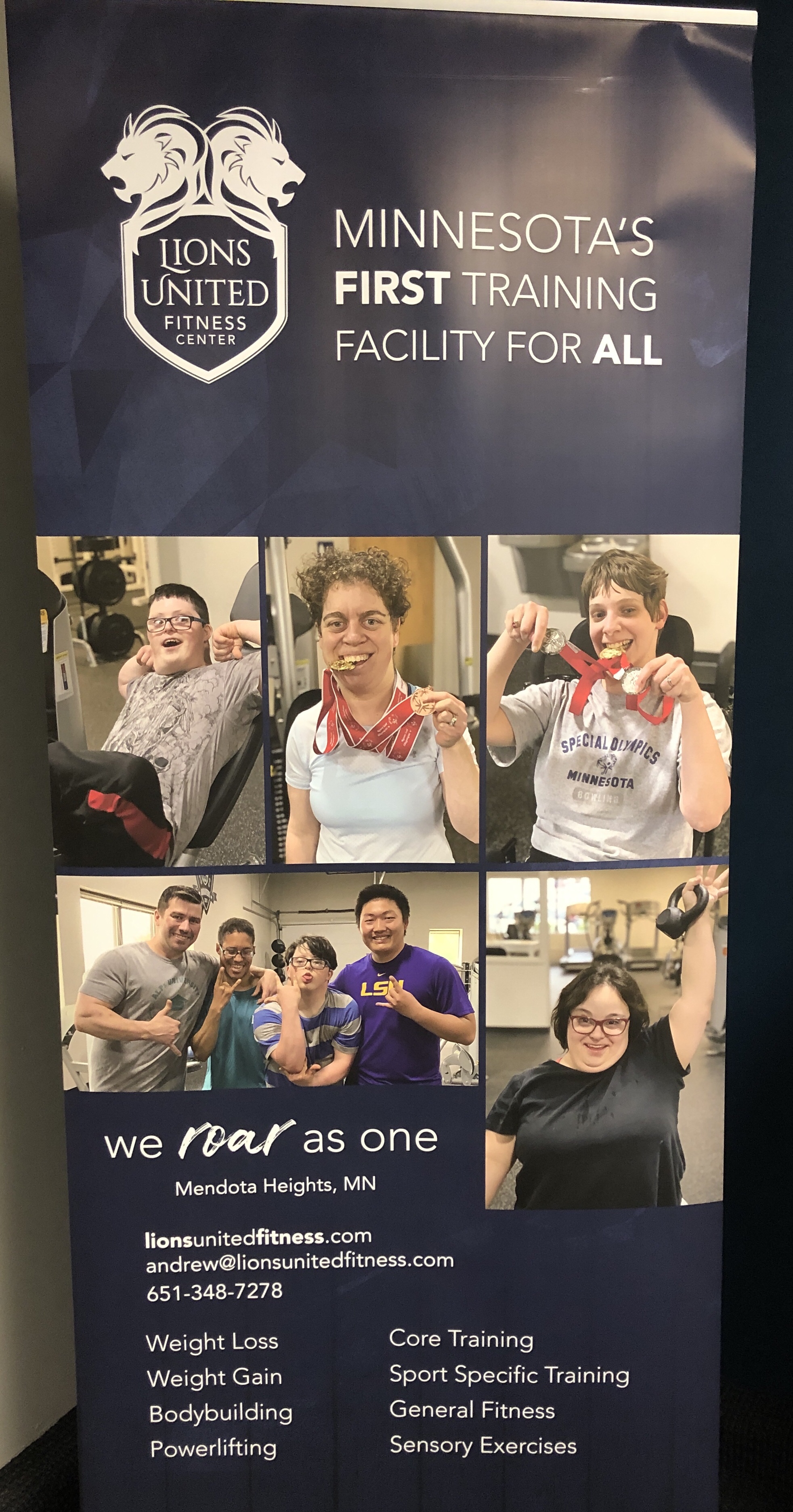
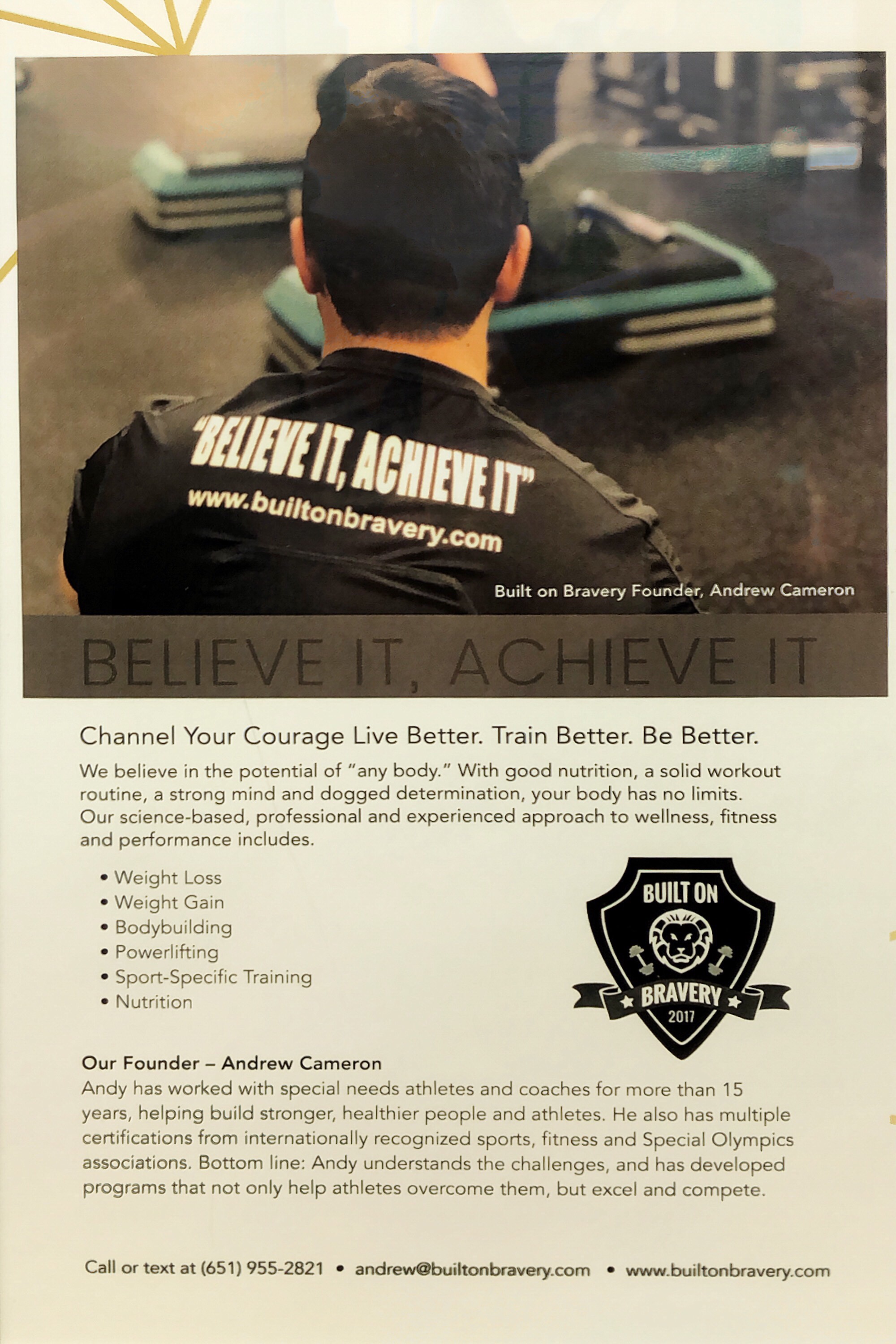
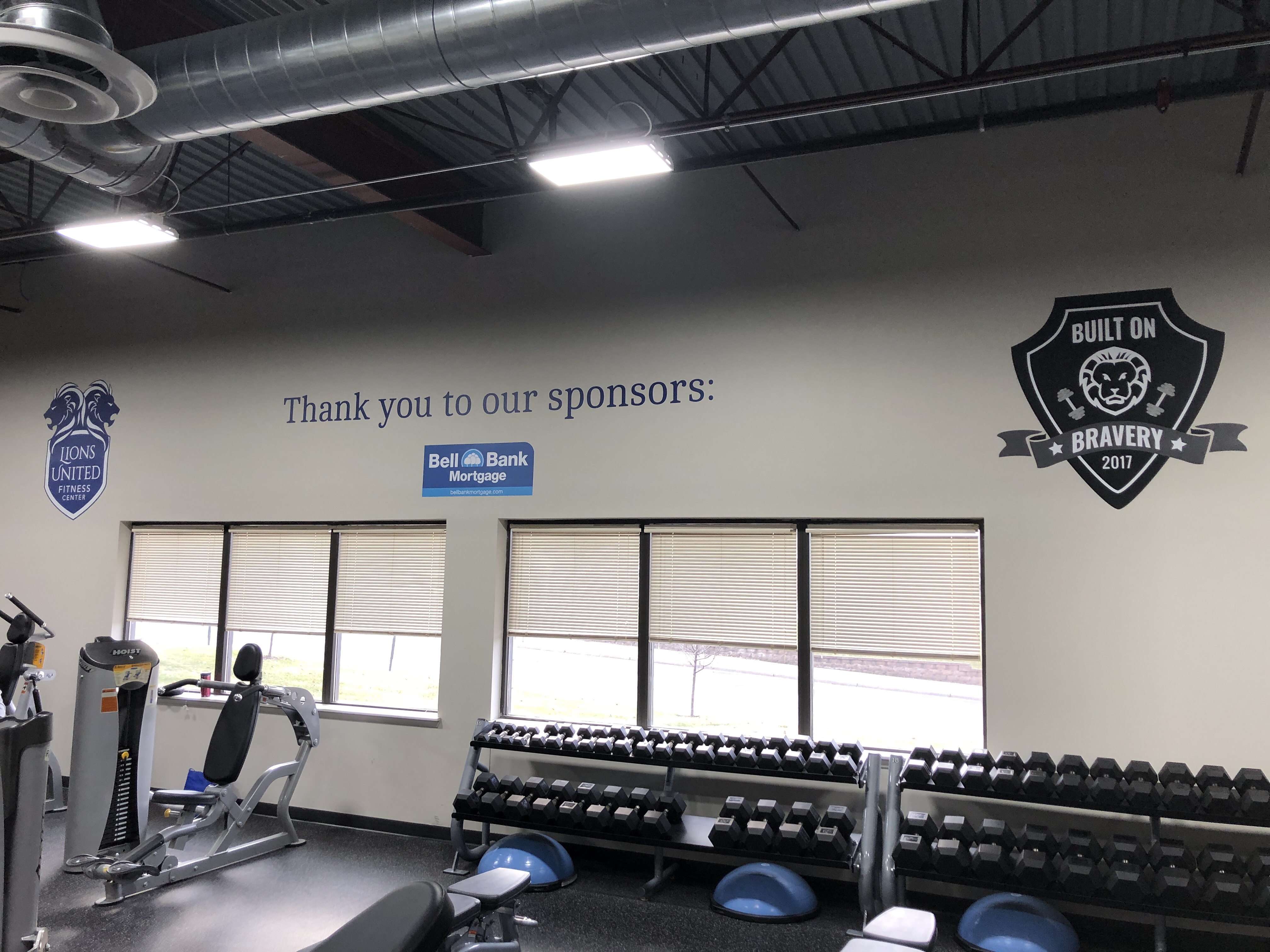
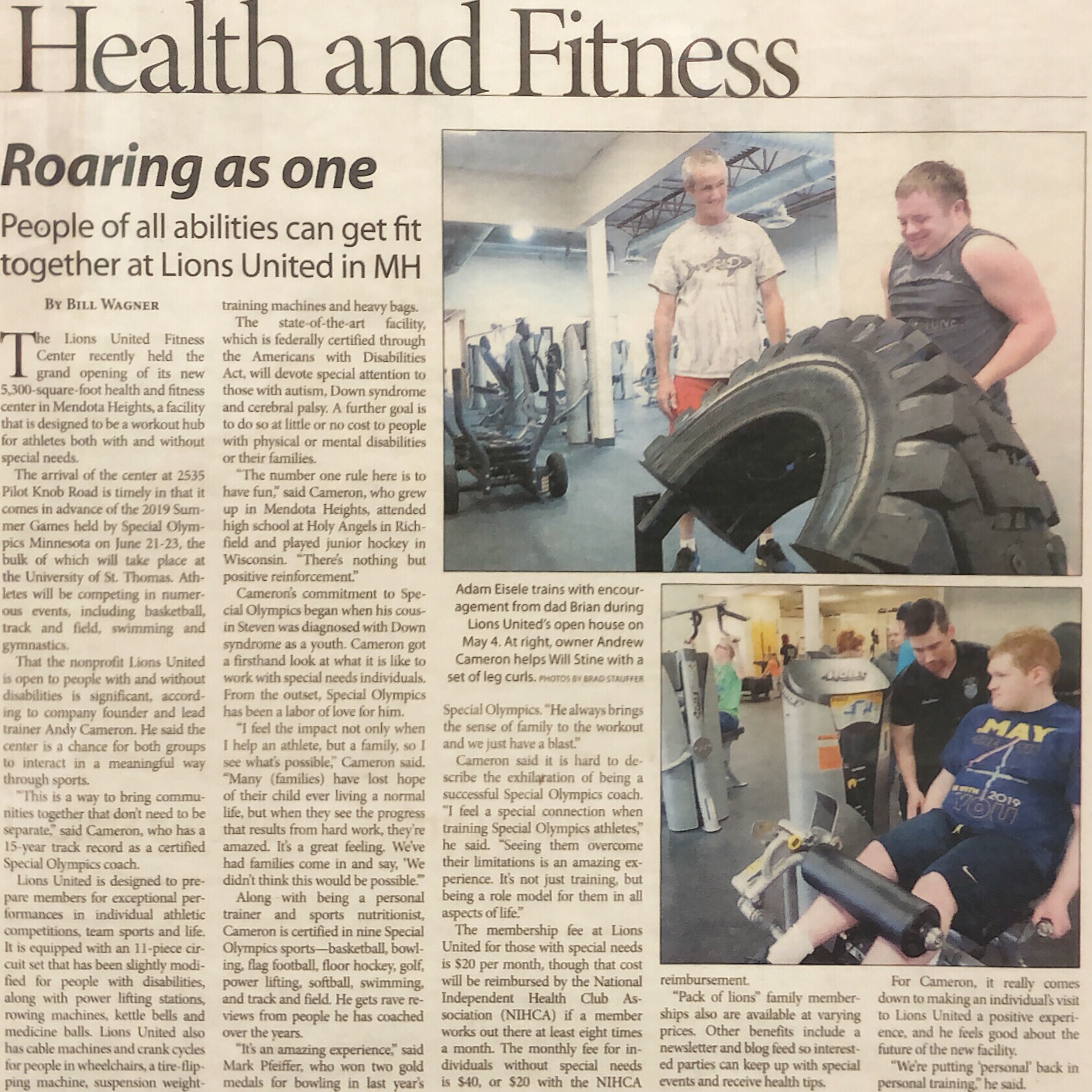
My #1 is doing their special Olympics strength training at Built on Bravery, located at the Mendota Height MN Lions United Fitness Center (map):
... Lions United is a new kind of training center, designed specifically to prepare people with disabilities for exceptional performance in individual competitions, team sports and life, especially people with autism, down syndrome and cerebral palsy. We’re dedicated to Special Olympics’ Project UNIFY and Unified Sports®, which means we bring people of all abilities together to strengthen individuals, relationships and communities....This new facility is first in Minnesota to focus on persons with cognitive disabilities.
The Star Tribune did an interview with the founder:
Q: Membership fees and hours?I think there may also be family memberships.
A: Twenty dollars a month for people with special needs; $40 a month for others. We’ll also have an incentive program where any member can receive up to $20 a month through their insurance. Staffed hours are Monday-Thursday, 3:30 p.m. to 10 p.m.; Friday 8 a.m. to 10 p.m.; Saturday and Sunday 8 a.m. to 6 p.m. But members will have 24-hour access.
There is a big unmet need for health and fitness support of special needs teens and adults. Diets are often worse than average and there are few welcoming places to go. (Several CrossFit gyms are welcoming, but that's a big climb. This facility has grant support.)
We need more like this!


Tuesday, March 12, 2019
A (very) inclusive CrossFit gym - in Reno Nevada
Fitness is a problem for many people, not least special needs teens and adults. Diabetes and obesity are common in our population.
Diet is a factor — it takes a lot of cognitive work to outrun the American junk food industry. The special needs population is vulnerable to deceptive advertising implying health benefits of "sports drinks".
Exercise is also a problem. Special Olympics and Special Hockey programs are low volume — typically once a week. Group classes may be intimidating or unwelcoming. Incomes are low and gyms can be costly [1]. Workout music may be intolerable. The feel and odor of sweat may be unusually bothersome. Lastly, suffering for health is a bit abstract for many with special needs.
Today I learned of an extraordinary example of doing something more ...
Upstate Nevada - CrossFit Everyday Heroes
… Upstate Nevada is the first nonprofit facility for community fitness and is motivated by the philosophy that “nobody should be denied a healthy lifestyle due to physical, cognitive or financial impairments.” ...
… The Upstate Nevada board and staff run a community first, gym second … Inclusive and adaptive programs for any type of physical or mental impairments...
… Our Everyday Heroes program offers free or reduced price memberships for the following ...
-Adults with physical or cognitive impairments and their families
-Children with physical or cognitive impairments and their families
Wow. Very impressive. I’ve seen something a bit like this at CrossFit Icehouse in Fargo ND, but Upstate Nevada is at another level. I hope they share their learnings with the broader health and special needs community.
- fn -
[1] OTOH, adults on disability support often have to spend down to avoid asset caps — exercise classes and personal trainers can be a healthy option.
Sunday, January 27, 2019
How did the story end?
I started writing this particular blog in September of 2004. At that time Explorer #1 was 7 and #2 was 5. They are adults now.
The early years before this blog are a blur now. I think by the time I started writing we had developed a reasonably effective approach and seen some progress. The years between 2000 and 2004 were harder.
We aged a lot in those years.
Now this blog is infrequently updated. That’s partly because of my related book project, partly because adult Explorer challenges are personal, and partly because the complex educational and financial (SSD, etc) challenges we deal with now are managed by my wife — and she doesn’t blog. We’re specialized that way.
So the story continues, but the blogging is less frequent. For the few that have followed this blog I feel like I should provide a summary of sorts. For those who are starting on a similar journey it might help to know one ending, then maybe go back through past posts and pick out things of value.
In general our Explorers have done well. They are both adults, for now both have guardianship status. We have, to date, for the moment, avoided the catastrophes parents of special needs children justly fear.
#1 has cognitive disabilities. Once he was an “explosive child”. Now he reads and even writes a bit, albeit largely on his phone. He has two part time jobs (no benefits) and he has longterm disability status and thus some potential security after our deaths. He’s been a reliable employee. His self-regulation and planning ability continue to improve. He loves his family. His diet could be better; it’s a typical non-college US diet (i.e. terrible). He needs more exercise. He remains a pretty good athlete for someone who rarely practices.
#2 is on the classic autism “spectrum". He is in a post-secondary transition program and is a B/C student at our local community college (he’s fine with a C). Sadly he has shown zero interest in learning coding — the one path I think could lead to his financial independence. He is usually delightful but struggles with novelty, travel, and changes in routine. He has screen time issues but works them. His self-regulation continues to improve. His work capacity is limited, but growing. His diet and exercise are better than the US average. He is kind, sweet, compassionate, and a typical middle sibling peacemaker. His great strength is persistence. He has a bad day, but the next day he tries again.
Were I to have read this in 2002 I think I’d have felt relief. The story doesn’t end until the narrator dies; it could all change at any time. But for now, well enough.