Monday, January 29, 2024

AI Guardian - a summary post

This post will be updated for a week or two. It's to track those interested in the AI Guardian concept; this and similar posts have the tag "AIGuardian"

Friday, December 29, 2023

What I am up to these days - Smartphones for all (updated)

Update 12/29/2023

I've retired the Smartphones for all project, at least for now. I really couldn't find much interest in the topic, so I came to feel I was writing something just for myself. I have retired the sphone4all.com domain, it will be soon available for others (including, certainly, spammers can scammers - no way to avoid that).

I have moved archived the WordPress site as a subdomain of another domain I own. If for any reason you'd like to see the archives they are at:

https://www.sphone.bethebestyoucanbe.us/

I've removed the URLs from the post below.

Original: 4/2018

This blog is quieter than it used to be. There are a few reasons for that, but mostly I’m spending blogging time slogging away on the Smartphones for All book project — which is now iPhone specific. I publish chapter excerpts on a blog there every few weeks. Here are a few recent examples:

You can follow that project by blog feed, or on Facebook or visit the blog to see all the recent posts.

I no longer make predictions as to when I’ll be done. I know the topics to cover, I write and revise, one day it will be finished. I plan to do the Amazon self-publishing thing.

Saturday, November 11, 2023

AI and special needs adults: The AI Guardian is in sight

Over the past decade I've written on social media about the concept of an AI Guardian, but I realize I've never put it into a blog post [4]. With the release of the LLM AIs [1] including ChatGP4, ChatGPT plugins,  and recently GPT Agents (GPTs) the AI Guardian is much closer than I'd expected. So it's time to write something.

First, of course, I decided to ask ChatGPT. I've never seen the concept of an AI Guardian online, but evidently I've been looking in the wrong places. As of its April 2023 incarnation ChatGPT4 has quite a bit to say:

You: What do you know about the concept of an "AI Guardian" for special needs adults?

ChatGPT

The concept of an "AI Guardian" for special needs adults, particularly those with low IQ or autism, revolves around using artificial intelligence to provide support and assistance in various aspects of daily life. This concept is still emerging, but it has several potential applications: 

Safety Monitoring: AI can be used to monitor the individual’s environment for safety hazards or emergencies, alerting caregivers or authorities when necessary.

Routine and Schedule Management: AI systems can help in managing daily routines, providing reminders for medication, appointments, and other important activities.

Behavioral Analysis and Support: For individuals with autism, AI can analyze behavior patterns to predict and mitigate potential stressors or overstimulation.

Communication Aids: AI-driven tools can assist in communication, especially for non-verbal individuals or those with speech difficulties, by interpreting signs, gestures, or other forms of non-verbal communication.

Learning and Skill Development: AI can offer personalized learning experiences and skill development activities, tailored to the individual’s needs and learning pace.

Social Interaction Facilitation: AI can help in guiding and facilitating social interactions, which can be challenging for some individuals with special needs.

Health and Wellness Monitoring: Continuous monitoring of physical health, including vital signs, sleep patterns, and physical activity, ensuring prompt response to health issues.

This concept is still in its nascent stages and raises important considerations regarding privacy, ethical use, and the need for human oversight. It's crucial to balance the benefits of AI assistance with the dignity and autonomy of the individuals being assisted. As a physician with experience in health informatics [2], you'd appreciate that while AI can provide valuable tools, it cannot fully replace the nuanced understanding and empathy provided by human caregivers.

Well, that covered the bases. I would love to know what ChatGPT4 has been reading on this topic.

In our family iPhones and narrow focus AIs like Google Maps have been both an essential tool for independence and a screen addiction curse [3]. The ability to locate our children was key to them learning to navigate by bike and bus. Mapping tools compensated for very limited navigation ability. Calendaring helped with anxiety and organization. Notes and Reminders helped with memory and recall limitations. Beyond the obvious advantages of messaging we discovered both our children were better able to process text messages than verbal communication -- especially for difficult topics.

Now there is the near term prospect of far more support going forward. Monitoring email, messaging and apps for the scams and frauds that live on the cognitively disadvantaged. Monitoring financial transactions for worrisome trends and events. Monitoring home environments for worsening or dangerous conditions. Encouraging better diet and activity.  Acting as a job coach. Appropriately paced and reinforced lifelong learning. Guiding our children through the vast complexity of medical care. Even providing a form a companionship in time or facilitating finding company in the physical world. Doing, in other words, what Emily and I do after we are incapacitated or (inevitably) dead.

In the absence of personal immortality for Emily and I the AI Guardian is the best hope for our children's longterm health and happiness. Even as I have profound concerns about the disruption that comes with the rise of the modern AI I also have hope for a better options for the cognitively disadvantaged.

- fn -

[1] Some dislike applying the term "AI" to Large Language Models because they don't appear to be conscious or sentient.  Much of my professional career was loosely related to precursors of modern AI and there is absolutely no doubt that in 1995 we'd have called ChatGPT a bloody scary AI. The goalposts are mobile. LLMs are AIs by any reasonable definition. Insofar as we understand human cognition we do much of the same things that LLMs do.

[2] This "as a physician" bit startled me until I remembered that I'd given ChatGPT4 that information as a persistent context for our sessions.

[3] I tried writing a book on how best to balance these harms but I gave up when I finally accepted that there was absolutely no interest in such a book from the community I was writing for.

[4] A 2015 post on Google Inbox was the closest I could find on the topic of AI assistance. I tagged that nsAI for non-sentient AI.


Friday, November 10, 2023

Email cleanup - reducing predation opportunities

After falling prey to a predatory "Second Swing" (golf) promotion #1 agreed to let me cleanup his email stream.  He's fond of signing up for email but, inevitably, there was more garbage than he could handle.

I unsubscribed from about 20 lists and deleted perhaps 5000 messages -- all junk.

I'm hoping he'll let me do this periodically. He's particularly vulnerable to email marketing but he does use his email and he dislikes clutter.

Sunday, February 05, 2023

Explosions and anxiety: Adult special needs life is a tough haul

My 26yo son, "#1", is pretty solidly in the 3-4th (bottom) percentile of cognitive abilities. It's a cognitive continuum of course; what's true of the 3rd percentile can also be true of the 10th or the 20th -- especially when lack of sleep or alcohol is involved. So this isn't just about special needs adults. It's something useful to understand for tens of millions of Americans.

The other day he exploded. No harm came of it, except to him. It's a behavior we've known from childhood though it's only with time we came to understand how closely tied it is to his anxiety.

It happened during an ice hockey game. We play together at local pickup games. He's a good mid-level adult hockey player, a step above me and our usual pickup skaters, but he's not a fitness guy. He gets tired towards the end of a game and, unlike a neurotypical player, he doesn't push himself. He just takes it easy. (This logical but socially wrong behavior isn't unique to #1.) This can irritate teammates who expect him to perform well.

In this case a teammate made a mildly inappropriate (for this kind of hockey) criticism of #1s lackadaisical play. Once upon a time I'd have made a similar comment, but I've learned it doesn't work. What works is to praise the things he does well. (This simple principle took me forever to learn and apply.)

I get those kinds of comments myself from better players sometime -- but I enjoy them.  It means I can guilt my critic into being a reluctant game-long coach. (Sadly this only works once, they don't really want to coach.) Or, if it's late in the game, I'll laugh and say "yeah, I suck". 

That's advanced stuff. In this case #1 was tired. He exploded with a red faced rant and various scary seeming threats. I was nearby though, so I sat between him and his critic and explained to the poor guy that my son was a special needs adult and that I'd sort things out. #1 hates to hear himself described that way (you would too) but the moment passed for everyone but my son. For him these things endure.

I've learned not to criticize these behaviors -- for him it's all about extinction-reinforcement. I was able to walk him through how I'd have handled the comment. It wasn't over though. He's been kind of wreck since. He's complaining of a variety of physical symptoms consistent with somatization (or some horrible disease that we'll feel very bad about -- my wife and I are both physicians). It's hard to understand his internal reasoning but his behavior is consistent with shame, guilt, and a deep fear of exploding again. His usual response to an episode like this is to replay it for years and avoid the setting. I don't know if he'll continue to do the pickup hockey. For now we're managing what we think is somatization (and not, say, some post-COVID neuropathy or lymphoma [1] or whatever) and working on resetting him.

Not a good day, but also not avoidable. But it could have gone much worse. It does go much worse. A lot of men with limited cognitive or emotional control can melt down like this. If police are involved and aren't at the top of their game it can escalate very badly. Even if police aren't involved it can turn into a physical fight with all of the problems that come from that. Most special needs adults, and most men, don't have a 60+ neurotypical father to sit between them and the guy they are excessively angry with.

It's a hard world out there. If you're one of the lucky guys with good emotional control and understanding it might help to know how this goes. If you're a cop -- I hope you're getting the autism/special needs training now being introduced into high performing police forces.

- fn -

[1] That's physician humor. Any symptom can always be early lymphoma.

See also:

Tuesday, October 11, 2022

Social media ad-based education on fake profiles soliciting funds

Our two special needs children are chronologically fully adult now. The challenges they face are increasingly complex but their capabilities have likewise grown.

As in the past their challenges are not unique to adults with a life history of cognitive and/our neurological disorders and diversities. They are, however, more vulnerable than most adults to social media predators who focus on loneliness and relationship frustration. I have a thought on what to do about that, but first I need to provide some context for people who don't live in this world.

In the past I had more control over our children's online actives. That is no longer true, most of what they do online is their own affair.  That's partly because managing online activities at any age is very difficult; parents and guardians fight against vast economic forces with little support from Apple or Google. Mostly though it's because they want and deserve the right to make choices, including bad choices.

The bad choices including falling victim to loneliness exploits. Being alone socially and sexually is one of the biggest hardships of adults with cognitive disorders. This is an intractable problem. Cognitively disabled males outnumber females by a large margin (the curse of the stunted Y chromosome) and social interactions including friendships and sexual relationships are almost always cognitively matched. Additionally friendship creation and maintenance requires significant social and cognitive skills.

Loneliness exploits are diverse and can shade into a straightforward business transaction. Is Patreon money solicited for custom art or storytelling an exploit or a commercial transaction or a bit of both? Is the "friendship" of the Patreon relationship different from my favorite writers responding to my tweets? How does this compare to "only friends" or phone sex or sex work?

Fake social media accounts are a step beyond the murky world of Patreon friends. All men receive Facebook and Instagram messages that feature images of beautiful women with large to absurdly large breasts. Most of us understand these are not entirely sincere, but this can be difficult to explain to a lonely adult with a significant congenital or acquired cognitive disability. They want to believe, they forget explanations, and for some the line between imagination, memory, and reality is fluid.

If the authors of these fake profiles were satisfied with small monthly stipends they could be considered just another step beyond Patreon purchases or "only friends" memberships. Sadly, the authors of these fake profiles are looking for large amounts of money. The problem needs our attention.

It's a hard problem to approach directly. "I was looking at the notifications on your lock screen and this beautiful woman is actually a desperate 43 yo man in a Sri Lankan sweatshop" doesn't go over well. Instead I'm going to try responding to the next large breasted invitation I receive and then use the thread to do "hey, look what I got, do you think this is real?" indirect education.

Which leads me to the idea that prompted this post. The best way to educate vulnerable adults about this problem would be a targeted Facebook and Instagram advertising program. These would be paid ads to vulnerable users to remind them that beautiful young women do not do not send flirtatious messages to strangers. 

It would be tricky to get these ads onto social media accounts; they aren't the kind of ad that attracts Instagram users. Government support could help, but the cognitively disabled community is too small and invisible to get political support. However the demential (acquire disability) community is large, growing, and politically important. So there might be a way to benefit the congenitally cognitively disabled community by targeting the acquired disability (dementia) community. I need to play with that idea a bit. 

It would be interesting to try running a small local campaign that targeted my son. If I do that I'll update this post.

Saturday, February 12, 2022

Progress in adulting

 Progress in adulting

  1. When asked to do something he doesn't want to do #1 rants for shorter and shorter periods of time and often then just does it. (Assuming he sees the point of it.) Or he comes up with a reasonable compromise.
  2. #2 has a line on a reasonable government job that he can do well and that is well suited to him. (Government jobs have lots of accommodations and support for neuroatypical.)
  3. #1 hasn't gotten a handle on his diet (he's classic 'metabolic syndrome') but he understands the need and sometimes he tries. He cheerfully does his 300 calorie a day bike trainer routine. Every day.
  4. #1 has done a good job as a volunteer/aide for special hockey. (He can't really play because his shot is far too hard for our goalies and he never figured out how to shoot any other way.)
  5. #1 has managed, so far, to avoid conflict with an adult coworker who bullies and torments him.
  6. #2 has passed his community college courses so far and may be willing to do more technical coursework (that's likely to be a good fit for the gov job).
  7. #2 has been doing a solid CrossFit derivative workout once weekly. He's willing to exercise 3 times a week and his strength and endurance are consistently improving.

Tuesday, October 26, 2021

Exercise for autism - the home mini-CrossFit program

A few weeks ago I posted about a mandated 300 calorie a day weight stabilization program for #1. I also mentioned there's a different program for #2. There's no mandate for his program -- it's something he and I put together. He dislikes exercise but feels it his duty to do it.

The program has 3 events each week that we do together:

- Depending on season either a 1h singletrack mountain bike ride or a 1h MN Special Hockey event.

- A few miles of walking or (depending on season) 2h family road bike ride or 1h outdoor ice skating loop*.

- Home mini-CrossFit

The home mini-CrossFit is a highly scaled version of a standard CrossFit workout -- perhaps 1/3 of the intensity and effort. We have a COVID home gym so we have a good range of options.  He does it with my wife and I; having Mom participate was key to building his confidence.

After some experimentation we've settled on a standard pattern. First the "WOD" (workout of the day) then the strength portion. The strength portion is standard power lifting, no Olympic lifts. We have a good set of dumbbells and a full rack and bar.

The WOD follows a standard pattern. It has four different movements that vary widely (movements are chose to also be a warm up for the strength portion since he won't do a separate warmup). The duration is always 16 minutes and each movement is done within 1 minute (so each of the 4 movements has 4 reps) or 2 minutes (each of 4 movements has 2 reps). Movement number is set so he has roughly equal time spent working and resting.

We've been doing this particular pattern for a few months and he's dramatically fitter and stronger. I don't think he realizes how much he's improved. Things that were hard for him a few months ago he now does while reading his phone. I have been gradually increasing the frequency and weight as he starts to finish in 15 seconds rather than 30 seconds. Sometime in the next year his bench press will pass mine.

I think most of the improvement is from the mini-CrossFit, though the singletrack ride would tire many adults and its certainly helpful. His exercise days are my rest days, but the effect is still impressive. It helps to be young.

* Years ago our entire family inline skated at the Metrodome every week or two all winter long. It was great and we'd do it again ... except that structure was torn down for an essentially useless Vikings football stadium.

Saturday, August 07, 2021

Metabolic syndrome and cognitive disability - 300 calories a day with Zwift and a Schwinn IC-4

Short version

A cognitively limited adult with early metabolic syndrome (hyperlipidemia, elevated glucose, elevated blood pressure, obesity) has halted weight gain over 9 months with a 300 calorie a day exercise program and some compliance with dietary guidelines.

Ingredients

  • Schwinn IC-4 trainer ($900 to $1000 depending on demand and supply chain). This is one of the few quality cycle trainers on the market that doesn't require a subscription. (Review)
  • Zwift exercise service on iPad ($15/month - we could put this on his ABLE account but I hate his ABLE account)
  • Zwift Companion on iPhone to monitor activity (free)
  • iMessage to send screenshot of activity and praise (free)
  • The ability to disable WiFi service to a specific iPad (free with most routers)
How it works

To receive free afternoon WiFi service to his iPad #1 must do one of:

  • Complete 300 calories on the IC-4 trainers as measured by Zwift (bluetooth connection to the IC-4). This takes him about an hour at a fairly easy pace.
  • Go for a bike ride -- his usual ride is about 10 miles and takes about an hour but sometimes he goes longer
  • Go for a CrossFit workout. He does this infrequently now -- that's a challenging social environment. He'll go most often if the son of a close friend of our family is there. (He's pretty strong by the way!)
  • Participate in a family exercise outing -- typically bicycling or Nordic skiing
There are no days off -- it's 300 calories daily.

I check his workouts after 5pm using the Zwift Companion app on my iPhone. I take a screenshot and send him (and my wife) an iMessage praising his work. The iMessage is very important; if I forget he's likely to stop doing the workout.

Background - including health challenges of adults with cognitive disabilities

Obesity varies by education -- which is also a proxy for cognitive ability:

Adults who didn't finish high school had the highest level of obesity at 35.5 percent, followed by high school graduates (32.3 percent), those who attended college (31 percent) and college graduates (22.2 percent).

Adults with cognitive disabilities have the greatest risk of all. When #1 was younger he was pretty active -- participating in many sports from wrestling to inline skating to bicycling to hockey to mountain biking and more. As an adult in a socially challenging world his activities are much more limited.

His diet hasn't helped. It was never healthy, but with income from his two part-time jobs it's gone from bad to worse (switching from Coke to Coke Zero helped). His BMI steadily increased over the past two years to 30, at the low end of obesity. That's bad by itself, but his obesity is abdominal. The worst kind. 

Emily and I arm twisted him into a basic evaluation and he's classic metabolic syndrome. Everything is at the high end of normal or worse: BMI, blood pressure, glucose (HgbA1c), and LDL. He had "diabetes in 5 years with MI at 45" all over him. [1]

So we decided to exercise the "guardian of a dependent adult" role and came up with a 300 calorie a day goal and the Zwift/IC-4 scheme. Given his diet and screen habits that's not enough to lose weight but we hoped it would hold him for a while.

The incentive was WiFi restriction of his iPad. I framed as "earning" the WiFi. If he didn't do the cals, he didn't earn afternoon WiFi for his iPad (I can disable that from my wifi router).

It's #1's nature to 'just say no'. He says 'no' to most everything, then often 'yes' after he's given it some time. In this case his objections were, by his standards, pro forma. He didn't get upset when he lost WiFi for a day and then he just started doing the cals. He likes the Zwift app and rides with this videos, podcasts, and music. He takes his time -- anywhere from 50 to 70 minutes for about 10-11 miles and 300 calories.

Every day I check Zwift Companion on my iPhone, screenshot his work for the day, and iMessage it with a comment. That's important. If I forget he stops riding.

He's done it daily for 9 months, 3 seasons and a pandemic. It's a routine, and he's good at routine. He gets bored with it, but then he can do road biking or hockey or CrossFit or something else. So I'd call it successful.

PS. More posts on exercise in special needs children and adults. Incidentally, #2 is classic autism spectrum and very different from #1. He's "overweight" but not remarkably and, with fewer complaints over time, routinely does 3 exercise outings a week -- mountain biking/inline skating, home CrossFit with Emily and me, and a family bike ride or equivalent.

- fn -

[1] Or, if he was willing, he'd be on metformin, a glutide, and atorvastatin. I'm a convert to the Church of Lipitor. That sh*t is amazing.

Update 10/26/20221
I wrote their were "no days off" but he insisted he did an adequate amount of exercise running food at the local NHL arena and shouldn't have to do the trainer those days. I didn't believe it, but he wore his Apple Watch and showed me an estimate of 600-800 calories per shift (over many flights of stairs). So he won that one.

Sunday, August 02, 2020

Special Needs CrossFit

It's been two years since #1 started working with a personal trainer I knew from her CrossFit coaching, maybe one year since he started going to my regular CrossFit classes.

#1 is 23 now. He can read at about a third grade level, most of his writing is text messaging to Emily or I. He's impulsive, but has generally done well with listening to coaches and workplace supervisors. Putting it all together I thought CrossFit was a bridge too far. Trying it was his idea, not mine.

I was wrong about that. He can now do up to 2/3 of a workout with some minor guidance. Sometimes he does less, but over time he's getting better. His belly grew during the lockdown, it's been shrinking since our gyms reopened. His mood is substantially better. He rarely pushes the limits of his strength, but when he does he's clearly stronger than his 61yo Dad (he is built like a bull - his "max effort" is my routine effort).

If he persists then sometime in the next 3-4 years he will be doing the men's "Rx" workouts. I can rarely do those.

The box has been supportive but they really haven't done much for him beyond any other member. They know his name, tolerate his eccentricities, and pretty much let him do his own thing. Coaches don't push him and that's the right choice.

Anything could happen tomorrow. He has often given up on things he's good at, often for no reason he can express or we can imagine. Sometimes he goes back to them, sometimes he doesn't.

Still, it has been done. He's not the first special needs adult to do CrossFit it a regular group class, but around here he's been a pioneer. Again.

Saturday, April 11, 2020

ABLE (529A) plans -- what's a good one and who has it

Wikipedia has a succinct description of the 529A (ABLE) plan:

ABLE programs are similar to tax-advantaged 529 plans for college savings.[8] In addition, a 529 plan can be rolled over into an ABLE account for a qualified beneficiary.

An ABLE account can be opened by a disabled individual who became disabled before 26 years of age.[8] An ABLE account can receive after-tax cash contributions from any person, including its owner.[1] Contributions in a year are limited to the federal gift tax exclusion [9] for that year — $15,000 in 2018.[10] If the beneficiary works and does not contribute to a 401(a), 401(k), 403(b), or 457 plan, the beneficiary can contribute an additional amount above that limit. The additional amount is equal to the lesser of the beneficiary's annual compensation or the federal poverty level for an individual — $12,060 in 2018.

ABLE plans were based on 529 plans, but the comparison misleads. The value of a 529 plan is that after-tax donations can grow and be disbursed without taxation. That's also true of a 529A, but it's not the point. People with ABLE accounts don't pay income tax anyway.

The entire value of an ABLE account is that it bypasses the savings limits of Social Security Income. SSI savings limits are extremely low -- about $2000. SSI recipients can't save more than that. The cap was last updated in 1989, it's been minimally changed since 1974. It's insanely low. There are limits on income too; and gifts are part of income.

ABLE accounts bypass that crazy low limit. In an ABLE account savings can grow to $100,000; 50x higher than the SSI limit.  Money can come gifts or from the account owners's contributions. The catch is those savings can only spent on qualifying expenses. Rent is the big one. Things that are related to independence -- like a smartphone, maybe gym expenses (health), legal fees, disability expenses. Training and education, health costs, transportation.

ABLE accounts launched in 2016-2017. I don't think they've been super successful. The rules are fuzzy and people on SSI learn mistakes are punished severely. There's also not enough money in play to excite the banks.

Our #1 has an ABLE account through Minnesota - currently managed by MinnesotABLE. They aren't a great solution. The web site is mediocre at best and key topics are undocumented, It's easy to add money, hard to remove it. In particular there isn't a useful debit card.

MN doesn't do anything special for residents so I went looking for better plans using the ABLE National Resource Center State Compare app. I want:
  • A debit or credit card tied to the account. I want self-documenting transactions. If #1 is buying a new iPhone I want that on the transaction record.
  • Low fees
  • Small management fees
  • A quality web site
It's very hard to find information on ABLE plans. This is one of the best discussions of the general options and why expenses are high or hard to discover (from 2018):
... 529 plans, especially ABLE accounts can only be administered by a state. When does a state see money and not figure out a way to skim off the top. The dirty little secret is that a significant portion of program management fees goes to the state. For example, Maryland and Oregon take 0.30% in administrative fees themselves in their 529 ABLE plans. 
The best I have seen so far is LA ABLE for Louisiana state residents only. No annual fee, no program management fee and 0.07%-0.15% for six Vanguard funds, including the four LifeStrategy Funds. There is a state alliance of GA, KY, MO, NH, OH, SC, and VT that offers funds with asset based fees of 0.31%-0.34% for those state's residents (0.57%-0.60% non-residents). 
For non-residents the National ABLE Alliance of AK, CO, DC, IL, IA, IN, KS, MN, MT, NC, NV, PA and RI. Offers funds with asset based fees of 0.34%-0.38%. Their program management management fee is 32% and I'm sure the states gets a significant chunk of that. The underlying expense ratios are 0.02%-0.06% (based on fixed portfolios using Vanguard, Schwab and iShares funds/ETFs). They have a $15 ($11.25 e-delivery)/qtr account fee. 
The best plan for non-residents based on cost might be Tennessee's ABLE TN, offering Vanguard and DFA funds with asset based fees mostly in the range of 0.35%-037% (Wellington at 0.35%) with no account fees. As always the devil is in the details. E.g. the plan does not offer a debit card.
I'll update this post with what I find, for tonight I'll review:

Ohio
  • STABLE card: loadable prepaid debit card
  • Vanguard
  • $42/year maintenance fee
Massachusetts
Oregon
  • web site information unimpressive, doesn't explain how the prepaid card works
  • has annual fee, does at least describe management fees on mutual funds (most sites don't do this)
Pending: Tennessee, Lousiana,Virginia

See also

Friday, November 22, 2019

Thanksgiving 2019 - update

Continuing in the vein of "how does the story end" (Jan 2019) #1 and #2 continue to mature and achieve. It would have been a great comfort 17 years ago to see #1 vault the 36" box jump at our family CrossFit Box. I didn't think he could jump that high. Wrong.

I guess I gave away the story there. After about a year of working with a personal trainer who is also a CrossFit coach #1 joined my box. He has done better than my fondest hope. Not least because coaches have hit just the right tone ... friendly, supportive, but also treating him much like every other adult. Same for our athletes. The power of expectations is hard to overstate.

And ... special hockey volunteer, plays adult rec hockey with me, works with and rides horses, special  olympics snowboarding, power lifting, golf, summer bicycling, works two part-time jobs ...

#2 had his best grade ever on a college exam. His studying is better. Started working in a minimum wage job filling popcorn bags but tells me he doesn't mind the boring work, likes using his hands, likes the money. Managed a challenging problem while working with a supportive teacher that would have melted him a year ago. Taken on a mentoring and support role with his special hockey colleagues. Continues his Tae Kwon Do training.

Both gentlemen are a pleasure to be with.

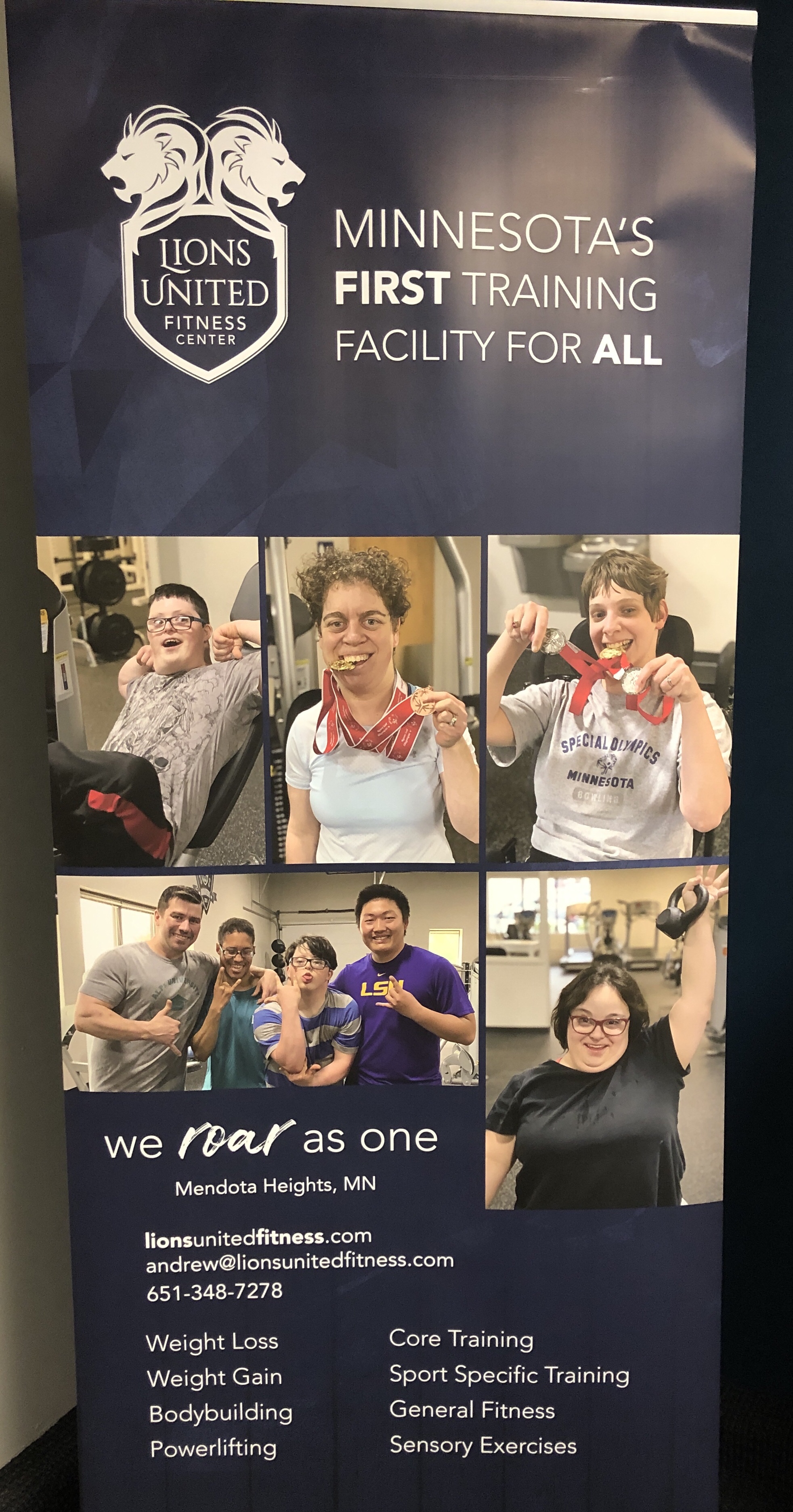
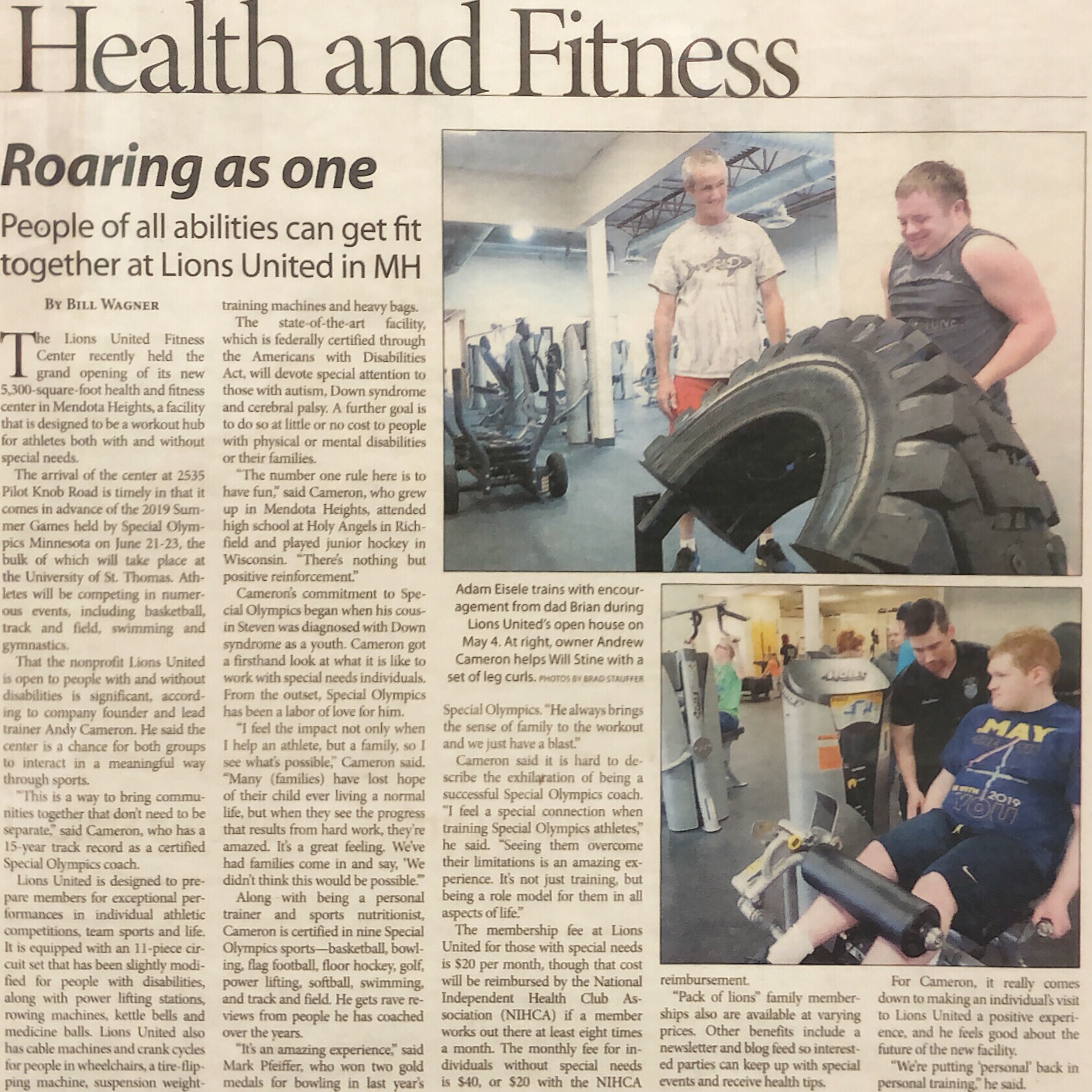
Twin Cities facility for special needs strength and fitness training

(I copied this over from my shares feed as it fits better here).

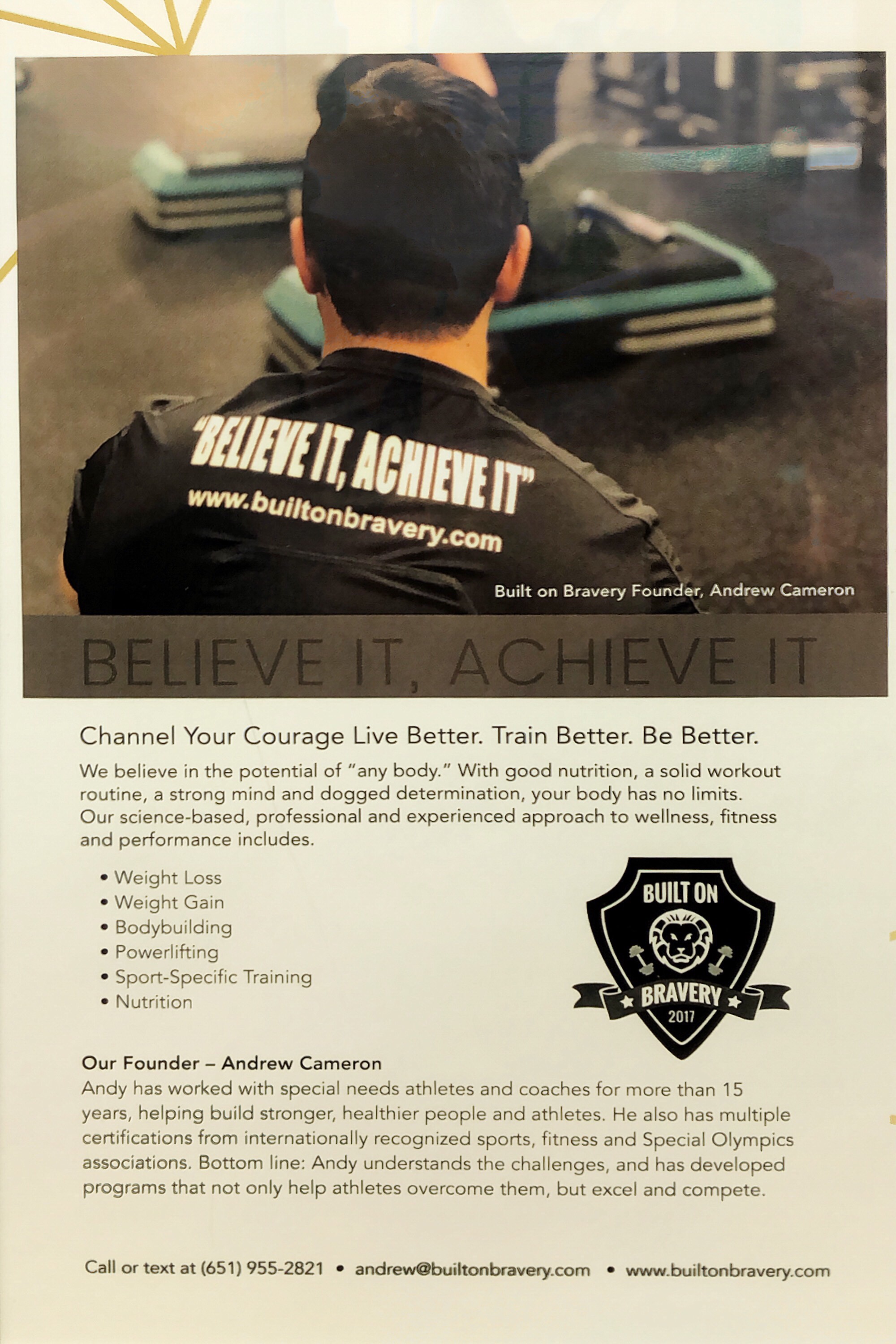
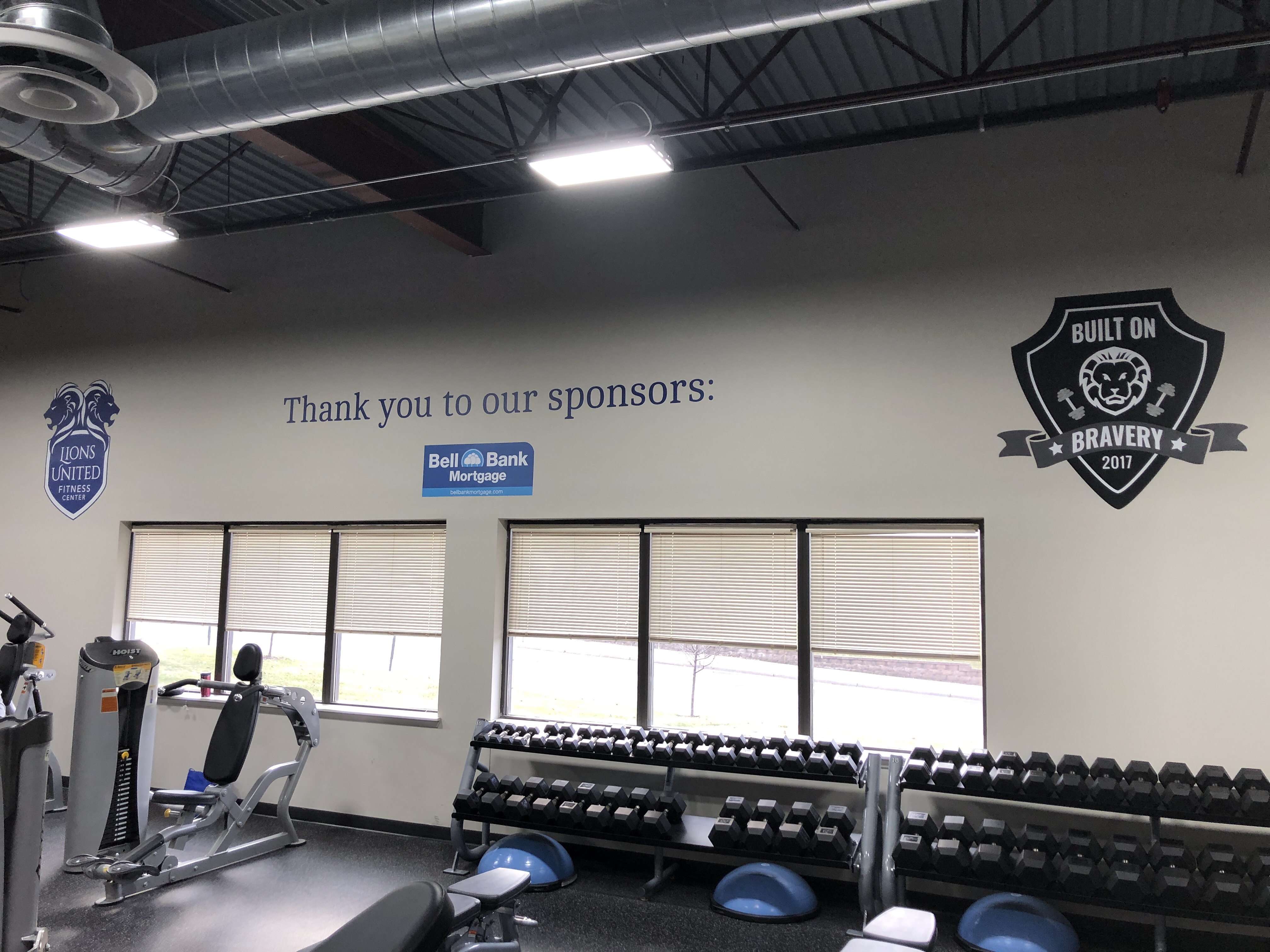
My #1 is doing their special Olympics strength training at Built on Bravery, located at the Mendota Height MN Lions United Fitness Center (map):
... Lions United is a new kind of training center, designed specifically to prepare people with disabilities for exceptional performance in individual competitions, team sports and life, especially people with autism, down syndrome and cerebral palsy. We’re dedicated to Special Olympics’ Project UNIFY and Unified Sports®, which means we bring people of all abilities together to strengthen individuals, relationships and communities....
This new facility is first in Minnesota to focus on persons with cognitive disabilities.
The Star Tribune did an interview with the founder:
Q: Membership fees and hours?
A: Twenty dollars a month for people with special needs; $40 a month for others. We’ll also have an incentive program where any member can receive up to $20 a month through their insurance. Staffed hours are Monday-Thursday, 3:30 p.m. to 10 p.m.; Friday 8 a.m. to 10 p.m.; Saturday and Sunday 8 a.m. to 6 p.m. But members will have 24-hour access.
I think there may also be family memberships.

There is a big unmet need for health and fitness support of special needs teens and adults. Diets are often worse than average and there are few welcoming places to go. (Several CrossFit gyms are welcoming, but that's a big climb. This facility has grant support.)

We need more like this!

Tuesday, March 12, 2019

A (very) inclusive CrossFit gym - in Reno Nevada

Fitness is a problem for many people, not least special needs teens and adults. Diabetes and obesity are common in our population.

Diet is a factor — it takes a lot of cognitive work to outrun the American junk food industry. The special needs population is vulnerable to deceptive advertising implying health benefits of "sports drinks".

Exercise is also a problem. Special Olympics and Special Hockey programs are low volume — typically once a week. Group classes may be intimidating or unwelcoming. Incomes are low and gyms can be costly [1]. Workout music may be intolerable. The feel and odor of sweat may be unusually bothersome. Lastly, suffering for health is a bit abstract for many with special needs.

Today I learned of an extraordinary example of doing something more ...

Upstate Nevada - CrossFit Everyday Heroes

… Upstate Nevada is the first nonprofit facility for community fitness and is motivated by the philosophy that “nobody should be denied a healthy lifestyle due to physical, cognitive or financial impairments.” ...

… The Upstate Nevada board and staff run a community first, gym second … Inclusive and adaptive programs for any type of physical or mental impairments...

… Our Everyday Heroes program offers free or reduced price memberships for the following ...

-Adults with physical or cognitive impairments and their families

-Children with physical or cognitive impairments and their families

Wow. Very impressive. I’ve seen something a bit like this at CrossFit Icehouse in Fargo ND, but Upstate Nevada is at another level. I hope they share their learnings with the broader health and special needs community. 

- fn -

[1] OTOH, adults on disability support often have to spend down to avoid asset caps — exercise classes and personal trainers can be a healthy option.

Sunday, January 27, 2019

How did the story end?

I started writing this particular blog in September of 2004. At that time Explorer #1 was 7 and #2 was 5. They are adults now.

The early years before this blog are a blur now. I think by the time I started writing we had developed a reasonably effective approach and seen some progress. The years between 2000 and 2004 were harder.

We aged a lot in those years.

Now this blog is infrequently updated. That’s partly because of my related book project, partly because adult Explorer challenges are personal, and partly because the complex educational and financial (SSD, etc) challenges we deal with now are managed by my wife — and she doesn’t blog. We’re specialized that way.

So the story continues, but the blogging is less frequent. For the few that have followed this blog I feel like I should provide a summary of sorts. For those who are starting on a similar journey it might help to know one ending, then maybe go back through past posts and pick out things of value.

In general our Explorers have done well. They are both adults, for now both have guardianship status. We have, to date, for the moment, avoided the catastrophes parents of special needs children justly fear.

#1 has cognitive disabilities. Once he was an “explosive child”. Now he reads and even writes a bit, albeit largely on his phone. He has two part time jobs (no benefits) and he has longterm disability status and thus some potential security after our deaths. He’s been a reliable employee. His self-regulation and planning ability continue to improve. He loves his family. His diet could be better; it’s a typical non-college US diet (i.e. terrible). He needs more exercise. He remains a pretty good athlete for someone who rarely practices. 

#2 is on the classic autism “spectrum". He is in a post-secondary transition program and is a B/C student at our local community college (he’s fine with a C). Sadly he has shown zero interest in learning coding —  the one path I think could lead to his financial independence. He is usually delightful but struggles with novelty, travel, and changes in routine. He has screen time issues but works them. His self-regulation continues to improve. His work capacity is limited, but growing. His diet and exercise are better than the US average. He is kind, sweet, compassionate, and a typical middle sibling peacemaker. His great strength is persistence. He has a bad day, but the next day he tries again.

Were I to have read this in 2002 I think I’d have felt relief. The story doesn’t end until the narrator dies; it could all change at any time. But for now, well enough.

Saturday, October 20, 2018

On autistic meltdown and exhaustion

Via Twitter I’m reminded of two autism blogs that have passed on - Musings of an Aspie (ended Jan 2015) and Everyday Aspie (2017)/Everyday Aspergers (2016). @mxmackpoet called out 3 in particular [1]:

All 3 match our family's experience from the (sort-of) neurotypical outside.

There is a lot of buried wisdom in these blogs written by people towards the neurotypical end [2] of the autism spectrum. It’s sad that these individuals no longer write on these topics, there really is no replacement for blogs and RSS notification mechanisms. I hope we reinvent them some day [3]. In the meantime I’ll use this post to remind me to explore. I hope one day our #2 will find these essays helpful.

- fn -

[1] It may not be chance that these 3 articles were written in dark times of the northern year. 
[2] It’s not really a linear spectrum of course. It’s some multidimensional space we can’t visualize. People further from the neurotypical space aren’t able to communicate as clearly, these writers are translators.
[3] Or simply recultivate what still exists. Lots of things wax and wane over generations.

Wednesday, July 25, 2018

ABLE Plans and Special Needs Trusts

#1 is now on either SSI or SSDI or both. Yeah, we’re not sure. Might even have changed. This is a lot weirder than I expected.

There is, with one or the other, apparently a peculiar incentive for caregivers to retire at 62 rather than, say, 67 (something to do with family Social Security caps and spouses). There’s also something in there about Medicare with MA Backup after two years on SSDI, claims that it’s best to do at least one year of SSI before SSDI, 9 month income averages, retroactive payments that can be clawed back and so on.

The accounting is interesting — trying to stay below income and asset caps.

With SSI/SSDI we can get an ABLE 529A account so that he can save without running over his asset caps. The funds can only be used for things that improve health/mobility/function — but that’s could cover a lot of ground. Maybe mobile data services? Fitness services? Golf gear? Bicycle?

The best discussion I found on ABLE plans was in the respected Bogleheads forum:

You are not going to find any 529 ABLE plan with no annual account fee and expense ratios of 0.1%, certainly for non-residents. I call the reason for this the "529/HSA Effect". While they might be quite popular among Bogleheads, only a distinct minority of the population takes advantage of either of those plans. With volume comes competition and lower costs. Now consider the minuscule population eligible for 529 ABLE accounts. If they hadn't been smart and piggy backed on Section 529, they would be even more expensive.

ABLE plans will have the same pattern as the majority of HSA accounts. Their owners will be making a number of withdrawals throughout every year such as by a debit card. Compare this to retirement accounts, where most withdrawals only happen in retirement and then maybe once a year. This adds significant administrative costs.

529 plans, especially ABLE accounts can only be administered by a state. When does a state see money and not figure out a way to skim off the top. The dirty little secret is that a significant portion of program management fees goes to the state. For example, Maryland and Oregon take 0.30% in administrative fees themselves in their 529 ABLE plans.

The best I have seen so far is LA ABLE for Louisiana state residents only. No annual fee, no program management fee and 0.07%-0.15% for six Vanguard funds, including the four LifeStrategy Funds. There is a state alliance of GA, KY, MO, NH, OH, SC, and VT that offers funds with asset based fees of 0.31%-0.34% for those state's residents (0.57%-0.60% non-residents).

For non-residents the National ABLE Alliance of AK, CO, DC, IL, IA, IN, KS, MN, MT, NC, NV, PA and RI. Offers funds with asset based fees of 0.34%-0.38%. Their program management management fee is 32% and I'm sure the states gets a significant chunk of that. The underlying expense ratios are 0.02%-0.06% (based on fixed portfolios using Vanguard, Schwab and iShares funds/ETFs). They have a $15 ($11.25 e-delivery)/qtr account fee.

The best plan for non-residents based on cost might be Tennessee's ABLE TN, offering Vanguard and DFA funds with asset based fees mostly in the range of 0.35%-037% (Wellington at 0.35%) with no account fees. As always the devil is in the details. E.g. the plan does not offer a debit card.

Do your own due diligence. You can check all the available state 529 ABLE plans here. 529 ABLE Accounts

Ugh. Much higher fees than I’d hoped for.

We’re working on the special needs trust. We’ll probably use Vanguard to hold funds, have to dust off old Trust documents to create the trust. Good discussion on Trust and home purchases here.

Saturday, May 19, 2018

Catch 22: Special needs students in transition programs can't take community college classes in Minnesota

We’ve discovered  an interesting “Catch-22. It applies to Minnesota but may be common elsewhere.

In MN a student entering a state funded transition program cannot do courses at a community college — even if they pay for them directly and even if they were doing them while in High School through Minnesota’s PSEO program.

The reason is that Community Colleges require a High School diploma, but transition programs require that a student not have a High School diploma [1]. While in High School students may attend Community Colleges for advanced courses through programs like PSEO (MN), but not after finishing High School. Once a student is in a transition program they may likewise, through the transition program, be eligible to attend selected community college classes.

This catch-22 won’t snag many students. Most students entering transition won’t have been doing PSEO classes or be interested in most community college courses. It may, however, catch autism-spectrum adults with relatively strong academic skills. Our #2 falls into this category.

We’re sorting out our options, but wish we’d known this in advance.

- fn -

[1] In practice though either adaptation or modification a MN student with an IEP (includes “special needs”) will typically have the credits to graduate. To maintain eligibility for transition program education for ages 18-21 the student may attend graduation, but the diploma is not placed in their hands. So, they finish High School at age 18, but they don’t actually graduate. This bizarre ritual must have its roots in the slow evolution of law and regulation. It might, for example, be rooted in an era where students “failed grades”; perhaps states chose 21 as a maximum age that anyone could spend in public high school regardless of grade. When post-secondary transition programs were created perhaps they were subsumed into this framework. I’m only speculating, but it would be consistent with how structures of law and regulation evolve.

Sunday, April 15, 2018

Adventures in Special Needs travel: Hawaii

The family went to Hawaii. Two special needs adults, one neurotypical daughter and two parents. There was a lot of planning work and a lot of on-the-fly adjustment. We chose Honolulu/Waikiki because our Explorers are more comfortable with concrete than with nature. The trip was a success, in part because, by sheer luck, the atypical rainfall spared both golf outings with #1. 

Luck aside — some things that worked well:

  1. Direct flight. A five hour mechanical delay (Delta) was stressful though.
  2. Single residence located in Waikiki with kitchen and good parking. We ate most meals there. Nearby groceries. Many things we could walk to.
  3. Fairy detailed advanced schedule that we then swapped around based on weather.
  4. Copious research.
  5. Explorers now independent enough they could stay in hotel room or go off on their own in many settings.
  6. Private tour (“Oahu Private Tours" <jason@oahuprivatetours.com>). We got lucky with our guide too; #1 is on his best behavior with young women.
  7. We rented a van (very expensive in Hawaii by the way).
  8. Good attractions for our Explorers: Zoo, Aquarium, Waikiki beach, Paradise Cove snorkeling (quiet, no Hanauma stress), Foster Botanical Gardens (tranquility), Diamondhead hike, “Edge” restaurant hotel table that was near beach so we could mix food and sand…
  9. English language generally worked, McDonalds and Subway ubiquitous.

It was a very big expense of course few families could afford it. We did it this one time because we could manage cost and the children are leaving school settings, entering work, moving out soon, etc.

It’s perhaps useful to know this can be done — and the general approach might work for others. It’s a long way from our 2010 family trip to a nordic ski resort and 2008 road vacations but I don’t think we’re quite ready for, say, a week in Korea.

Saturday, March 10, 2018

When imagination becomes memory

I think this is terribly important, but I’ve never seen it described. So, in a few minutes, I’ll share what I think.

Almost animals have memory, save perhaps the simplest single celled organisms. We think plants have a form of memory as well. There’s nothing uniquely human about memory.

Imagination is less common. It’s not uniquely human either; crows, wolves, cephalopods, cetaceans, primates — they all have some form of something that looks like imagination. We think humans have much more of it though. We can create memories of things that have not happened or did not happen. Imagination is a form of ‘false memory’ that we know to be false.

Except … when we don’t know it to be false. And there lies a problem — but I’ll come back to that.

When did humans develop the ability to create false memories and know them to be false? We think it is older than what we call “human” now — we think our fellow modern hominids, Neandertal, Denisovan and more had well developed imaginations. We suspect we have more of this talent though, and that we might have picked up additional abilities as recently as 50,000 to 75,000 years ago.

That’s very recent evolution, so it’s not surprising that, like strength and height, imagination might vary among people. It might vary in the ability to create “false” memories, and, perhaps independently, in the ability to know them to be false.

The latter variation is key. We know from research over the past forty years that it is relatively easy to create false memories in many people, but we also know that some study subjects, typically healthy university students, are more resistant to false memories than others. If we consider imagination as the generation of false memories that we know to be false, then similarly some people will be better at retaining the knowledge of what happened versus what they imagine happened.

So we know this ability to divide imagination from memory varies. It is plausible, and it fits my own experience, that people with “connectopathies” and other cognitive disabilities may have not only more limited imaginations, but also more difficulty separating the memory of what is imagined from all other memory.

I have seen this in someone close to me. When he was a child I would be upset that he was not telling me the truth, but over time I have come to believe that for him memory and imagination are inextricably blurred. What he imagines, what he wishes to be or have been, is poorly separated from what has been. There is just enough separation, I think, to create anxiety or agitation around the recall of false memory, but not enough to tell what is true memory and what is imagination.

I don’t think this problem is unique to persons with an IQ below the 5th percentile. I suspect it’s true for very many people, and it may explain why so many today are susceptible to novel kinds of media manipulation.

It’s a problem we need to research and understand both for persons with cognitive disabilities and for our society.